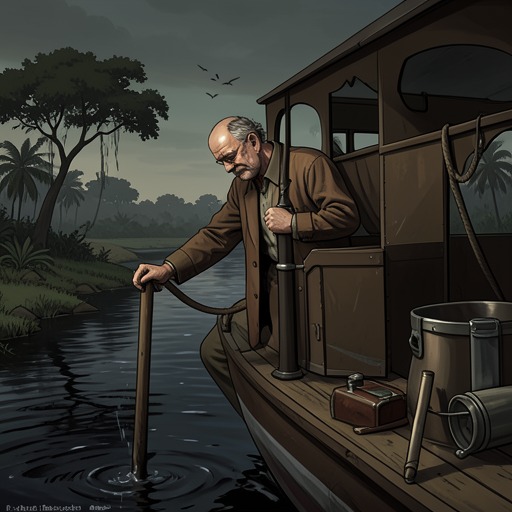
Kurtz's moral and psychological collapse
Heart of DarknessKurtz's moral and psychological collapse is the transformation by which a celebrated, eloquent advocate of humanitarian improvement becomes an ivory-seeking power whose conduct has escaped restraint. The change is disclosed not in a single revelation but through documents, other people's accounts, and Marlow's encounters with the consequences of Kurtz's authority. His ideals do not simply disappear: they remain beside the evidence of exploitation, making the distance between noble language and actual conduct central to the portrait. At the end, Kurtz's final judgment of his life offers Marlow neither an excuse nor a simple explanation, but a stark recognition of what he has become.
Ideals and the Report
Kurtz arrives in Marlow's account first as a name surrounded by expectation. Before meeting him, Marlow has heard that he is associated with ivory and is a figure of unusual importance, but has no clear image of the man himself. That distance matters: Kurtz's reputation precedes his presence, and for a time Marlow responds to the promise represented by the name rather than to personal knowledge. The report Kurtz prepared for the International Society for the Suppression of Savage Customs gives that reputation a substantial basis. It is a seventeen-page argument, described by Marlow as eloquent and animated, presenting Europeans as capable of exercising immense beneficial influence over the people they encounter.
The report's form makes its contradiction especially revealing. Its elevated language advances a vision of benevolent European power, while a later handwritten postscript urges the violent destruction of the very people the report claims to address. Marlow understands the postscript as an abrupt exposure of the violence concealed beneath the document's civilizing rhetoric. Kurtz later asks Marlow to preserve the pamphlet, apparently believing it could still benefit his career; the request shows that the earlier work continues to matter to him even after his conduct has made its claims untenable. The report thus records both an idealized public identity and the gulf between that identity and the actions that followed.
Authority, Ivory, and the Loss of Restraint
The Russian Trader's account supplies a practical history of Kurtz's deterioration. Kurtz's expeditions into the surrounding country were largely undertaken to obtain ivory. By the time the Russian Trader encountered him, Kurtz had no trade goods to offer, yet he continued to acquire ivory by force. The Russian Trader describes villages following Kurtz and says that people regarded him with devotion, while also recounting that Kurtz threatened to kill him unless he surrendered a small store of ivory and left the country. The Russian Trader handed over the ivory but remained nearby, still attached to Kurtz despite the danger and instability of their relationship.
That attachment does not make Kurtz's behavior less coercive. The Russian Trader describes a pattern in which Kurtz might receive him warmly on one occasion and make caution necessary on another. He says Kurtz repeatedly agreed to leave, only to set out again on an ivory hunt or disappear among the villages. The account presents the pursuit of ivory not as an isolated lapse but as a recurring action that overrides promises, prudence, and the possibility of retreat. Kurtz's authority over local followers magnifies that pursuit: he can draw armed support and command a presence that makes his threats credible. Marlow's report that the General Manager considered Kurtz's methods ruinous to the district further connects his conduct to material damage, though Marlow leaves the precise measure of that damage unstated.
The displayed human remains outside Kurtz's dwelling offer a visible sign of power exercised without ordinary restraint. Marlow rejects the idea that they serve any useful commercial purpose; to him, they show that Kurtz has indulged his desires without the restraint his eloquence might have led others to expect. The Russian Trader is reluctant to explain the display and says that he did not dare remove it. He also describes the local chiefs as approaching Kurtz deferentially. When he calls the displayed dead rebels, Marlow challenges that explanation, noting the succession of labels used to justify colonial violence. The episode exposes how political terms can recast opposition, while Kurtz's position allows him to impose his own authority beyond effective correction.
The Wilderness and an Inner Reckoning
Marlow places this collapse within a landscape that repeatedly unsettles the distinction between external danger and inward change. During the journey up the Congo River, the forest, silence, and difficult channel make practical attention a matter of survival. Shoals, submerged obstacles, and the need to find fuel occupy Marlow so completely that he can attend to immediate tasks instead of confronting what he senses in the surrounding wilderness. He later describes the river's stillness as an implacable force, not a reassuring peace. The landscape does not explain Kurtz's actions by itself, but it frames the weakening of the social routines and moral checks on which people ordinarily rely.
The encounter with people gathered along the river complicates any easy division between European restraint and African otherness. Marlow says that what unsettles him is the recognition of shared humanity and the possibility of a response across that apparent distance. His reflections connect this recognition to the peril of encountering fundamental human emotions without the familiar protections of custom. In that setting, principles and social conventions can prove inadequate unless a person has an inward commitment capable of sustaining restraint. These reflections establish the standard against which Kurtz's actions appear: his collapse is not simply a departure from European manners, but a failure to maintain limits when external checks weaken.
Marlow's account also insists on the limits of explanation. He cannot fully convey the life-sensation of a past period, and he describes narration as unable to reproduce the strangeness and disorientation of lived experience. That uncertainty shapes the reader's understanding of Kurtz. Marlow can report the document, the ivory raids, the Russian Trader's testimony, and what he sees at the dwelling, but Kurtz's inner life is never presented as a transparent case history. The account instead assembles evidence around a central difficulty: eloquence and intelligence remain present even as moral restraint fails.
The Attempted Flight and Final Judgment
The collapse becomes most intimate when Marlow finds Kurtz away from the dwelling, moving toward the forest and the fires where his followers are gathered. Kurtz is physically unsteady, yet his voice retains enough force to make the situation dangerous. He tells Marlow to go away and hide himself; Marlow understands that Kurtz could still summon the people nearby. The exchange shows that Kurtz's authority and his attachment to the life he has made there persist even as his health declines. Marlow tries to turn him back by reminding him of the future awaiting him in Europe, while recognizing that ordinary appeals have little purchase on a man who has placed himself beyond familiar standards of judgment.
Marlow eventually supports Kurtz back to the dwelling. He describes the encounter as a struggle with a soul that remains intelligent and concentrated but is also profoundly disordered. This distinction matters: Kurtz is not depicted as simply unaware of himself. Marlow sees him struggling inwardly, without the stabilizing restraints that might have checked his conduct. The scene gives physical form to the collapse without reducing it to illness alone. Kurtz's weakness is evident, but his earlier choices and the authority he exercised remain part of what Marlow must reckon with.
Near death, Kurtz's expression changes in a way that Marlow reads as encompassing pride, power, terror, and despair. Marlow wonders whether Kurtz is reviewing his desires, temptations, and surrenders, but does not claim direct knowledge of his thoughts. Kurtz then speaks a final judgment, repeating it in a whisper. Marlow later treats that utterance as an act of candor: Kurtz has reached a recognition that Marlow considers more truthful than the empty or evasive words he fears he might have produced in a comparable extremity. The judgment does not undo the exploitation or restore the restraint Kurtz lacked. Its force lies in naming, at the last, the moral reality of his life.
Meaning and Narrative Afterlife
Marlow's retrospective account holds Kurtz's achievements in speech beside the consequences of his conduct. The eloquent report, the postscript, the pursuit of ivory, the Russian Trader's testimony, and the evidence at the dwelling form a sequence of contrasts rather than a simple before-and-after portrait. Kurtz's ability to inspire admiration and fear persists alongside his failures of restraint. Marlow cannot dismiss him as ordinary, but neither does his fascination amount to acquittal. The distinction between intelligence, persuasive speech, and moral discipline is essential to the character's collapse: the first two survive where the third has failed.
The narrative also makes Kurtz's final judgment consequential beyond his death. Marlow returns to it while reflecting on his own nearness to death and on the difference between Kurtz's final recognition and what Marlow imagines he might have said. He regards Kurtz's words as a form of belief and a moral victory, but one purchased through repeated defeats and terrible satisfactions. This interpretation preserves the severity of Kurtz's record while explaining Marlow's continued loyalty to his memory. At the close, the overcast sky and darkened waterway echo the account's recurrent imagery of obscurity and scale; the frame does not settle Kurtz's meaning, but leaves the listeners facing the darkness into which the story has led them.