Marlow’s Lie to the “Fiancée”
Heart of DarknessMarlow’s Lie to the “Fiancée” is the final, deliberate substitution through which Marlow tells The Intended that Kurtz’s last word was her name, concealing the actual words he heard: “The horror! The horror!” It gives her an answer she can preserve as proof of Kurtz’s love, but it leaves Marlow carrying the knowledge that his consolation depends on withholding the truth. The scene makes the lie at once intimate and moral: a response to another person’s grief, and a refusal to deliver the judgment Marlow believes Kurtz was owed.
The Need for a Last Word
The lie takes shape in a conversation already structured by The Intended’s faith in Kurtz. She recalls him as a man who drew others toward what was best in them, and insists that Marlow has heard him and therefore knows him. Marlow answers that he knows, but his assent is accompanied by despair. He recognizes her faith as an illusion that shines in darkness, yet regards it as something he cannot defend her from—or even defend himself from. His silence is thus prepared before she asks about Kurtz’s final words: he has already seen the power of her idealized account and his own vulnerability to it.
Her grief is not presented as a single outburst. She first speaks of the loss as hers, then corrects herself generously to include the world; she describes herself as once happy, fortunate, and proud, and now unhappy for life. Against that sense of permanent bereavement, a last utterance could become something more than a report of what Kurtz said. It could serve as a surviving bond, a phrase to keep and revisit when the person himself is gone.
Marlow has already begun to reveal that he heard Kurtz’s final words, then stops in fright. The Intended asks him to repeat them because she wants “something—to—to live with.” Her request names the emotional purpose the truth would have to serve. She is not simply seeking a factual detail: she wants a final possession that might sustain her in the absence of Kurtz. Marlow understands the need, but the words he remembers cannot meet it without bringing their horror into the room.
The Substitution
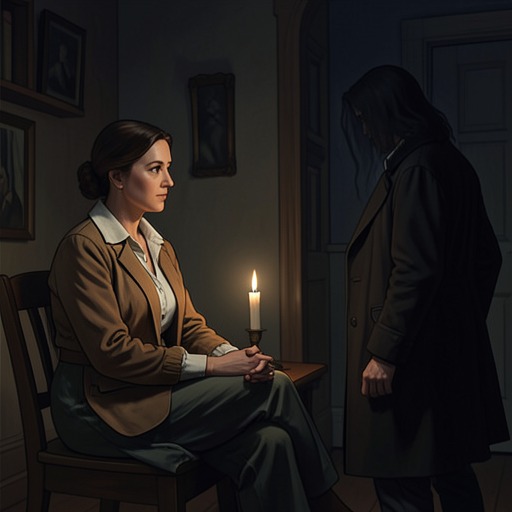
Marlow hears the remembered phrase in the surrounding dusk, which seems to repeat and amplify it. The whisper presses in on the scene; the last words are not merely a piece of information he can choose whether to disclose, but a sound that returns insistently as he faces her request. He nearly cries them out. Instead, he speaks slowly and gives her a different ending: “The last word he pronounced was—your name.” The sentence is a direct answer, shaped to sound like the testimony she has asked for, while concealing the words he actually heard.
The substitution changes the meaning of Kurtz’s death for The Intended. His actual last words leave her outside the utterance, confronted with a final judgment she cannot turn into a declaration of devotion. Marlow’s version places her at its center. Her light sigh gives way to a cry of triumph and pain; she says, “I knew it—I was sure!” and hides her face in her hands as she weeps. The response shows how completely the answer confirms what she already believes. Marlow has not persuaded her through a new account of Kurtz’s character so much as supplied the final sign her existing faith required.
The lie’s effectiveness depends on its fit with her conviction. The Intended has already described Kurtz’s influence as a gift of greatness and spoken of him as a loss to the world. Marlow’s answer lets that ideal survive the final moment without interruption. Her certainty is emotionally real, but it rests on words Marlow has knowingly replaced. The scene therefore holds consolation and falsification together: the statement eases her grief by making her central to Kurtz’s farewell, and it does so by denying her the truth about what he said.
Marlow’s Choice and Its Cost
Marlow does not present the choice as an easy kindness. Once the Intended accepts his answer, he imagines the house collapsing and the heavens falling upon him. The imagined catastrophe gives physical scale to his fear of what disclosure might do, while the world’s failure to collapse makes his act seem, outwardly, unpunished. But he turns immediately to a different measure: whether he has denied Kurtz the justice that was due to him. Kurtz, Marlow recalls, had said that he wanted only justice; the question makes the lie not just a protection of The Intended, but a withholding of testimony about the dead man.
Marlow’s answer to that self-accusation is also the scene’s limit: he could not tell her; it would have been too dark altogether. The phrase does not erase his awareness that he has falsified the last word. Instead, it records the pressure under which he chooses silence. The Intended’s grief, her insistence that she loved Kurtz, and her need for something to live with all stand opposite the words Marlow remembers. He chooses the account that preserves her faith, while remaining conscious that it is not the truth he heard.
Ending and Narrative Significance
The lie closes the encounter between Marlow and The Intended, but it does not close its moral question. Marlow’s telling preserves both versions at once: the phrase he heard, which returns as a whisper, and the name he gives her, which she receives as confirmation. Because the reader knows the substitution, her relief cannot simply settle the scene. Her belief brings comfort within the room while making Marlow’s concealment visible beyond it.
After Marlow finishes, his listeners remain motionless for a time before the Director remarks that they have lost the first of the ebb. The tale then returns to the darkened waterway and overcast sky, imagery that extends the scene’s darkness beyond the private conversation. The ending does not grant Marlow a clean verdict: the lie has spared The Intended the words he could not bear to tell her, yet the narration leaves his question of justice unresolved. His final gift to her is also the burden he retains—the knowledge that the last word she will live with was not Kurtz’s.