Pilgrims
Heart of DarknessThe Pilgrims are the white agents encountered at the stations and aboard Marlow’s river steamer. Their collective significance lies in the contrast between the work and philanthropy they appear to represent and the pursuit of Ivory that actually organizes their ambitions. At the stations they wait, scheme, and compete for profitable appointments; on the river, they join a journey whose motives and perceptions remain distinct from Marlow’s. Their actions during the attack on the steamer sharpen the contrast between confident colonial authority and limited understanding of what is happening around them.
Identity and Station Life
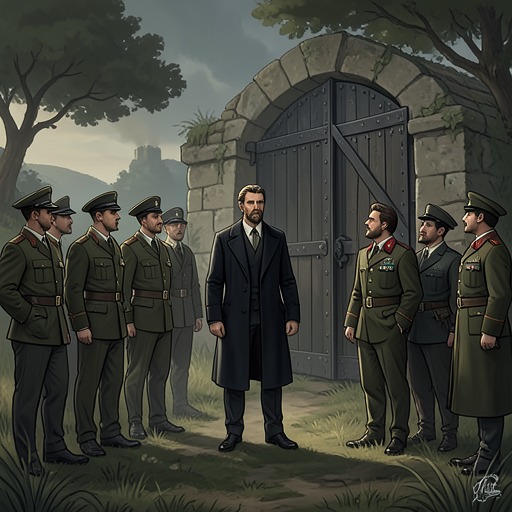
At the Central Station, the Pilgrims are a group of roughly sixteen or twenty agents, all waiting for something to happen. The station’s assigned work offers little evidence of purposeful activity: an agent charged with making bricks has been there for more than a year, yet not a brick has been produced because some necessary material is unavailable. The Pilgrims share this atmosphere of suspension. Disease, rather than productive labor, is the only consequence Marlow can clearly see arising from their wait.
Their idleness is active in one particular way. They backbite, intrigue, and slander one another, creating an atmosphere of plotting without any result beyond mutual hostility. These rivalries have a material focus: the agents want appointments at trading posts where Ivory can be obtained, because those positions bring them percentages. The competition is therefore not simply for status within the station. It is directed toward access to profit, while the work and governance that might justify the station remain, in Marlow’s assessment, largely pretense.
Commerce and the Eldorado Expedition
The arrival of the Eldorado Exploring Expedition interrupts the station’s waiting, but it does not supply the rivets Marlow and the boiler-maker hope to receive. Instead, over three weeks the expedition arrives in five installments, bringing white men, donkeys, tents, camp equipment, cases, and bales. The successive deliveries deepen the station’s disorder and give the arrival the appearance of an expedition transporting a great quantity of supplies into the wilderness without a clear, serious purpose.
The Pilgrims are among those impressed by the new arrivals, but the expedition represents a separate organization rather than a shared enterprise with them. It calls itself the Eldorado Exploring Expedition and is led by the General Manager’s uncle. Marlow characterizes its members as greedy and cruel without courage or foresight, and sees their desire as extracting treasure from the land without a moral purpose. His account places the expedition beside the station agents’ own pursuit of profitable Ivory posts: their methods and scale differ, but both reveal how material gain undercuts the language of service and work.
Aboard the River Steamer
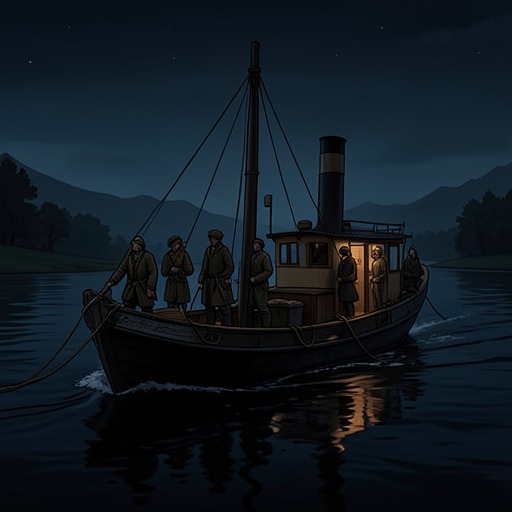
The Pilgrims also appear as passengers on Marlow’s river journey. The General Manager travels aboard with three or four of them, carrying staves, while Marlow’s steamer moves through long, quiet stretches between stations. At occasional settlements, white men emerge from dilapidated buildings to welcome the boat; the word Ivory is heard, and the journey continues. These encounters place the agents within a trading network whose scattered outposts orient attention toward the commodity, even when the surrounding river landscape feels remote and unfamiliar.
Their purpose on the journey is not identical to Marlow’s. He understands his own course as a movement toward Kurtz, whereas he suspects that the Pilgrims imagine the steamer is taking them toward something they expect to obtain. The distinction matters: the boat carries people together without giving them a common understanding of the journey. The Pilgrims travel within the same landscape, but their expectations remain tied to acquisition and the opportunities of trade.
The Attack and Its Aftermath
During the attack on the steamer, the Pilgrims open fire with their Winchesters toward the bush. Marlow observes that they fire without taking aim and that almost all their shots pass too high. Their gunfire produces smoke and noise, but he judges that the attackers’ retreat follows the steam whistle rather than the Pilgrims’ marksmanship. The scene presents force without reliable knowledge: the agents respond to danger with weapons, yet their confidence in what their firing has achieved is not borne out by Marlow’s account.
After the attack, the Pilgrims treat the outcome as a slaughter and regard Kurtz as avenged. One red-haired Pilgrim celebrates the supposed victory, although he had nearly fainted when he saw the wounded man. Marlow counters the celebration by pointing out the smoke and the poor aim, and attributes the retreat to the whistle. When the General Manager identifies the station ahead, the group’s attention shifts to that discovery. Their talk has already moved from the attack to the assumption that Kurtz and the station have been lost, showing how quickly uncertain events become confident conclusions in the group’s telling.
Narrative Role
The Pilgrims function as a collective portrait of the station system rather than as individually developed characters. Their recurring activities—waiting for profitable postings, competing with one another, traveling in the company of the General Manager, and firing during the attack—connect bureaucratic idleness to commercial appetite and then to misguided action. Marlow’s observations distinguish what the agents claim or believe from what he sees: a station with little effective work, an expedition without serious purpose, and gunfire that does not explain the attackers’ retreat.
Their name suggests a shared destination or conviction, but the evidence shows no comparable shared ideal guiding their conduct. Instead, they are united chiefly by their place in the trading enterprise and by expectations of gain. In this way, the Pilgrims embody the distance between the rhetoric of useful occupation and the pursuit of Ivory that drives the station’s rivalries. Their certainty after the attack extends that irony: they interpret the event as a victory even as Marlow’s account undercuts their claim to have produced it.