Thames
Heart of DarknessThe Thames opens Heart of Darkness as both a real tidal waterway and a landscape in which the history of maritime power darkens into uncertainty. At dusk, aboard the anchored Nellie, the river appears at once peaceful and freighted with memory: it has carried celebrated sailors and ships outward, toward “the mystery of an unknown earth,” and now prompts Marlow to call it “one of the dark places of the earth.” That reversal makes the Thames more than a quiet frame for his tale; it establishes the book’s recurring tension between national grandeur and the obscured costs and dangers of exploration.
Estuary and Setting
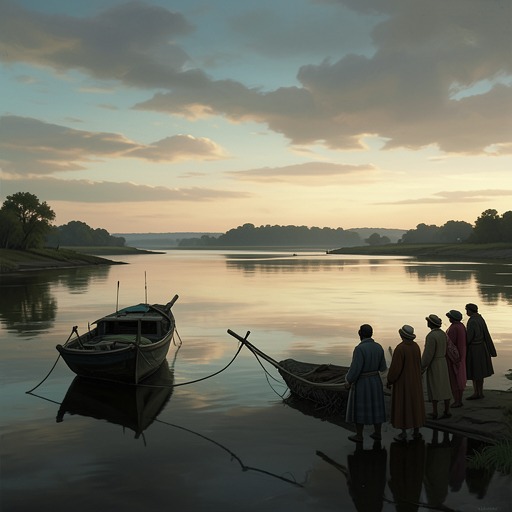
The opening scene places the Nellie in the sea-reach of the Thames, bound downriver but waiting for the tide to turn. The flood has made, the wind is nearly calm, and the yawl rests at anchor without a flutter of sail. This suspension gives the narration its initial stillness: the boat cannot yet proceed, and the company aboard it settles into watching rather than action.
The estuary stretches toward the open sea, where water and sky appear joined. Barges drift upriver with the tide, their red canvas and varnished spars distinct against a haze lying over the low shores. As the view recedes toward Gravesend and the upper reaches, the atmosphere changes: a motionless gloom gathers above the great town behind the river. The scene’s geography therefore has a double orientation. The luminous estuary opens outward to sea, while the darkened western distance draws the eye back toward the urban center.
The men aboard the Nellie initially share the quiet without making it an occasion for speech. They watch the Director of Companies, whose nautical appearance seems to belong to the estuary even though his work lies behind him, in the gloom. The river’s visible calm and the hidden world of commercial activity are held in the same view, a contrast that anticipates the story’s scrutiny of what lies behind the language of enterprise and progress.
Dusk and the Change in Meaning
As daylight fades, the Thames changes without ceasing to be still. The sun loses its glow and becomes dull red; the water’s serenity grows less brilliant but more profound. The river is described as resting after ages of service to the people on its banks, its broad reach carrying the dignity of a waterway that leads toward distant ends of the earth. The movement from bright surface to deepening dusk gives the landscape a historical dimension: the present evening seems to open onto earlier voyages rather than simply close a day.
The shift is not a sudden storm or physical upheaval. Instead, the setting’s significance accumulates through atmosphere and recollection. The tidal current continues its unceasing movement, while the light weakens and shore lights begin to appear. The Chapman lighthouse shines from a mud-flat; ships’ lights move up and down the fairway. Farther west, the town remains visible as an ominous presence, first as gloom in daylight and then as a lurid glare beneath the stars. The Thames thus combines ordinary navigation with a more unsettled visual pattern: moving lights suggest ongoing traffic, while the dark or glaring town anchors the scene in unease.
A River of Maritime Memory
For the frame narrator, the Thames summons the past because it has borne generations of sailors and ships. Its tidal current is imagined as crowded with memories of those who returned home and those who went to sea for battle. The river has known figures from Sir Francis Drake to Sir John Franklin, and vessels including the Golden Hind, which returned laden with treasure, and the Erebus and Terror, which set out on other conquests and never came back. Their different outcomes place triumph and disappearance within the same inherited maritime history.
The account broadens from famous names to the ordinary routes and institutions of expansion. Ships sailed from Deptford, Greenwich, and Erith; among them were royal vessels, commercial ships, East India fleets, adventurers, settlers, hunters for gold, and seekers of fame. The river is presented as the channel through which people and ambitions left the country, carrying both the sword and the torch. Its history is consequently not only one of navigation. It is also the history of outward power, conquest, trade, and settlement, expressed through the image of ventures launched from a familiar home waterway into an unfamiliar world.
Marlow’s Reversal
Against the narrator’s elevated account of the Thames as a bearer of national achievement, Marlow suddenly describes it as “one of the dark places of the earth.” The remark redirects the meaning of the opening landscape. Darkness is not confined to a distant, supposedly unfamiliar region: it also belongs to a river associated with England’s proud maritime past and the imperial voyages that carried its influence outward.
Marlow’s position aboard the Nellie sharpens that reversal. He is the only man present who still follows the sea, but he is also described as a wanderer rather than a typical, settled seaman. His stories do not contain their full meaning like a kernel; their meaning surrounds them, becoming visible gradually, as a glow brings out a haze. The Thames supplies a fitting threshold for that method. Its changing light first presents a serene and venerable river, then reveals the shadow beneath the familiar view. From this anchored boat, the river’s remembered departures turn into the point of entry for Marlow’s account of a journey into darkness.