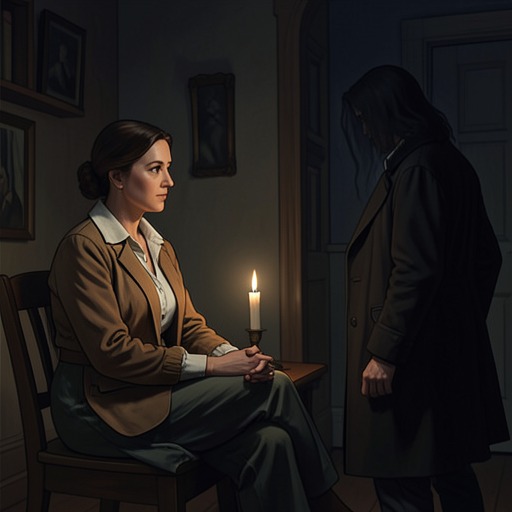
The Intended's idealization of Kurtz
Heart of DarknessThe Intended’s idealization of Kurtz is a conviction that his character was noble, his influence beneficent, and his life too consequential to end in mere loss. It comes into sharpest view in her conversation with Marlow after Kurtz’s death: she treats his goodness and their intimacy as settled truths, while Marlow knows that the truth of Kurtz’s final words cannot be reconciled with the comfort she seeks. Her faith sustains her grief, but it also helps make his silence—and his lie—possible.
Identity and grounds for her belief
The Intended’s account rests on a claimed intimacy with Kurtz. When Marlow calls him remarkable and hesitates before saying more, she supplies the feeling she expects him to confirm: she insists that it was impossible to know Kurtz without loving him. She says she had his “noble confidence,” knew him best, and had been told by Kurtz himself that she understood him better than anyone. These assertions make her more than a mourner recalling a lost fiancé: she presents herself as the person best qualified to preserve his character and interpret his life.
Her belief also has a personal history of deprivation and attachment. She tells Marlow that since her mother’s death she has had no one, and that she wants him, as someone who heard Kurtz’s last words, to know she had been worthy of Kurtz. The account suggests that this bond is central to how she understands herself, but it does not independently establish the accuracy of her claims about Kurtz. Marlow reports that their engagement had been disapproved of by her family, apparently because Kurtz was not wealthy enough. He also suspects that impatience with comparative poverty helped drive Kurtz out to Africa. The gap between her noble image of Kurtz and this account of material ambition remains unaddressed in their conversation.
The posthumous encounter with Marlow
Marlow’s visit becomes a scene in which the Intended’s certainty draws him into confirming more than he can honestly say. She interprets Kurtz’s gift of papers—and Marlow’s arrival—as evidence that Kurtz considered him a friend and sent him to her. Yet Marlow is unsure whether he has brought the right bundle. He suspects Kurtz may instead have wanted him to safeguard other papers, which he later saw the manager examining. The Intended’s confident reading of the papers and visit therefore exceeds what Marlow can verify.
She also generalizes Kurtz’s appeal into proof of his moral greatness. She says that anyone who had heard him speak once could be his friend, because he drew out what was best in other men; to her, this power is the gift of the great. Marlow answers that he knows, but the narration places that response beside his despair and his sense that her belief is a “great and saving illusion.” The phrase captures the double effect of her idealization: it offers her a way to endure the loss, while requiring Marlow to stand inside a version of Kurtz he cannot wholly affirm.
The room grows darker as she speaks, and only her forehead remains illuminated by what the narration describes as the light of belief and love. That image does not simply make her faith false; it shows how strongly her certainty governs the encounter. Her tears do not fall, though she declares herself unhappy for life. She corrects her first description of Kurtz’s loss to include the world, giving her private bereavement a public scale. The grandeur of that claim accords with her picture of Kurtz as a figure whose importance must exceed the intimate circle around him.
A life and legacy she cannot accept as lost
The Intended refuses the idea that Kurtz’s promise and greatness have ended with his death. She invokes the vast plans she knew of, though she admits she could not fully understand them and believed others could. From that premise she insists that something must remain: his words have not died. Marlow agrees. When she adds his example, describing men as having looked up to Kurtz and his goodness as shining in every act, Marlow assents again. His replies preserve her account rather than test it; the exchange lets her build a legacy from words, example, and remembered promise.
Her repeated inability to believe that she will never see Kurtz again exposes the cost of that idealized continuity. She does not merely praise him; she struggles to imagine a world in which his life has concluded and his presence cannot return. Her statements that she had been fortunate and proud, and is now unhappy for life, hold gratitude and permanent bereavement together. The idealized image gives the loss meaning, but it cannot undo the loss itself.
Narrative contrast and consequence
The Intended’s confidence contrasts with Marlow’s recurrent uncertainty about whether experience and character can be made fully knowable through words. Before he meets Kurtz, he admits that the name has no definite human image for him; he even lets a foolish young employee imagine that he has influence in Europe because he hopes the pretense might help Kurtz. Later, reflecting on experience, Marlow says that it is impossible to convey the subtle essence of a period of life. His narrative thus sets limits on confident accounts of another person, while the Intended speaks as if love has given her privileged and complete knowledge.
That contrast culminates in Marlow’s concealment. When the Intended presses him about Kurtz’s last words, he tells her that Kurtz’s last word was her name. The statement gives her the confirmation she seeks, and she receives it as proof that she was right. Marlow’s narration makes clear that this is a lie, motivated by his inability to tell her the truth. His decision protects the Intended’s idealized memory at the price of withholding the actual last words. In the final framed scene, after Marlow falls silent, the darkened waterway seems to lead into immense darkness; the image carries the story’s unresolved tension between comforting belief, painful knowledge, and what narration leaves unspoken.