The power of the wilderness
Heart of DarknessThe power of the wilderness is the central pressure against which Marlow measures colonial ambition, human self-command, and the limits of understanding. It appears not simply as a physical setting but as an immense presence that seems to observe the expedition and outlast it. Marlow’s account makes that presence a counterforce to The Company’s activity, while also showing how his own language turns an unfamiliar world into something difficult to comprehend and describe.
The wilderness and the colonial intrusion
At the station, Marlow sees men moving without clear purpose while Ivory dominates their talk. Their gestures and long staves suggest to him the appearance of pilgrims, but their devotion is directed toward a commodity. He reads the scene as rapacity disguised by the routines of a trading post. Beyond the cleared ground, the surrounding wilderness appears, in his view, greater and more enduring than the small settlement. He imagines it waiting for the passing of the invasion. This is Marlow’s interpretation rather than a neutral account of the landscape: the wilderness acquires intention in his telling, while the Company’s project is reduced to a temporary interruption.
The contrast also shapes Marlow’s response to a damaged steamer and the manager’s associate, who speaks of his plans and hopes of advancement. Marlow sees the wrecked vessel as a carcass against the forest and river, while the associate’s conversation continues as if the surrounding scale did not matter. In the moonlight, the river and forest seem to him expectant and mute. His uncertainty about whether this silence is an appeal or a threat registers a more basic disturbance: the expedition cannot assume that its own purposes define the situation. Ivory and Kurtz are still largely abstractions to Marlow at this point, but the wilderness is already an overwhelming presence against which those abstractions seem insubstantial.
The river as an ordeal of attention
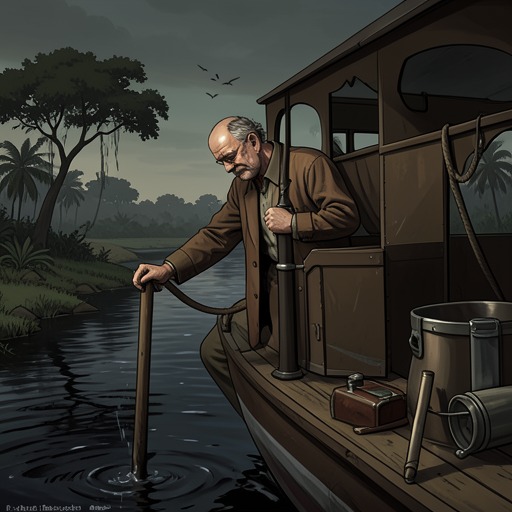
The journey up the Congo River gives this pressure a practical form. Marlow describes a waterway that repeatedly frustrates easy passage: wooded islands and shoals make the channel difficult to find, hidden obstructions threaten the steamer, and the crew must gather wood for continued travel. Steering and watching for hazards occupy his attention. The expedition’s progress therefore depends not on confident mastery but on laborious adjustment to conditions it cannot fully control.
Marlow initially experiences the journey as a return to an earlier world, estranged from the life he knew elsewhere. Yet he also explains that the demands of navigation crowd out sustained reflection. When he must attend to the channel, the steamer, and its fuel, immediate practical tasks become a buffer against the larger reality he senses. His account holds these two experiences together: the wilderness remains powerful, but attention to work can temporarily keep its implications at a distance. The protection is incomplete. He says that the stillness continues to seem watchful even when he has little time to notice it.
The river’s apparent silence is not presented as peace. Marlow describes it as an inscrutable force, while admitting that his understanding is limited by the demands of travel and by his own perspective. This tension matters to the concept: the wilderness is not made knowable simply because Marlow gives it images of intention or menace. His language conveys the pressure of an experience that resists explanation, even as it interprets that experience through his own fears and assumptions.
Human kinship and the limits of restraint
The encounters along the river further unsettle the boundary Marlow draws between the travelers and the people on shore. He initially describes the gatherings in terms of distance, confusion, and apparent frenzy. But he also arrives at the recognition that the people are not inhuman and that their actions may express emotions and meanings with which he shares a remote kinship. This recognition complicates his earlier separation of civilized observer from supposedly primitive spectacle. It does not give him full access to what he sees: he acknowledges that the travelers cannot understand the gatherings from their position aboard the steamer.
Marlow connects this moment of recognition to the question of restraint. He argues that inherited principles and outward appearances may not be enough when familiar social protections fall away; a person needs an inward commitment capable of withstanding pressure. Yet his account also shows how material work interrupts such reflection. He has to help address leaking steam pipes, steer the vessel, avoid obstructions, and attend to the fireman. Practical tasks keep the expedition moving, but they also disclose how thin its claims to command are: survival depends on attention to fragile machinery and on workers whose labor sustains the voyage.
Kurtz and the wilderness within
The wilderness’s power becomes most disturbing in Marlow’s account of Kurtz. At the Inner Station, human remains displayed on poles lead Marlow to conclude that Kurtz has lost restraint in the pursuit of his desires. Marlow does not present the display as a useful or profitable practice. Instead, he takes it as evidence of a deficiency that Kurtz’s eloquence could not repair. He imagines that solitude and the wilderness revealed something about Kurtz that had previously been concealed from him, and that this revelation held a powerful attraction because Kurtz was inwardly empty. This remains Marlow’s interpretation of another man’s collapse, but it binds the wilderness to the exposure of conduct that civilized language had failed to restrain.
That conflict recurs when Marlow finds Kurtz away from the station, moving toward the forest and the sounds and fires beyond it. Marlow understands the movement as a return to passions that have become difficult to govern. He tries to bring Kurtz back by reminding him of his plans and assured success in Europe, and he threatens force if Kurtz calls out. The exchange is not a simple contest between a rational man and a confused one: Marlow insists that Kurtz’s intelligence remains clear, while judging his inner life to be unrestrained and profoundly disordered. The wilderness, in this scene, is both the surrounding environment and the pressure through which Kurtz’s loss of self-command becomes visible.
Narrative limits and the final darkness
Marlow’s reflections on the wilderness are inseparable from his doubts about whether an experience can be communicated. He compares his recollection to a dream and says that its essential sensation cannot be transferred intact to another person. The difficulty is more than a shortage of descriptive detail. The experience combines uncertainty, surprise, and resistance to ordinary explanation; the listener receives a shaped account, not the original event. The wilderness thus tests the narrator’s authority as well as the characters’ control over their surroundings.
The frame of the novel preserves that uncertainty. After Marlow’s account ends, the Frame Narrator observes the darkening view along the Thames, which seems to lead toward an immense darkness. The closing image connects the distant river journey to the world from which the listeners have heard it, without making the two places identical. The wilderness’s significance therefore outlasts the expedition: it names the force Marlow believes can expose human vulnerability, but it also marks the limits of his ability to explain what he encountered or to separate that encounter from the assumptions through which he saw it.