“Be the actor, not the reaction.”
Heart of the Hunter“Be the actor, not the reaction.” is the principle Thobela Mpayipheli retrieves from his training with Otto Müller while travelling under pursuit. The phrase turns a lesson in game theory into an immediate practical challenge: instead of letting an opponent’s presumed moves dictate his own, Thobela must decide what he will do, find the options open to him, and change the pattern others expect.
The Lesson from Otto Müller
On a night road through the Karoo, Thobela remembers Otto Müller, an East German instructor who had taught him nearly twenty years earlier. Müller had explained Nash equilibrium as a condition in which two players have no reason to change their chosen strategies. Trying to break that equilibrium by second-guessing the opponent does not work, Müller’s lesson insists: anticipating the other player is itself part of the existing strategy.
The memory also recalls the particular bond between instructor and pupil. Thobela had been one of ten operators, the rest from Eastern Bloc countries including Poland, Czechoslovakia, and Romania; Müller was fascinated by having his first Black student. Their exchange included Thobela’s deliberately performed German accent and Müller’s approving recognition of his attitude. In the later crisis, the lesson survives not as abstract theory but as usable instruction.
From Reaction to Agency
The principle takes on urgency when Thobela considers the report that he is armed and dangerous. He does not even have the pistols attributed to him, and he cannot tell whether a pump jockey has reported him or merely adopted an attitude of indifference. Rather than settle on one interpretation, he recognizes that the authorities may be miscalculating and that imagining every possible move could overwhelm him.
Müller’s answer is to focus on Thobela’s own strategy: think about what he will do, how he can change his approach, and how he can take control of the contest. The imperative to act therefore counters the paralysis of endless speculation. It does not mean that Thobela can know what his pursuers will do; it means that their uncertainty, like his, need not determine his next move.
Changing the Expected Pattern
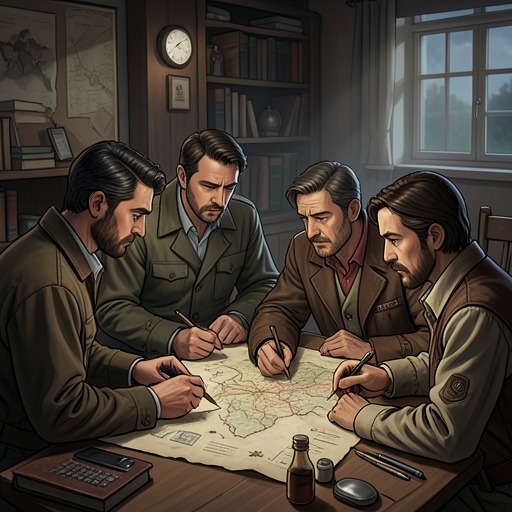
The lesson returns in the image of chess. An opponent searches for patterns of play, so Thobela can allow a familiar pattern to be read as Nash equilibrium and then alter it. But intention alone is insufficient. His pursuers expect him to follow the N1, and he realizes that he can change that pattern only if he knows what alternatives are available. He needs a good road map, turning the maxim’s emphasis on agency toward a concrete need for information.
The expression thus links strategic choice to the material limits of escape. Thobela is urged not merely to respond to pursuit but to become the source of a changed course; at the same time, the missing map shows that effective action depends on knowledge he does not yet have. The principle offers a method for breaking an expected pattern, not an assurance that every option is within reach.