Botswana
Heart of the HunterBotswana becomes both the destination of Thobela Mpayipheli’s escape and the place where the pursuit’s apparent momentum breaks. For Mpayipheli, crossing the border promises distance from the South African manhunt; for his pursuers, it creates new logistical and jurisdictional obstacles. The country is not simply a point on his route: its roads, border approaches, and northern settlements shape the risks of flight and the possibility of rescue.
A refuge plotted from a distance
The intelligence operation treats Botswana as the direction in which Mpayipheli is likely to flee. Janina Mentz reasons that Kimberley lies close to a straight line between his position and the border, and expects him to regard Botswana as freedom and success. On that basis, she orders manpower concentrated around Kimberley, with police and army units watching the roads and the Rooivalk squadron placed on standby. This is an informed prediction rather than certainty: the pursuit depends on anticipating a route through a country whose many possible approaches make comprehensive surveillance difficult.
Mpayipheli’s own calculations are equally shaped by the border. At one point he weighs the hours needed to reach Lusaka against the complications ahead: at least two national borders, a passport but no papers for the BMW R 1150 GS, and the time-consuming uncertainty of dealing with customs. He considers slipping through a gap in a border fence instead. The Zambezi River, however, presents a more formidable obstacle than a road checkpoint. Botswana therefore stands within a larger geography of escape, not as a guaranteed safe end but as a stage on a journey whose crossings and waterways may impose fresh delays.
The crossing under pursuit
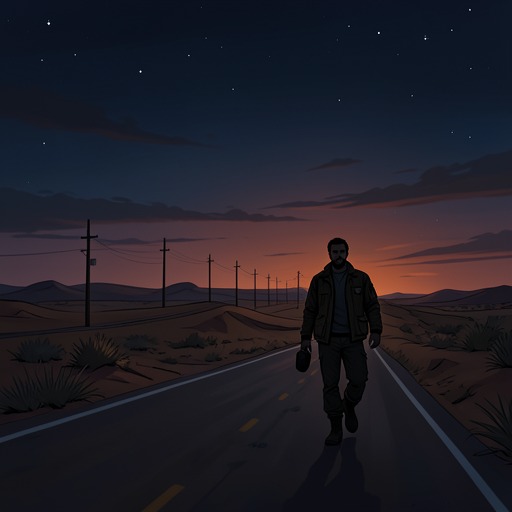
The effort to reach Botswana unfolds amid long-distance travel and changing conditions. Mpayipheli calculates fuel stops and overnight rest while moving through the Great Karoo, then later maps a route north from Petrusburg through possible alternatives such as Dealesville or Boshof. His planning depends on darkness, road choice, and the chance to multiply his options before authorities can predict them. When two helicopters pursue him, he accelerates toward a bank of heavy rain; once the storm reduces visibility, their noise fades. The weather does not end the chase, but it gives him a temporary opening in the surveillance that has been organized against him.
At a later point, a helicopter carrying him races across the landscape as Mpayipheli identifies Botswana as the direction he needs to go. The captain says he cannot cross the border. Mpayipheli insists that they can do so if they fly low enough to evade radar. The exchange makes the border a practical barrier, but also a boundary he is prepared to test through speed and concealment. His crossing is not presented as a settled passage into safety: he is injured, still moving, and dependent on the choices of others as well as his own route-finding.
A rival pursuer enters Botswana
The pursuit crosses the same boundary. Captain Tiger Mazibuko enters Botswana an hour after midnight in a Volkswagen Golf GTI Turbo, driving as fast as the darkness and narrow road allow. The vehicle has been arranged for him through Mentz’s operation and is waiting at the police station in Ellisras. Once across, Mazibuko follows his calculations about Mpayipheli’s likely progress, relying on information from the helicopter pilot and on the belief that the fugitive’s injuries will slow him down. The chase thus becomes a contest between two vulnerable kinds of movement: Mpayipheli’s improvised escape and Mazibuko’s organized attempt to close the distance.
Botswana also complicates the pursuers’ confidence. Mazibuko’s prediction that Mpayipheli may not last the night is uncertain, and his own progress depends on the fugitive’s unknown position. Later, the injured man is found near the Mpandamatenga turn-off. Local people load him into a pickup and take him to Kasane rather than notifying the authorities. Their choice changes the immediate outcome of the pursuit: Mpayipheli reaches medical care, while the intelligence network loses the straightforward trail it had hoped to follow.
Kasane and the chance of recovery
The news from Kasane reaches Allison Healy through a call from Doctor Pillay, who has found her telephone number in the pocket of an injured man brought in after falling from his motorcycle in northern Botswana. Mpayipheli is in serious but stable condition and has lost a great deal of blood; the hospital has given him transfusions, but more blood is needed and supplies are limited. The location offers treatment, not certainty. His condition makes the journey’s cost plain, while the scarcity of blood means that survival still depends on resources that cannot be taken for granted.
The account of his arrival emphasizes local action rather than official protection. People living near the Mpandamatenga turn-off carry him to Kasane, and, as reported to Healy, no one contacts the authorities. The episode sharply contrasts the state’s extensive effort to locate him with the help he receives from people outside that apparatus. Botswana becomes a place where the fugitive can be found by civilians without being immediately returned to the pursuing agencies.
Surveillance, jurisdiction, and significance
The search continues beyond the initial rescue. Two London agents travel to northern Botswana after receiving a tip from Inkululeko, obtain a vehicle, and make visual contact with a Presidential Intelligence Unit Reaction Unit member lying in wait for Mpayipheli. Botswana authorities arrest that operative. The agents remain at the roadside through the night but fail to intercept either Mpayipheli or the hard disk. The sequence reveals that the pursuit is not a single national operation: information, personnel, vehicles, and authority cross borders, but their coordination remains incomplete and their access is not unlimited.
Later, a further contact from Inkululeko gives the agents an address where Mpayipheli is apparently recovering from his journey, with only three hours before the Reaction Unit is expected to arrive. The address is not identified as being in Botswana, so the earlier northern search remains distinct from this later lead. Taken together, the episodes show the country’s importance without making it a permanent sanctuary. Botswana first appears as the objective of Mpayipheli’s escape, then as the scene of pursuit, medical rescue, and a failed interception. Its narrative significance lies in the gap between a border plotted on an intelligence map and a lived landscape of roads, local decisions, limited supplies, and uncertain passage.