Hero–villain framing
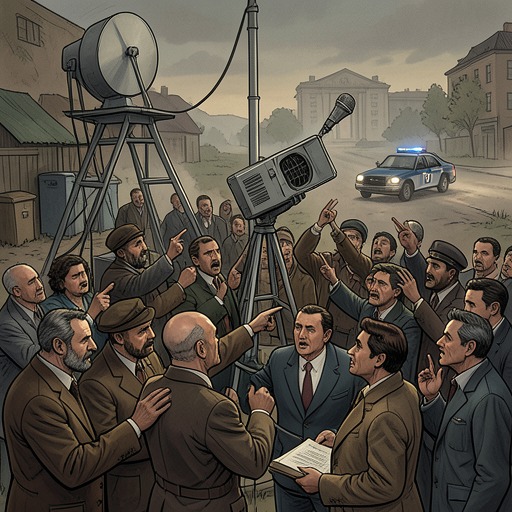
Heart of the HunterHero–villain framing is the struggle to make Thobela Mpayipheli legible through a single moral story. The government’s proposed media account assembles him as a criminal and public danger; the people Allison Healy questions offer a more complicated portrait. The contrast does not settle whether he is a hero or a villain. Instead, it shows how the selection and interpretation of facts can make either label seem persuasive, while leaving the underlying person harder to define.
The State’s Proposed Narrative
In a conversation about using the media to the government’s advantage, the Minister of Intelligence argues that the distance between hero and villain is narrow and depends on how facts are interpreted. The plan is to give the public a particular set of facts about Mpayipheli, arranging them into a case against him. This is not merely a description of his conduct: it is a conscious effort to direct the meaning attached to it.
The proposed account depicts Mpayipheli as a former participant in a drug network said to have damaged social life and harmed children on the Cape Flats. It alleges that he turned his MK training to intimidation and violence, suggests that unexplained money in his bank account may indicate continuing criminal activity, and presents him as exploiting an innocent woman and child. It also invokes his lack of a home, his deliberate injury of a young white soldier, and two occasions on which he allegedly obstructed the state rather than surrendering. The details are chosen to accumulate into a recognizable public type: reckless, criminal, and undeserving of sympathy.
That portrait gains force through comparison. The Minister of Intelligence contrasts Mpayipheli with former MK members who, in the government’s account, chose to help build the nation despite unemployment and poverty. The contrast makes political history itself part of the moral argument: past service does not guarantee present virtue, and other people with a similar background are offered as evidence that Mpayipheli could have chosen differently. Yet the scene presents these points as the material of a proposed media case, not as an independently verified judgment. The distinction matters: the government’s capacity to select and circulate a story is not the same as proof that its complete interpretation is true.
Allison Healy’s Search for a Person Behind the Labels
Allison Healy’s reporting begins amid competing accounts. Miriam Nzululwazi and Immanuel, a shoeshine man, have argued with conviction that Mpayipheli is a good man; the Minister of Intelligence has offered the opposite figure, a once-trustworthy soldier gone badly wrong. Allison recognizes that neither account, simply by being forcefully delivered, resolves the contradiction. Her response is to keep asking questions, investigate, and sift what can be established from what merely supports a convenient picture.
Her approach is shaped by a gradual loss of youthful idealism. When she joined the Cape Times, she had studied journalism at Rhodes University and hoped eventually to write for magazines such as Cosmo or Fair Lady. At first she trusted people and looked on the famous she encountered with wonder. Experience steadily unsettled that outlook: she came to see dishonesty, self-interest, violence, and betrayal as possible across differences of status, nationality, and colour. This disillusionment does not give her an easy replacement for innocence. Instead, it sharpens the question her reporting must face: where is the truth when human beings and institutions can furnish such different accounts?
The narrative also gives Allison’s own life some of the moral unevenness that her investigation encounters. She identifies loneliness as the reason she entered a sixteen-month relationship with Nic, who was still married, while describing him as basically a good man apart from his unfaithfulness. The episode does not make her a judge whose private life settles Mpayipheli’s character. Rather, it places her among people whose actions resist simple classification: affection, loneliness, betrayal, and a judgment of someone as basically good coexist without cancelling one another. That complexity makes the demand for investigation more consequential than a choice between credulity and cynicism.
Arendse’s Refusal of Simple Categories
Orlando Arendse challenges the packaging of people into labels. Speaking to Allison, he argues that people contain both good and bad, and that neither side can be treated as the whole of a person. Allison presses the distinction between ordinary human complexity and serious crimes such as murder or rape; Arendse grants the point rather than claiming that all conduct is equivalent. His objection is narrower: a label can erase the circumstances and capacities through which a person acts.
His account of Mpayipheli makes that distinction concrete. Mpayipheli was six foot five, Arendse says, and his size alone could make a drug dealer on the Flats see a threat in a confrontation. According to Arendse, Mpayipheli did not seek violence; his presence carried the possibility of it, so violence was often the last thing anyone wanted to provoke. This does not prove that he never resorted to violence, and Allison keeps asking precisely that question. The answer remains unresolved in this exchange. Arendse’s testimony therefore complicates the official image without simply replacing it with an acquittal: a capacity to intimidate is not identical to a settled desire to harm, but neither does that distinction erase the need to examine what he did.
Meaning and Limits of the Frame
The competing accounts expose a gap between facts and the stories built from them. The government’s strategy emphasizes a sequence of damaging allegations and contrasts Mpayipheli with former comrades who chose nation-building. Allison’s reporting instead places the official case beside testimony from Miriam, Immanuel, and Arendse, then treats continued inquiry as necessary. The contrast is not between a wholly false state account and a wholly reliable alternative. The evidence establishes the existence of opposed portrayals and the methods used to advance or question them; it does not, in these scenes alone, verify every allegation or deliver a final verdict on Mpayipheli.
Hero–villain framing is thus both a political tactic and a problem of knowledge. A fugitive can be made into a public villain by gathering facts into a persuasive sequence, while testimony about his character can make the same sequence look incomplete. Arendse’s warning about labels does not make moral judgment impossible: Allison explicitly distinguishes human complexity from grave wrongdoing. It instead cautions against mistaking a usable public image for a complete account. The narrative’s decisive emphasis falls on the labor between those positions—asking, checking, and keeping interpretation open until the facts can bear the weight placed on them.