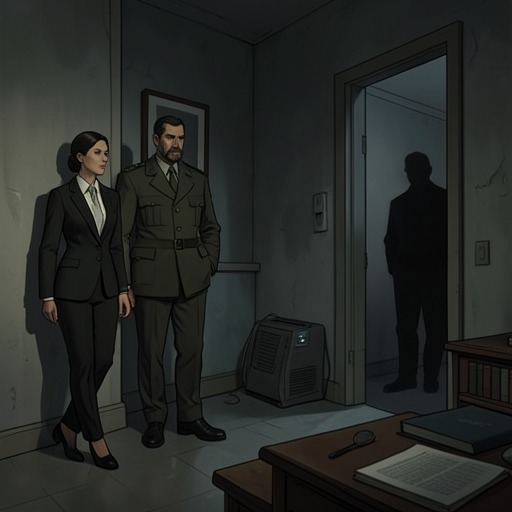
Janina Mentz
Heart of the HunterJanina Mentz is a senior intelligence officer whose defining strength—her capacity to impose order on uncertain situations—also exposes the limits and costs of institutional control. As Chief of Staff: Operations at the Presidential Intelligence Agency, she directs a widening manhunt for Thobela Mpayipheli while trying to protect sensitive intelligence and manage the political story around it. The later revelation that Inkululeko is a disinformation identity designed to divert suspicion toward someone other than its source recasts her command role: the officer insisting that her team follow the facts is herself at the center of a concealed operation.
Identity and Command
Mentz holds a senior operational position in a new governmental intelligence agency. The Director is her superior, and the two work in a relationship shaped by access, trust, and the pressure of sensitive decisions. When she enters an afternoon briefing, sixteen staff members are already seated in the Ops Room. Their anticipation reflects the circulation of rumors and the competition for information within the organization; Mentz’s arrival signals that the developing situation is no longer routine.
Her approach to command is direct and practical. At the start of the pursuit, she instructs Quinn to bring Mpayipheli and his bag from the airport quietly, quickly, and without a confrontation. The order treats discretion as an operational necessity: the objective is to secure the fugitive and his belongings, not to make a public spectacle. Her later anger at the loss of control shows how strongly she depends on knowing where people are, where they are going, and how they will get there.
Mentz articulates a principle of realism: she believes in seeing circumstances as they are rather than as one wishes them to be. In the briefing, she applies that standard to the hard disk. She tells her staff that its contents concern a mole at the highest level, code-named Inkululeko, and could cause grave damage if they reached the wrong hands. Her instruction is to protect the State, remain professional, and attend to facts rather than the people implicated in them. The language establishes a disciplined institutional ethic, but it also reveals how readily her immediate decisions are framed as questions of national security.
The Manhunt and Its Escalation
Mentz initially believes the operation is under control. When information changes and cooperation between agencies becomes difficult, that confidence gives way to frustration. She sees rivalry and political maneuvering as obstacles, but also recognizes that the new information, the fugitive’s capabilities, and her team’s underestimation of him have altered the situation. She anticipates escalation and decides that if the National Intelligence Agency intends to play games, she will need greater leverage.
The pursuit soon becomes public. Police and traffic authorities along the N1 are alerted to look for an armed fugitive riding a large BMW motorcycle. Mentz objects not only to the operational risks but also to the consequences of the coverage: news reports are making Mpayipheli into a hero while the intelligence service risks appearing like the Gestapo. Her anger at this reversal becomes a demand for solutions. The chase is no longer simply a matter of locating a man and a hard disk; it is also a contest over which account of events the public will believe.
The facts available to the public complicate the official portrayal. A crime reporter, Allison Healy, questions the claim that Mpayipheli stole the motorcycle. She reports that no theft charges or investigation have been filed and that the dealership owner received a note in which Mpayipheli described the motorcycle as borrowed and promised to pay. The discrepancy gives Mentz’s opponents material with which to challenge the government’s account. It also illustrates the practical limit of her control: an official alert can direct police attention, but it cannot ensure that every detail supporting the alert will withstand scrutiny.
At a discussion with the Minister of Intelligence, Mentz confronts the widening public-relations crisis and the prospect that the President will demand an explanation. One proposed way to counter sympathy for the fugitive is to emphasize his past: his connection to a drug network on the Cape Flats, his use of MK training for intimidation, unexplained money, and alleged obstruction of the State. The argument contrasts him with former MK members who chose to help build the country. This reframing attempts to replace the emerging image of a persecuted fugitive with that of a dangerous criminal, but its necessity also shows how far the public narrative has moved beyond the agency’s initial control.
Private Pressures and Institutional Duty
Mentz’s professional urgency exists alongside a private life that the operation repeatedly interrupts. After a call, her first impulse is to be with her children. Later, she is at home between her daughters’ schoolwork books when she can barely make out Mazibuko’s words. These moments place the responsibilities of command beside ordinary family care, without suggesting that she can simply leave one sphere for the other.
The physical demands of the crisis are also visible in her routine. After sleeping for only two hours on the sofa in her office, she rises as soon as her cellphone alarm sounds. She showers in the office building and uses the short interval to think through the next steps, arranging the coming day like a map. The detail makes her composure less effortless than it appears: it is maintained through brief rest, preparation, and repeated acts of self-command.
When she reports to the Director, she begins with the background to the Ismail Mohammed interview and the counterintelligence operation, including what has gone wrong. She also discloses that she involved Johnny Kleintjes and suspects that Mpayipheli has the real hard disk. In the exchange, the possibility that her own name is among those implicated becomes part of the discussion. The scene places her on both sides of the investigation: she is responsible for explaining its failures while evidence and suspicion draw closer to her own position.
The Director’s habitual smile is an understated measure of changing strain. Mentz has never seen him without it, but after she tells him of Miriam Nzululwazi’s death, the smile disappears. She observes that the affair’s stress is reaching him and that his warmth toward her has diminished. The report does not merely add another consequence to the operation; it changes the emotional atmosphere between two officials whose working relationship depends on trust.
Inkululeko and the Disinformation Plan
The later account of Inkululeko supplies a concealed history behind the operation. In 1996, the source suggested that code name, pointing out its value for disinformation despite having no Zulu ties and being of European extraction. In 2000, the value of the source increased when she was approached and recruited as Chief of Staff: Operations for the newly created Presidential Intelligence Agency. These details connect a deliberately misleading identity to Mentz’s rise inside the institution.
The plan associated with Inkululeko is described as a disinformation initiative intended primarily to direct suspicion away from her. Mentz’s public role and the hidden purpose therefore run in parallel: she takes part in a search for a mole while a plan is operating to obscure the source’s identity. She is also prepared to write a full report for the Minister of Intelligence while bypassing her immediate superior, whose name would be among the strongest candidates for Inkululeko. The maneuver shows how suspicion can be redirected within an organization, and how a report presented as a route to accountability can also shape who is investigated.
A later confrontation gives the secret a personal cost. Williams contacts Mentz from police cells and says he has a bomb, then plays her a tape. She keeps her reaction contained while fearing that the shock may show on her face. Her thoughts turn to her daughters and to the possibility that they will regard their mother as a traitor. The narrative resists a simple explanation for her actions: there is no single grand reason, but a dramatic moment at the American Embassy set against a lifetime of disappointment, disillusionment, and frustration. That context explains the pressure behind the choice without erasing its consequences.
Inquiry, Final Bargain, and Narrative Role
The aftermath includes a Commission of Inquiry into Miriam Nzululwazi’s death. At the hearing, Mentz questions whether information was supplied to Muslim extremist groups during the operation. When the chairman asks whether leaving the interview-room door unlocked was negligence, she maintains that she believes it was deliberate. The exchange directs attention toward the circumstances of Miriam’s detention and escape, while showing Mentz participating in an inquiry whose questions concern the conduct of the operation she helped oversee.
Near the end, events return to the hard disk and the child held as leverage. Allison Healy follows a woman driving out of the Wale Street Chambers parking garage; Mpayipheli is lying flat on the back seat. The route runs through the city, onto the N1, and toward the northern suburbs. During the ensuing exchange, Mentz asks where the hard disk is. Mpayipheli answers that it is in the car and makes its transfer to Tiger a condition of recovering the child. Mentz’s cry for him to wait leaves the immediate bargain unresolved. Her final position is not that of a distant administrator: she is present at the point where the competing demands for the disk and the child meet.
Mentz’s arc is built from the collision between operational certainty and realities that refuse to remain contained. She issues precise instructions, insists on professionalism, and tries to manage both the investigation and its public meaning. Yet the fugitive’s growing public support, the agency’s internal rivalries, the death examined by the commission, and the concealed purpose of Inkululeko all expose the instability beneath that order. Her story makes intelligence work a struggle not only to obtain information, but to control who can interpret it—and what happens when the official account cannot contain the truth.