Kat River Valley
Heart of the HunterKat River Valley is both a specific landscape in Ciskei and a place of origin in the novel’s account of Thobela Mpayipheli. Its river and rural community frame the childhood memories that precede his departure for The Struggle, while the valley’s older generation supplies a history of competing ideals: peacemaking and armed resistance. Recalled later as Thobela’s name returns over the radio, the valley becomes the measure against which his transformation from promising boy to fugitive is felt.
Landscape and Setting
The valley is evoked through the Kat River, described in a historical account recalled by the narrator as a stream descending from the mountainous Great Escarpment through a broad, fertile valley toward the Fish River. That remembered geography gives the setting a physical shape: water runs down from the heights into cultivated lowland. The narrator’s language presents it as a beautiful place, but not as an untouched refuge outside history. It is also a home to communities whose lives and political expectations are shaped by poverty, inherited culture, and the upheavals of the surrounding country.
The valley is associated with Ciskei and with the Xhosa cultural life in which Thobela’s family grew up. The account of the previous generation recalls children doing herd duty with cattle, learning Xhosa culture around evening fires, and hearing the history of the People from elders. Initiation is part of that inheritance too, though the narrator distinguishes an earlier practice from what it had become when exploited for the benefit of the poor. The setting is therefore more than scenic background: its traditions are learned and transmitted through work, storytelling, and communal rites.
A Family Divided by Different Callings
The valley’s history is carried into the plot through Lawrence and Senzeni, brothers whose contrasting temperaments become contrasting ways of serving their people. Lawrence is remembered as the tall, clever peacemaker, while Senzeni is shorter, muscular, impatient, and drawn to fighting. As a young man, Lawrence refuses to strike another boy even when a crowd expects him to defend his honour with his fists. The moment gives him a lasting recognition of another person’s pain and helps direct him toward Christian faith and a life as a disciple among his own people in Kat River Valley.
Senzeni rejects Lawrence’s faith as the white man’s religion and follows another form of discipleship. He becomes the warrior and, as the brother who would by default be the next tribal chief, attends to reports of a movement from the North and repeatedly reads accounts of the Rivonia trials. In the family history, the valley holds both brothers, but it does not reconcile their convictions: one turns toward healing and religious service, the other toward Freedom and armed struggle. Their divergence establishes the inheritance against which Thobela’s own path will be understood.
Thobela’s Youth and Departure
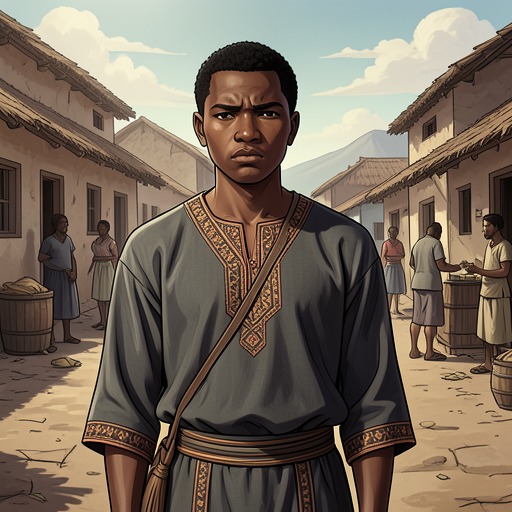
A retrospective narrator remembers Thobela as a fourteen-year-old in 1976, when the violence of the Soweto uprising could be felt in the valley’s small, secluded hamlet. Spring carried an expectation that change was coming. Thobela is recalled as a natural athlete and a brooding, handsome loner, with a bearing that seemed princely. The narrator links that impression to his family background and to his presence, rather than to any later achievement: at this point, he is still a boy whose future appears open.
In late September, the narrator witnesses Thobela fight Mtetwa, a large, mean boy two years older than he is, on a narrow patch of river sand at a bend in the Kat River. Thobela takes hard punches but continues forward, calm, quick, and agile. What stays with the observer is not simply his physical skill, but his detachment, as if the fight were a test of himself and of an inner conviction. The riverbank scene makes the valley a place where his capacity for violence first becomes visible, without reducing him to it: the fight is recalled as a moment of self-measurement, not as a declaration of the man he must become.
Three years later, Thobela is gone. Whispers in the valley say that he has joined The Struggle and gone to the front as a carrier of the Spear of the Nation. The remembered departure turns the local landscape into the starting point of an absence: the community can report that he has left, but does not see the life that follows. Years afterward, when his name is heard on the radio as that of a motorcycle-riding fugitive and common labourer, the narrator sets that public image against the boy remembered beside the river. The question is not answered by the valley, but the contrast makes the loss legible: the boy once imagined as a future leader has taken a path that has carried him far from the promise others saw in him.
The Valley as a Place of Memory and Research
Kat River Valley also connects the novel’s remembered landscape to the research and travel behind its road narrative. Acknowledgments explain that a grant made it possible to take a GS along many of the routes described in Heart of the Hunter, to tour the valley by motorcycle, and to conduct research in Grahamstown. The valley is thus encountered both through the story’s retrospective memories and through the practical journey undertaken to research its routes and region. These are distinct forms of attention: one follows a character’s childhood and departure; the other traces roads and gathers material for the book.
The novel’s return to the valley is consequently not a return by Thobela himself, but a return in narration. Its riverbank preserves an image of him before the years of fighting and flight, while the family story places that image within a history already divided between peacemaking and resistance. When the narrator later hears of the fugitive, the gap between that remembered boy and the man reported on the radio gives Kat River Valley its lasting narrative significance: it is the ground from which Thobela’s story departs, and the place from which his change can still be measured.