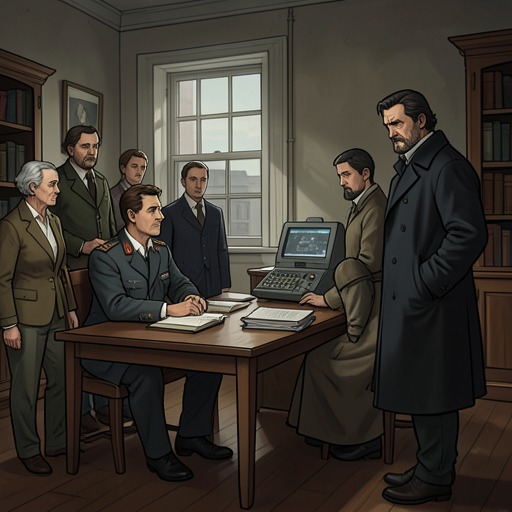
Kleintjes’s hard disk
Heart of the HunterKleintjes’s hard disk turns an immense and compromised intelligence archive into a single, portable stake. Its contents are never disclosed, and its location remains unconfirmed in the official account, but the struggle over it links Johnny Kleintjes’s archival work to Monica Kleintjes’s appeal for help, Thobela Mpayipheli’s flight, and a contest among intelligence operatives over who will control the evidence.
Origin in a troubled archive
The disk’s significance derives from the records environment in which it was reportedly created. After the elections, South Africa’s intelligence services had to consolidate records held across rival branches and institutions, including the apartheid state’s agencies and systems associated with the African National Congress in Lusaka and London. The scale described is formidable: an estimated four or five hundred gigabytes, spanning personal information, weapons systems, informants, and double agents. Johnny was put in charge of combining the computer records into a uniform central database, a project that required him to remove material considered dangerous and preserve what was useful.
That consolidation was not a neutral process of simply gathering files. Records were being selected, deleted, and made accessible through systems whose custodians distrusted one another. In a later account of the work, a team member explains that some employees could not shed habits of secrecy and that operational records disappeared when individuals feared what the records might show. Johnny responded by making backups; when a backup tape itself went missing, he began taking work home. The official report later treats the sought-after disk as possibly containing information he had secretly retained during the 1994 integration. The connection is therefore strongly suggested, but the evidence does not inventory the disk or establish exactly which files it holds.
The novel places that history against the vulnerability of electronic records. Digital information is easy to copy and distribute, and any connected database may be penetrated. One response within the intelligence system is to convert information into a single controlled paper copy, transcribed by typists and stored with restricted access. The hard disk belongs to the opposite condition: a concentrated electronic store that can travel beyond institutional custody, attract rival claims, and remain difficult to verify. The contrast makes the archive’s security procedures part of the object’s meaning, not merely its background.
From private backup to target
The hard disk becomes the object of a violent intelligence operation after Johnny is killed in Lusaka. The official account suspects that the unknown operatives were after information he had allegedly kept from the integration process, rather than fabricated material associated with him. It reports that, after the killings of Len Fortenso and Peter Blum, those operatives blackmailed Johnny’s daughter in Cape Town and demanded that she bring a particular disk to Lusaka. Monica, who is physically disabled, asks Thobela, her father’s former friend and colleague, to carry it for her.
This chain of requests transforms the disk from a possible record of institutional wrongdoing into a practical obligation between people. Thobela’s stated reason for accepting the task is his debt of honour to Johnny: he believes he can refuse, but insists that paying the debt is the right choice. The disk’s movement is thus not simply an intelligence transfer. It is carried within a relationship of loyalty, while Monica’s effort to retrieve and deliver it is bound to the danger facing her father. The evidence does not establish that Thobela knows the disk’s contents; its importance to him lies in the promise and responsibility attached to it.
Pursuit and competing claims
The official theory gives the disk a second, conflicting destination. A Presidential Intelligence Unit member is believed to have been waiting near the Zambian border to intercept Thobela and the disk, possibly to prevent it from falling into the unit’s hands. The same report reasons that the original data might reveal a Muslim mole within the South African intelligence community. This remains a hypothesis rather than a confirmed finding: the source of the operation’s leak is unexplained, and the report itself allows for a leak inside the intelligence unit.
Efforts to seize the disk do not resolve the uncertainty. After receiving a tip from Inkululeko, two agents from the London office travel to northern Botswana, make contact with the ambushing unit member, and witness Botswana authorities arrest him. They wait through the night but fail to intercept either Thobela or the disk. Later, Inkululeko gives them the address where Thobela is recovering and allows them three hours before the Reaction Unit is expected to arrive. This disclosure helps the agents reach him, but the account does not say that they obtain the disk there. Across these episodes, reports of its intended route and the capture of one would-be interceptor create no reliable chain of custody.
The unresolved handover
The disk’s status becomes part of the negotiation over Pakamile. Janina Mentz asks where it is; Thobela answers that it is safe and asks where the child is. Mentz says Pakamile is in a car behind them and makes the child’s return conditional on giving the disk to Tiger Mazibuko. The exchange establishes the disk’s immediate leverage in the confrontation, but it does not show Thobela handing it over to Tiger or identify who possesses it at that moment.
At the Waterfront, a further threat makes the stakes explicit: unless Pakamile is waiting in the underground parking lot at eleven the next morning, a copy of the disk will be sent to every newspaper in the country. Yet the later message is carefully qualified. A driver says the disk is safe, not in the speaker’s possession, and believed to be absolutely secure; a street hawker agrees to pass that assurance on. The message offers reassurance without revealing the custodian, location, or contents. Accordingly, the official report’s statement that the disk is still missing is not conclusively overturned by the closing relay. The object has been declared secure by an intermediary, but its custody remains outside the account’s view.
The disk’s unresolved whereabouts give physical form to the book’s larger concern with records that are simultaneously preserved, erased, hidden, and contested. Its reported contents could expose past intelligence activity and perhaps identify a mole, but the archive itself has already been shaped by deletion, secrecy, and institutional rivalry. The promised public release threatens to move that knowledge beyond official control; the final assurance, by contrast, leaves control opaque. The hard disk matters not because the reader is shown what it contains, but because no participant can settle who may possess, suppress, or disclose it.