Koos Kok
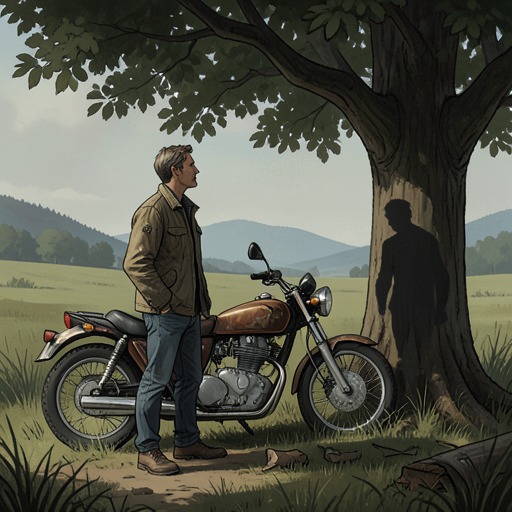
Heart of the HunterKoos Kok is a Griqua singer, storyteller, and roadside host who intervenes in Thobela Mpayipheli’s flight after recognizing the hunted motorcyclist from radio reports. His dilapidated Chevrolet El Camino becomes temporary shelter and transport for Mpayipheli and the BMW R 1150 GS; his help is improvised, personal, and consequential. Koos brings comic abundance to a pursuit defined by danger, but his part in it also turns on a serious question of agency: whether a person will remain a victim or choose another course.
Identity and Self-Presentation
Koos first appears at a cottage as a man in a tattered suit, anonymous grey shirt, and a bowtie so faded that it might once have been red. He holds his hands protectively in front of him and speaks softly, introducing himself as a man of peace. The contrast between his reassuring manner and Mpayipheli’s readiness for danger makes their meeting a threshold moment: Koos is not an armed pursuer, but neither man yet knows what the other intends.
Koos describes the cottage as his winter house. He says he came because he was lonely, and explains that he travels in summer, then returns in winter to make a fire and write songs. His life is tied to movement and temporary shelter rather than a fixed domestic setting. That pattern later gives his offer of help a practical dimension: the cottage and the road are both places he knows how to inhabit.
The Troubadour’s Story
Once he and Mpayipheli are seated together, Koos takes over the conversation. He has unloaded two chairs from his van, and they eat bread and tinned pilchards in chilli tomato sauce while drinking cheap brandy from enamel mugs. The meal is plain and the surroundings makeshift, but the shared table briefly replaces the isolated encounter at the cottage door with companionship.
Koos introduces himself as a great Griqua troubadour, a guitarist and entertainer for the town-dwellers who attend dance halls. His songs and verses concern the landscape and its people. He boasts that David Kramer overlooked him, then fills out his self-portrait with a tumble of claims about his birth, schooling, music, and appetite for life. The performance is so linguistically and personally expansive that Mpayipheli has to stop him: he cannot understand what Koos is saying. Koos answers that he can speak Dutchman Afrikaans, and his story then emerges in more conventional language before he slips back into his people’s tongue and has to be asked for translation. His shifting speech is part of the scene’s characterization: Koos tells his life in the voice and language that suit him, not in a form that guarantees immediate understanding.
His account ranges beyond music. He says he spends the winter writing songs and, when the mood takes him, goes to Beaufort West to spend time with women. The same self-absorbed talk that makes him comic also makes him vivid: Koos offers no restrained, official version of himself, but a wandering self-portrait crowded with appetites, boasts, and local knowledge.
Choosing to Help
Koos has heard radio coverage of the Xhosa biker on the run, including a broadcast by John Modise. When he sees the motorcycle behind his winter quarters, he recognizes Mpayipheli. He interprets the coincidence as divine guidance and decides he will not simply look on. Mpayipheli asks whether Koos is really going to help him; Koos replies that he has a plan, though the plan is not explained in detail at that point. His intervention is therefore grounded in a concrete sequence—he hears the reports, sees the bike, and acts—rather than in any prior connection between the two men.
Koos’s help changes the immediate conditions of Mpayipheli’s escape. The BMW R 1150 GS is laid on its side in the back of the Chevrolet El Camino, its baggage cases removed. Mpayipheli lies beside it on an old mattress beneath a dirty, paint-flecked tarpaulin, among rickety furniture and four suitcases filled with clothes and documents. A carton of stolen mutton travels with them; Koos jokes that it is a contribution toward the redistribution of wealth. The vehicle’s shock absorbers are gone, and the dirt road jolts the cramped hiding place, but the mattress makes the ride bearable. The comic cargo and uncomfortable concealment do not lessen the danger; they show how much of the escape depends on improvised transport and Koos’s willingness to carry both man and machine.
The Road and Its Counsel
The journey tests Mpayipheli’s patience. His legs cramp, his shoulder throbs, and the nest beneath the tarpaulin becomes too small, hot, and dusty. The monotonous drone of the van and a succession of turns make it seem that the destination is always just beyond reach. When Koos finally stops and lifts the covering with theatrical flourish, the midday sun blinds Mpayipheli before his eyes adjust to a landscape of grass veld, hills, and a distant town. Koos identifies it as Philipstown. His showmanship turns a practical pause into an entrance, but it also gives Mpayipheli the air and view he has been longing for.
Koos’s most direct counsel comes in a short exchange: “You have two choices in life, Xhosa. You can be a victim. Or not.” Mpayipheli answers only, “Oh.” Koos says he will understand one day. The statement is not developed into a lecture or a detailed account of Koos’s own past; its force lies in its blunt opposition between being acted upon and choosing not to accept that role. In the immediate story, Koos has already made that distinction practical by refusing passivity when he recognizes a fugitive in need.
Narrative Role
Koos is an ally, but not a conventional handler or strategist. He brings Mpayipheli shelter, food, a hidden place in the van, and onward transport; the evidence of his assistance is material, from the mattress under the tarpaulin to the jolting dirt-road journey. His flamboyant talk and theatrical gestures set a lighter rhythm against the pursuit, while his presence makes the fugitive’s progress depend on an ordinary person’s decision to intervene.
The journey also creates space for Mpayipheli to register his own restraint. Recalling the moment when Koos opened the cottage door, he feels satisfaction at having suppressed an almost irresistible impulse and chosen reason over instinct. He wants to tell Miriam that he is all right and imagines the stories he might someday tell Pakamile about Koos Kok. As the van turns toward Loxton, he remembers Otto Müller’s explanation of protean behaviour: an animal survives pursuit by moving unpredictably rather than in a straight line. Koos’s shifting speech, mobile life, and unorthodox route resonate with that image without making him a literal embodiment of the theory. He is, more simply, the unexpected companion whose help carries Mpayipheli onward while leaving the larger danger unresolved.