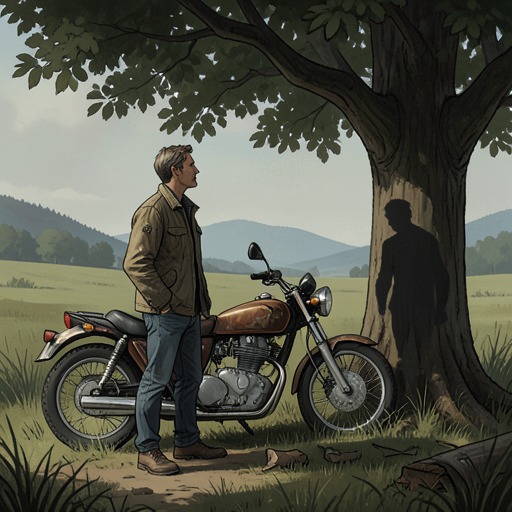
Koos Kok helps Mpayipheli evade the manhunt
Heart of the HunterKoos Kok helps Thobela Mpayipheli evade the manhunt not with weapons or speed, but with an old Chevrolet El Camino, an improvised disguise, and a willingness to take a fugitive into his care. The escape briefly turns the pursuit’s terms upside down: Thobela, exposed on a powerful BMW R 1150 GS, becomes cargo beneath a tarpaulin, while Koos’s inconspicuous bakkie carries both man and motorcycle past police. The episode also tests Thobela’s self-control, making the chance to get away inseparable from his decision not to kill a stranger at the door.
From the road to Koos’s door
Before Koos enters the journey, Thobela is still learning how to manage the BMW R 1150 GS he has taken to flee Cape Town. Its power nearly throws him as he turns onto Oswald Pirow; at the N1 traffic lights he nearly tips again when the anti-lock brakes engage. He proceeds cautiously, startled by the bike’s size and by reaching 100 kilometres per hour before properly getting into third gear. The open road offers mobility, but it also leaves him visible and vulnerable.
That vulnerability sharpens when two helicopters follow him at low altitude. Thobela pushes the GS beyond 200 kilometres per hour, but speed cannot make him faster than the aircraft. He passes traffic in worsening weather, then enters a dense curtain of rain, slowing because he cannot see clearly. When the helicopter noise fades, the storm has provided an escape the motorcycle alone could not. Elsewhere on the journey, fuel and distance remain pressing calculations: beyond Touws River he plans to refuel at Laingsburg, considers the long stretch to Beaufort West through the Great Karoo, and weighs whether he can reach Bloemfontein before sunrise. His route is a sequence of practical limits, not a clean line to safety.
Koos recognizes the fugitive
Koos’s help begins with recognition. He has heard radio coverage of the wanted biker and later listened to John Modise; when he sees the motorcycle near his winter quarters, he understands who has arrived. He interprets the encounter as divine guidance and decides to help rather than stand aside. His choice is striking because he is not introduced as an intelligence operative or armed ally, but as a local entertainer known for songs about the landscape and its people.
The meeting nevertheless carries immediate danger. In a shallow, fitful sleep, Thobela hears a car door slam and rolls off the mattress toward the wall beneath a window. When a man comes inside, Thobela is poised for violence. Koos appears in a tattered suit, a grey shirt, and a bowtie faded from what may once have been red, his hands raised protectively. Thobela later recognizes the encounter as a test of self-control: he had felt an almost irresistible impulse, but suppressed it. The importance of Koos’s arrival therefore lies not only in the shelter he offers, but in the choice Thobela makes at the threshold.
Koos’s account of himself is exuberant and digressive. He calls himself the Troubadour of the Northern Cape, a singer who performs for town audiences and writes songs at his winter home. His talk moves between conventional language and the language of his people, requiring Thobela to ask for translation. This distinctive, socially marginal figure becomes an unlikely guide through the pursuit: his local knowledge and his readiness to act matter more than any official authority.
The El Camino as concealment
Koos’s plan transforms the means of escape. Thobela lies on an old mattress in the back of the Chevrolet El Camino beside the BMW, which has been laid on its side with its baggage cases removed. Around them are rickety furniture, four tatty suitcases filled with clothes and documents, and a carton of stolen mutton. A dirty, paint-flecked canvas covers the load. The vehicle’s worn shock absorbers make the dirt road rough, but the mattress makes the cramped space bearable; rain taps and drips through holes in the tarp.
The arrangement is both practical concealment and a reversal of Thobela’s earlier exposure on the road. The motorcycle that had announced his presence through speed and engine noise is hidden among the ordinary disorder of a working vehicle. Koos’s joke about the mutton as redistribution of wealth gives the cargo a comic cover, but the stakes underneath it remain severe: Thobela is carrying the hard disk toward Lusaka, and every delay reduces the time available for a journey involving several borders. His passport is in his bag, but the GS has no papers. He considers bribery and the possibility of finding or making a gap in a border fence; the Zambezi River presents a further obstacle. Koos’s ride buys movement, not certainty.
The police stop and the handoff
The disguise is tested when the El Camino stops and Thobela wakes to voices. A sergeant orders Koos to show what is under the canvas and asks how many sheep are in the back. Koos denies being in the sheep-stealing business any longer, but the officer accuses him of remaining a sheep thief. Thobela, concealed nearby, wonders how many men are present and whether he could act if discovered. The exchange makes the danger concrete: a single inspection could expose both fugitive and motorcycle.
The police do not find Thobela. When one man asks about the short figure with the motorbike, another tells Koos to leave before he gets into trouble, saying they have more important things to do. Koos answers that he is going to drop off the motorcycle, climbs back into the bakkie, and drives away with spinning tyres. The escape does not defeat the manhunt outright; it passes through a moment of official scrutiny because the officers turn their attention elsewhere and Koos keeps the encounter moving.
After hours beneath the tarp, Thobela is cramped, hot, dusty, and increasingly impatient. Koos finally stops and theatrically lifts the canvas, revealing a different landscape: grass veld, hills, and a town in the distance. He identifies it as Philipstown. Thobela thanks him, then puts his bag in the BMW’s side case, pulls on his gloves, and starts the engine. After a brief hesitation, the GS catches. Thobela rides away through the gears, now comfortable in the machine and back in control, while Koos and the El Camino recede behind him.
Significance within the escape
The episode makes evasion a matter of changing forms of movement. The GS gives Thobela speed but leaves him exposed; the storm interrupts the helicopters’ pursuit; Koos’s bakkie conceals him by making him part of an unremarkable, cluttered load. The sequence recalls the idea of protean behaviour that Thobela learned from Otto Müller: survival depends on not moving in a predictable, straight line. Here, adaptation is literal, from rider to hidden passenger and back to rider.
Koos’s assistance also creates a pause in Thobela’s cycle of violent response. At the door he has the impulse to attack, yet chooses restraint; later he remembers that decision with satisfaction and imagines telling Miriam about it, as well as having stories to tell Pakamile. The ride does not resolve the dangers ahead, but it carries Thobela beyond one exposed stretch of the pursuit and gives his self-command a consequence: an ally lives, and the journey continues.