Mayibuye
Heart of the HunterMayibuye is a Xhosa cry spoken at moments when Thobela Mpayipheli’s personal history and the struggle that shaped him converge. First heard as his uncle Senzeni’s farewell when the seventeen-year-old leaves home, it returns decades later in a knife confrontation, carrying the weight of a remembered initiation into war and a life irrevocably changed.
A farewell carried into the present
Thobela remembers travelling with Senzeni by car through Queenstown, East London, and Umtata as they talked about the long road ahead. Senzeni repeatedly tells him that joining the struggle is his right and privilege, that the ancestors would smile on him, and that the revolution would sweep away injustice. When Thobela boards a bus at Umtata, Senzeni hugs him hard, tears in his eyes, and says Mayibuye. It is the last time Thobela sees his uncle. Years later, Thobela can remember the fervour of that departure but can no longer recover its fire: the zeal that once burned in him has become cold ash. The farewell therefore marks both a beginning and a loss, preserving the fervour of the young man he was while measuring the distance he has travelled from it.
The cry in combat
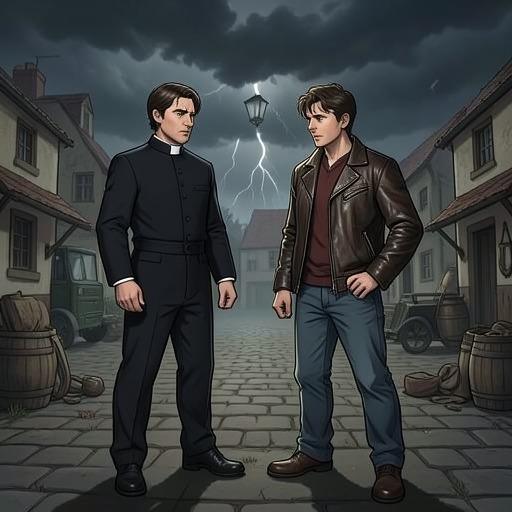
In a deserted university quarter of Paris, Mayibuye accompanies Thobela’s confrontation with Marion Dorffling. After the American falls and rises ready to fight, Thobela reaches for the short-handled assegai at his back and speaks the word softly. Dorffling answers with a racist insult; Thobela identifies the language as Xhosa, the click of his tongue echoing in the alley. The encounter becomes a measured, tightening dance before Thobela moves with sudden speed, drives the blade through Dorffling’s breastbone, and holds him close as he dies. The ex-Marine then attempts to say Umzingeli. In this scene, the cry belongs not to a speech about the struggle but to the instant before a lethal act: a remnant of Thobela’s past brought into the intimate space of combat.
The word returns in the later armed standoff at the house where Allison is present. Van Heerden throws Thobela the assegai Allison had bought for him; Thobela catches it as his opponent lowers his head and moves a broad-bladed knife. He says Umzingeli, then, more softly, Mayibuye. The opponent’s demand to know what language he is speaking repeats the earlier exchange, and Thobela again answers, Xhosa. Allison sees the light from the kitchen fall across his face and cannot forget its strange illumination. The repeated sequence—weapon caught, hunter named, farewell cry spoken, language challenged and identified—makes Mayibuye a ritual threshold between remembered political formation and present danger, while the returned gift ties that danger to Allison’s earlier act of care.
The threshold between two lives
The farewell is followed by a journey whose scale gives the word its lasting force. At seventeen, Thobela travels by bus from Umtata toward Durban and Empangeni, with insecurity rising as the road ahead becomes real. By dawn, fear has given way to bravado. At Pongola he feels ready; the next night he is smuggled across the border into Swaziland, and the following night into Mozambique. The change is described as irrevocable: Senzeni’s parting cry stands at the threshold of a life that will carry Thobela from a boy leaving home into the trained fighter who later speaks the same word before killing.
The distance between those moments is also a change in what the cry can accompany. In the remembered farewell, it belongs to a young man entering the struggle with belief in a coming revolution; in Paris, it is spoken by a forty-year-old whose former zeal has faded, while he uses skills learned from East Germans. The word persists even as the conviction surrounding it alters. Its recurrence links the beginning of Thobela’s political formation to the later violence of his life, without making those two moments identical: the first opens a road into danger, while the later utterance comes at the edge of a killing.
Sound, recognition, and return
The novel gives Mayibuye force through its delivery and recurrence rather than through an explanation of its meaning. In Paris it is spoken softly, followed by the sharp click of Thobela’s tongue against the alley walls; at the house, the same word comes after the deeper growl of Umzingeli and falls softer still. In both confrontations, an opponent challenges the language, and Thobela identifies it as Xhosa. The exchange makes the word audible as an assertion of identity at the point when violence threatens to define him by something else.
Its return also changes the scale of the remembered farewell. Senzeni’s parting word accompanies a young man’s departure; decades later, Thobela speaks it alone, on the brink of killing or being killed. The repeated sound does not erase that difference or restore the conviction he has lost. Instead, it holds the two moments together: a word first carried away from home resurfaces in danger, where recognition of its language remains even as the life around it has changed.