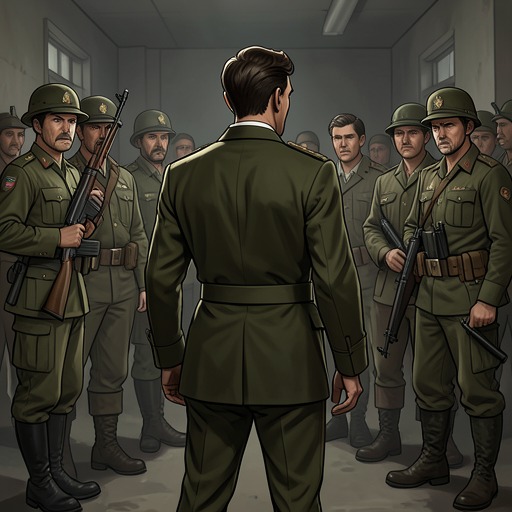
Mazibuko assaults a paratrooper officer at Tempe
Heart of the HunterAt Tempe, Captain Tiger Mazibuko assaults a paratrooper officer in retaliation for the officer’s treatment of Little Joe Moroka. The confrontation begins with a dog used against one of Mazibuko’s men and ends with the officer on the ground, a deadened disciplinary exchange, and Mazibuko preparing Team Alpha for an intelligence task. The episode makes loyalty to his unit both the stated ground for his violence and a means of asserting the Reaction Unit’s standing.
Setting and Immediate Cause
Mazibuko approaches the Parachute Battalion parade ground with Little Joe Moroka one step behind him. Four paratroopers are gathered beneath a thorn tree, talking rugby; their lieutenant holds forth while a German Shepherd rests nearby. In this ordinary military setting, Mazibuko’s arrival abruptly changes the terms of the gathering. He asks whether the lieutenant is the man he has been brought to see, then moves directly into the group.
The grievance concerns an earlier encounter. The lieutenant had objected that Little Joe failed to salute and had set the dog on him. The dog bit Little Joe’s trousers, but he was not physically hurt. Mazibuko’s later recollection makes clear that he regards the humiliation itself as an injury: Little Joe was embarrassed, and Mazibuko sees that as an injustice to his subordinate and, by extension, to the unit. He also describes Little Joe as someone who does not always register what is happening around him, rather than someone deliberately challenging the lieutenant’s authority.
The Assault at the Parade Ground
Mazibuko kicks the dog, prompting the lieutenant to protest and lash out at him. Mazibuko immediately presents the officer’s blow as a public fact: the soldiers present, he says, are witnesses that the lieutenant struck first. The exchange gives Mazibuko an audience as well as an adversary. He then attacks the lieutenant with a sequence of controlled blows and kicks, stopping briefly to identify the earlier incident and point out Little Joe as the person the officer had wronged.
The officer tries to explain that Little Joe had not saluted. Mazibuko rejects that as an answer, asking whether the failure to salute justified setting the dog on him. When the officer raises his hands, Mazibuko grabs his collar and strikes him again. Around them, the other paratroopers react: one tends to the dog while others move toward their injured colleague. The episode thus places the immediate violence before witnesses from both units, while Mazibuko frames it as a response to an earlier abuse of authority.
Unit Loyalty and the Use of Force
Mazibuko’s later account adds the reasoning that the scene itself leaves partly implicit. He considers the lieutenant’s conduct a serious military breach, but he has not chosen to pursue the matter through official channels. His stated concern is that allowing the incident to pass through ordinary procedures would encourage others to take chances with the Reaction Unit. He therefore treats the assault as a demonstration: the unit’s members are not to be humiliated or treated as expendable, and Mazibuko will personally enforce that boundary.
That logic makes the event more than a private quarrel between two officers. Mazibuko identifies the officer’s first strike as the point that allows him to call the paratroopers witnesses, but his own actions have already escalated the confrontation by attacking the dog. His appeal to witnesses and his insistence on the grievance do not erase that choice; they show how he turns a retaliatory assault into a claim about who may discipline or threaten his men. His declaration that nobody can mistreat his people condenses his personal code into a public warning.
Aftermath and Narrative Significance
The confrontation does not conclude with a formal resolution between the units. A sergeant stays with the fallen lieutenant, while Mazibuko’s phone begins to ring. Later, after ending a call with Janina Mentz, Mazibuko orders Team Alpha to open equipment cases and prepare weapons, protective gear, smoke grenades, and night sights. He tells the team to paint their faces, but gives them no explanation at that moment. The sequence shifts from a visible act of retaliation to operational preparation, connecting Mazibuko’s forceful command style with the work that awaits his unit.
When the paratroopers seek disciplinary action, Mazibuko challenges them to discipline him. He knows, however, that the Reaction Unit is difficult to touch, and the response he receives is that he must first earn his keep. That reply does not settle the question of his conduct; it redirects him toward the task Mentz is about to give him. The assault therefore establishes both his allegiance to Little Joe and the institutional leverage behind his confidence. It presents protection of one’s own as a real bond, but also shows how that bond can become a rationale for bypassing procedure and using force to make a point.