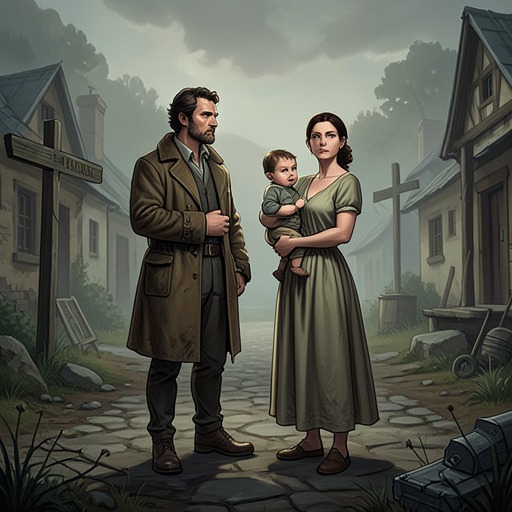
Miriam Nzululwazi’s detention
Heart of the HunterMiriam Nzululwazi’s detention turns the pursuit of Thobela Mpayipheli into a new confinement for the person closest to him. Held in an interrogation room, Miriam is not presented as a suspect with a disclosed case against her but as a partner whose connection to Thobela makes her useful to the authorities. The detention also reopens an earlier wound: the terror of being locked up as a teenager returns with force, while her present concern is that her child is waiting for her and her work may be lost. Her pleas expose the human cost of an operation whose decisions are made elsewhere and whose consequences reach into ordinary obligations of care.
Identity and circumstances
The narrative identifies Miriam as Thobela’s common-law wife. When Janina Mentz observes her in the interrogation room, she sees a woman marked by enduring unhappiness, a description that introduces Miriam through the visible traces of distress rather than through any claim to criminality. Her relationship to Thobela is the reason the authorities focus on her; the scene gives no indication that she has committed an offence.
Miriam’s immediate life is organized around work and motherhood. She repeatedly explains that she must return to her child, Pakamile, and fears losing her job because she has been taken away without warning. Her questions about whether the bank will think her a criminal and whether anyone will explain her absence show how detention threatens not only her freedom but also the routine supports on which she depends. The authorities’ failure to tell her when she will be released leaves her unable to manage either responsibility.
An older confinement returns
The interrogation room revives a memory from fifteen years earlier, when Miriam was seventeen. On her way home to the crowded settlement of Khayalitsha, carrying her week’s wages in her handbag, she was swept into a demonstration near the Parade. The protest concerned pay in the clothing industry; the crowd’s noise and movement gave way to tear gas, a police charge, and water cannon. Miriam was pushed into a yellow lorry and taken with others to the cells.
The remembered cell was dangerously overcrowded. One woman screamed that she needed to reach her sick child, while a red-faced policeman raised his truncheon and struck into the crowd. Miriam tried to push through the other women toward the bars; a hand pulled her back, and the screaming abruptly stopped. The scene is recalled not as a distant episode but as a fear that has carried into the present. In the locked, closed room, Miriam again feels the panic of being confined without reason or guilt. The earlier woman’s desperate need to reach a child also echoes Miriam’s own present urgency, making the memory more than background: it supplies the emotional pattern through which she experiences this detention.
Appeals and the decision to hold her
Janina tries to persuade Miriam that the authorities want to help Thobela and deliberately uses his first name. Miriam answers that Janina cannot keep her there. Later, Vincent Radebe finds her standing beside the one-way mirror, frowning, and she asks in Xhosa when she can go home. Radebe speaks gently and says he understands what happened, but Miriam turns away. When he says he is on her side and asks what would convince her, she gives a concrete answer: release her. She says she is not a criminal, has done nothing to anyone, must care for her child, and will lose her job if she remains detained. Radebe promises she will not lose it, but his reassurance does not resolve the central question of when she can leave.
The detention becomes more explicit when Radebe reports to Janina that he has realized they cannot let Miriam go and proposes bringing in a camp bed. Janina acknowledges that the decision was difficult, then organizes a night watch so the team can maintain a fresh shift in the morning. The contrast is stark: the operation is able to plan staffing and rest, while Miriam is left without a clear release time or control over her own night. Radebe waits until Janina has gone before returning to the interview room, aware that he must find words to tell Miriam what has been decided.
Separation and significance
When Radebe unlocks the door, Miriam springs up and says she has to go. She explains that Pakamile is waiting for her at day-care and that she is already late. Radebe replies that others will take care of him and tells her that keeping her there is safer. The explanation offers a security rationale, but it does not answer Miriam’s appeal on her child’s behalf. She weeps, sinks to her knees, and clutches Radebe’s leg, begging him as her brother to let her go. He insists that it is only for one night and says he will make sure the child is looked after; she continues to plead.
The scene makes the separation physical and immediate: a locked door stands between Miriam and the life she is trying to resume, while the people holding her decide that her absence is necessary for safety. Her earlier memory of a woman crying out for a sick child returns in altered form, now with Miriam herself pleading to reach Pakamile. The detention therefore binds the state’s pursuit of Thobela to an intimate cost borne by someone who is not shown as a participant in his actions. Its ending in the supplied account is not a release but the decision to keep Miriam overnight, leaving her fear, her employment, and her separation from her child unresolved.