Motorcyclists mobilize in support of Mpayipheli
Heart of the HunterMotorcyclists mobilize in support of Mpayipheli as his flight along South Africa’s highways becomes a public cause rather than a pursuit watched only by police and intelligence officers. A radio appeal and a rapidly circulating call for BMW riders to gather at Three Sisters turn the fugitive’s motorcycle into a point of solidarity. The response is not one organization acting under a single command: it spreads across rival marques and informal networks, then confronts military roadblocks whose officers must decide whether to let the riders pass.
From a reported sighting to a call for help
The mobilization becomes audible in a radio exchange involving the Pretoria Chapter of the Hell’s Angels. The presenters ask where Mpayipheli is and hear that he was near Three Sisters at six that morning; his present whereabouts are unknown. Asked why they want to know, a caller answers from the fellowship of riders: Mpayipheli is their brother, and he is in trouble. The exchange makes the first organizing principle personal rather than political. The Angels offer help because they understand the rider as belonging to a wider brotherhood.
That appeal does not establish that Mpayipheli is an Angel. A later radio discussion makes the distinction explicit: a speaker from the Pretoria BMW motorcycle club rejects the drug allegations being used to discredit him and says the BMW fraternity, not the Harley-riding Angels, should help because Mpayipheli rides a BMW. The remarks redirect the appeal from one club’s kinship claim to a broader network of motorcycle owners. They also place competing accounts of the fugitive’s character beside one another: official accusations are challenged on air, while the motorcycle he rides supplies a concrete basis for solidarity.
A message proposes that BMW owners across the country unite at Three Sisters, find Mpayipheli, and help him continue toward his destination. The plan is deliberately collective: riders are asked to assemble at a known point on his route, not simply to express support from afar. The call turns the geography of the manhunt into a possible corridor of assistance, though the evidence does not specify how the riders would guide him or what arrangements they would make once assembled.
Messages become numbers on the road
The proposed gathering acquires scale through messages monitored on the BMW motorcycle website. One post describes four riders leaving at 13:00 and arranging to meet in Kimberley. The detail gives the appeal a practical rhythm—departure time, group size, and rendezvous—rather than leaving it as a general declaration of sympathy. The posts multiply: an intelligence officer is told that twenty-two messages have appeared and that more than seventy bikers say they are on their way.
Those figures mark a shift from a broadcast exchange to a developing movement whose reach can be tracked by the authorities. They do not prove that every person who posted actually rode, or that all participants shared the same reasons for joining. What they do establish is that the appeal was being repeated and answered across distance, with Kimberley and Three Sisters anchoring the riders’ movement to the fugitive’s northbound route.
The Hell’s Angels form a conspicuous part of this response, but they do not exhaust it. BMW riders answer the call in their own name, while the broader rhetoric of brotherhood allows support to cross club boundaries. The contrast between Harleys and BMWs is not merely a matter of equipment: it becomes an argument over who has standing to help Mpayipheli. The competing claims converge on a practical purpose—getting riders onto the road—without turning the mobilization into a formally unified organization.
Roadblocks and decisions to let riders pass
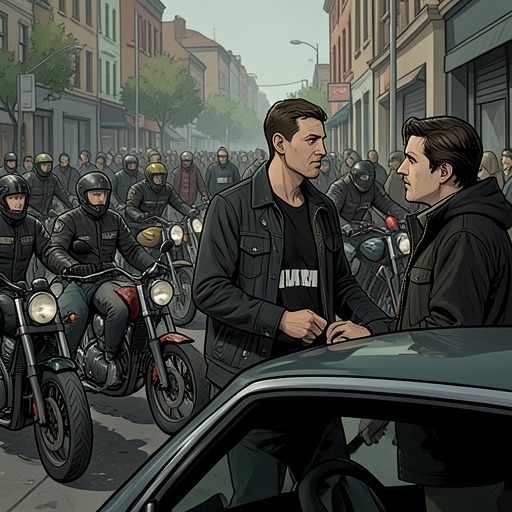
The movement meets armed authority at Windsorton Road, north of the N12. Officials are told that thirty-nine Hell’s Angels on motorcycles are waiting at the roadblock and want to pass. The number makes the question immediate: this is not an isolated rider seeking an exception but a sizeable group arriving together. The situation becomes more difficult when a further fifty riders are reported to be on the way, with the warning that stopping them could mean shooting them.
Tiger Mazibuko decides to let the Angels through. A colonel then gives the order over the radio for the sergeant to allow them passage. The exchange records a consequential choice under pressure: the armed authorities have the power to block the riders, but the prospect of a much larger crowd—and the danger of a violent confrontation—changes the decision. The bikers’ numbers therefore matter not only as evidence of support but as force exerted without a direct attack.
At another military checkpoint, a lieutenant reports that nineteen BMW riders have been stopped. One says he is a lawyer and will seek an urgent interdict if they are not allowed through. The lieutenant passes the decision up the chain of command, a move the narration identifies as a way for a soldier facing a difficult choice to cover himself. The riders wait in two-rider ranks, headlights on and engines idling, while soldiers watch with rifles over their shoulders.
The command asks whether any black riders are among the BMW group; the reply is that there are none. The lieutenant then receives the order to let them through. The sequence places a question about the riders’ racial composition inside the military decision, without explaining the question’s motive. It also shows that passage is not automatic: the riders’ presence prompts scrutiny, escalation through command, and a final authorization. The exchange makes the roadblock a point where the mobilization’s public and racial context enters the mechanics of movement.
A moving counterweight to the manhunt
The mobilization does not end the pursuit or guarantee Mpayipheli’s safe passage. Rather, it introduces another kind of pressure into a landscape already shaped by surveillance, checkpoints, and the threat of force. Information about his possible location travels by radio; calls to assemble circulate online; riders arrive at roadblocks in groups large enough to make the cost of stopping them a command-level concern. The response operates through mobility and visibility, not through evidence that the bikers possess official power or control over the route.
Its significance lies in the way a lone fugitive acquires a dispersed public constituency. The first claim is intimate—one rider is another’s brother—but the practical response expands beyond the Hell’s Angels to BMW owners and other motorcyclists. At the checkpoints, solidarity becomes something the authorities must physically accommodate. The motorcycles cannot erase the pursuit, yet their growing numbers complicate the assumption that every force on the road belongs to the state or that Mpayipheli travels entirely alone.