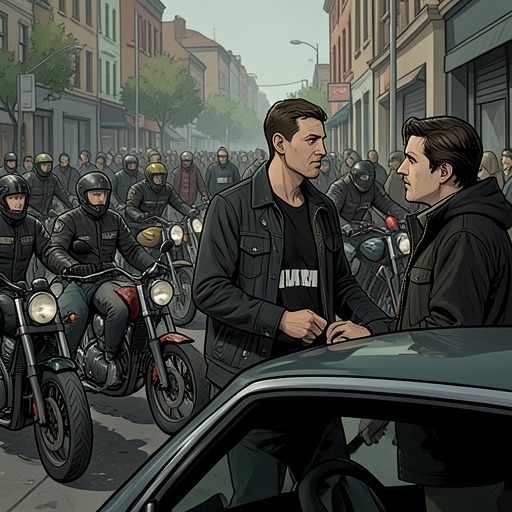
Motorcyclists ride north to support the fugitive
Heart of the HunterMotorcyclists ride north to support the fugitive as the manhunt for Thobela Mpayipheli turns his motorcycle into a point of connection as well as a means of escape. Riders who do not claim him as a club member nevertheless argue that he is one of their own in a broader sense. Their support becomes a practical complication for the authorities: at a roadblock, the growing group is large enough that stopping it may require lethal force, and Tiger Mazibuko decides to let it through as a diversion.
A fugitive’s route becomes public
Mpayipheli’s flight depends on the BMW R 1150 GS, a powerful, heavy motorcycle that he initially struggles to control. When he turns onto Oswald Pirow, the bike’s response nearly throws him off; at the N1 traffic lights, braking nearly tips it again. He proceeds cautiously, feeling his way through the gears, but the machine’s speed and ability to handle gravel roads eventually become essential to evading the roadblocks. The motorcycle thus provides a means of escape while also making him conspicuous: he is a black rider on a large BMW, an unusual sight that attracts attention even beyond the police pursuit.
By the time a radio conversation places Mpayipheli near Three Sisters at six that morning, no one can say where he is now. That uncertainty is central to the riders’ response. They are not reporting a confirmed location or describing a direct encounter; they are reacting to the knowledge that he has passed through the area and is in trouble. The route itself is dangerous and time-sensitive. Mpayipheli calculates the distance from Laingsburg to Beaufort West, then on to Bloemfontein, and knows that delays will cost him hours needed for the journey to Lusaka. Later, while hidden under a bridge, he worries that lost time will leave him facing at least two national borders without papers for the motorcycle. The riders’ mobilization unfolds against that same geography of distance, checkpoints, and uncertain passage.
Brotherhood without club membership
On air, a speaker associated with the Pretoria Chapter of the Hell’s Angels explains the proposed support in terms of brotherhood: riders regard Mpayipheli as a fellow motorcyclist in difficulty. The appeal does not depend on formal membership. A representative of the Pretoria BMW motorcycle club makes that distinction explicit: Mpayipheli is not a member of the club, but he rides a BMW, and the BMW fraternity can choose to help him. She questions whether the Hell’s Angels, riding Harleys, are suited to the Northern Cape’s gravel roads.
The competing claims reveal that the support is not a single, centrally coordinated club operation. The Hell’s Angels and the BMW riders each invoke a different basis for acting: a general kinship among bikers on one side, and an affinity with Mpayipheli’s particular motorcycle on the other. The BMW representative also rejects the idea that the Hell’s Angels can speak for all riders. Neither group claims to own Mpayipheli; the point is that neither has exclusive authority over who may help him. Solidarity here is asserted rather than bestowed by membership, and the differences between the groups remain visible even as both discussions make his escape a public concern.
Messages become a moving response
At the intelligence unit, Rajkumar shows Janina Mentz the BMW motorcycle website, where messages have been appearing throughout the afternoon. The scale is no longer merely rhetorical: the assistant reports twenty-two messages and more than seventy bikers saying they are on their way. Mentz says the number does not bother her, but the web activity makes the riders’ response legible to the people tracking the pursuit. A scattered group of sympathizers is becoming a movement whose intentions can be counted, monitored, and anticipated.
The messages do not establish that every rider reaches Mpayipheli or knows his current position. Indeed, the available information remains uncertain: he was last known to be near Three Sisters, and his location is anyone’s guess. That gap between sympathy and reliable intelligence matters. The riders can respond to his predicament without solving the authorities’ central problem of locating him, while their public declarations give the authorities another body of activity to watch. Their support therefore carries both practical possibility and operational exposure.
Windsorton Road and the decision to let them through
The mobilization becomes a direct issue at the Windsorton Road roadblock, forty-five kilometres north on the N12. Thirty-nine Hell’s Angels arrive on motorcycles and demand to come through; officials are told that another fifty are on the way. The prospect of stopping them is not a routine traffic matter. The warning is that, once the additional riders arrive, forcing the group back would mean shooting them.
Mazibuko reconsiders and orders that they be allowed through. His decision does not amount to joining their cause or confirming that they will reach Mpayipheli. Instead, he identifies the passage as a diversion, explaining that a group of frustrated soldiers can be distracted by it. The riders’ presence changes the tactical situation: the roadblock now has to account for a large, organized civilian group as well as the fugitive it is meant to intercept. Letting the bikers pass avoids the immediate prospect of a lethal confrontation and gives Mazibuko an opportunity to redirect attention.
The episode sets two forms of movement against one another. Mpayipheli uses the BMW R 1150 GS and gravel roads to slip past roadblocks; the riders arrive openly, in numbers, and insist on passage together. Their collective visibility is the opposite of his evasive mobility, but it can still interfere with the machinery of pursuit. The book does not establish that they rescue him or bring the journey to an end. Their significance lies in making support tangible: a fugitive whose whereabouts remain uncertain is no longer only an object of state surveillance, but also the focus of a public, mobile claim of fellowship.