Mpayipheli decides in hospital to end his life of violence
Heart of the HunterMpayipheli’s decision to end his life of violence begins not with a plan or a declaration, but with a pause in a hospital doorway. Still recovering from an ordeal shared with Zatopek van Heerden, he sees a black Xhosa doctor caring for a young white boy and is struck by the distance between that scene and the life he has lived. The encounter revives his childhood wish to make people better; after years shaped by conflict, he recognizes that he might still choose a different purpose, even though he cannot undo what he has done.
The hospital encounter
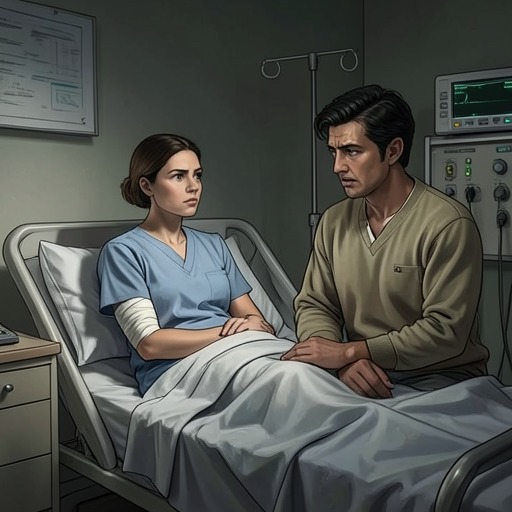
Mpayipheli later remembers that he and Van Heerden were in hospital when the change began. One evening, shuffling down a passage while his body remained broken from what they had been through, he stopped in a doorway simply to catch his breath. He looked into a four-bed ward. Beside a young white boy’s bed stood a doctor who was black, Xhosa, about Mpayipheli’s height and roughly forty years old, with grey beginning at his temples. Mpayipheli had not gone looking for a revelation; the moment came upon him during an ordinary pause.
The doctor’s presence returned him to a question his father had once asked about what he would become. At eight, Mpayipheli had answered that he wanted to be a doctor, and when asked why, he had said, “Because I want to make people better.” That aspiration had taken shape after a fever: a white doctor had come from Alice, spoken Xhosa to him, and promised that he would be made well. Mpayipheli remembered recovering and understanding himself as someone who wanted to heal, a maker of miracles. The adult doctor in the ward did not merely resemble that remembered future; his care for the boy made the old purpose visible again.
Recognition and grief
Watching the doctor and child, Mpayipheli relived the conversation with his father and felt the weight of the years he believed had been lost. The scene let him see his life from another angle, including the possibility of choices he had not made. That recognition did not erase his past. Instead, it brought the accumulated consequences of hatred, violence, and death into view, along with his consuming wish to be free of them. His response was physical and emotional: he sank against the wall, went down to his knees, and sobbed as memories opened up before him.
The passage makes the change a reckoning rather than a clean escape. Mpayipheli longs to be born again without the burden of what has happened, but the possibility he reaches is not literal erasure. He cannot blot out who he has been or reverse the harm. What becomes available to him is the narrower, harder power to decide where and how he will go next. The recalled childhood wish gives that choice a direction: away from destruction and toward making and sustaining life.
Care and the decision
The doctor notices Mpayipheli’s distress, places a hand on his shoulder, and holds him while he calms. He helps Mpayipheli up, supports him, lays him on his bed, and pulls the sheets up to his chin. The doctor’s care echoes the reassurance Mpayipheli remembers from his childhood illness: he is sick, but someone will help make him better. The scene therefore joins two moments across his life—not by promising that the adult’s past can be cured, but by placing care beside his vulnerability and showing that he can accept support.
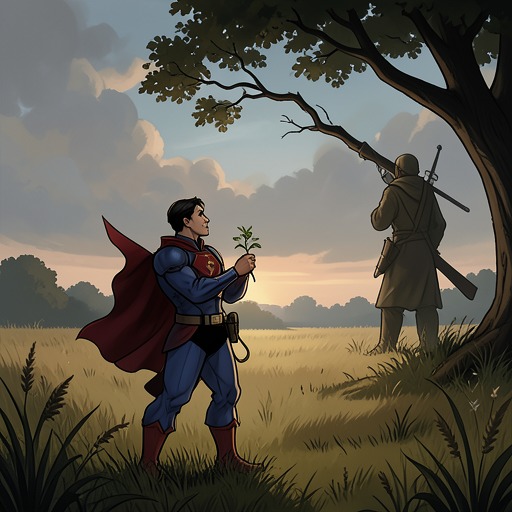
Mpayipheli sleeps, wakes, and continues an inward struggle against self-justification and rationalization. From the deaths he has witnessed and the violence in which he has participated comes a desire to become a farmer, a nurturer. The choice is explicitly difficult: he understands it as a step-by-step task lasting a lifetime, not as instant absolution. That night he eats a full plate of food and thinks through the night. Before six the next morning, he goes to Van Heerden’s room, wakes him, and says he is finished. When Van Heerden appears to underestimate his ability to change, Mpayipheli asks, “You don’t believe I can change?” His question turns the decision into a commitment he must defend, first to his friend and then through the life ahead.
Significance and aftermath
Van Heerden already knows what Mpayipheli has discovered, a knowledge connected in the narrative to what happened the previous night under a bridge in the Free State. The hospital episode is thus both a private recognition and the point at which that recognition is spoken aloud to someone who understands its seriousness. The passage does not present Van Heerden as granting Mpayipheli permission to change; rather, the exchange makes clear that Mpayipheli must claim the possibility for himself.
The encounter gives the decision its moral shape. Mpayipheli cannot recover the doctor he once hoped to become, nor cancel the violence that has marked his life. He can, however, refuse to treat that history as the only possible ending. The ward’s doctor and child recall an earlier act of healing; the adult Mpayipheli’s response is to choose, with full awareness of the past, the work of nurturing rather than continuing violence. His hospital decision is therefore a beginning, not a declaration that the struggle is over.