SABC
Heart of the HunterSABC is presented as a national broadcaster whose morning television programming turns the pursuit of Thobela Mpayipheli into a public news story. Its coverage helps make the fugitive visible across the country, while the account’s competing descriptions of him expose how media framing can influence what audiences are invited to believe.
Newsroom and National Coverage
At the SABC morning television programme in Auckland Park, Johannesburg, the news editor begins the day by comparing newspapers from Cape Town with the wider national press. The papers offer both routine political and sporting headlines and a view of events elsewhere in the country. He marks a local human-interest story for follow-up, then notices The Argus’s account of a supposed big, bad BMW biker. The moment locates SABC inside a daily process of selecting, comparing, and elevating stories: the fugitive pursuit reaches the national newsroom through another newspaper’s reporting before becoming part of the broadcaster’s own news environment.
The story’s movement from print into broadcast also changes its scale. Allison Healy’s Cape Times report begins with the official description of an armed and dangerous fugitive, identified as a Xhosa man travelling on a BMW motorcycle. Healy considers that wording too formal and too much like a police notice, then recasts the lead around the striking image of a big, bad biker. The contrast makes the news frame itself visible: the same man can be introduced through the authorities’ language of danger or through a distinctive, attention-grabbing public image.
The Fugitive on Screen
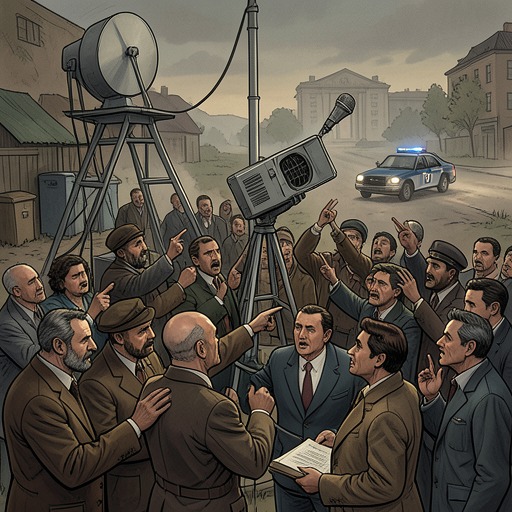
During the pursuit, television screens show the country’s channels, including cartoons, local news, sport, and CNN. On TV2, a newsreader appears beside a graphic of a man on a motorcycle. The broadcast says that Mpayipheli is somewhere in the Western Cape on a stolen motorcycle, describes him as armed and dangerous, and says that the reason authorities are seeking him is unclear. The graphic and the terse bulletin turn a moving fugitive into a repeated public image, while the admission that the reason for the manhunt is unknown leaves a conspicuous gap in the official story.
SABC’s coverage is therefore more than background noise to the intelligence operation. In the Ops Room, Mentz sees the motorbike graphic on the television bank as her cellphone rings; Rajkumar then raises the broadcast’s volume. The pursuit is being watched by the officials conducting it, even as those officials’ actions become material for public reporting. The scene places intelligence work and broadcast news in the same room without suggesting that either side controls the other’s account.
Allison Healy Challenges the Official Account
SABC’s interview with Allison Healy gives the dispute a different kind of visibility. Introduced as the Cape Town crime reporter who broke the biker story, she is asked about the fugitive and responds by questioning details in the information attributed to the Presidential Intelligence Unit. She reports that Mpayipheli left a note saying he had no choice but to borrow the BMW and would pay for its use. She also points out that police had laid no charges and opened no theft investigation, and that the dealership owner confirmed the note. These specifics undermine the simple assertion that the motorcycle had been stolen.
Healy’s second challenge concerns the government’s silence. More than five hours after the Cape Times published its story, she observes, the government has not publicly stepped forward to correct the record if Mpayipheli is guilty of an offence. Her intervention does not establish his innocence; instead, it makes the mismatch between the official allegation and the available public evidence an issue in its own right. Her position as an onlooker, someone who sees what others overlook, helps explain why she attends to the omission as well as to the accusation.
Media as a Political Arena
The government’s discussion of how to respond to the attention confirms that media coverage has become part of the pursuit’s political terrain. When the Minister asks about a second possibility, an official proposes using the media to the government’s advantage. The exchange frames broadcasting not simply as a channel for reporting events but as an arena in which officials may try to shape their meaning. The evidence establishes the proposal, not its eventual execution or success.
Across these scenes, SABC’s significance lies in the circulation of images and claims rather than in a demonstrated institutional position. The broadcaster carries the fugitive image into national television and gives Healy a platform to question a key element of the official account. That juxtaposition exposes the instability of the public label attached to Mpayipheli: the broadcast can repeat the authorities’ description, but a reporter’s concrete details can make that description harder to accept without scrutiny.