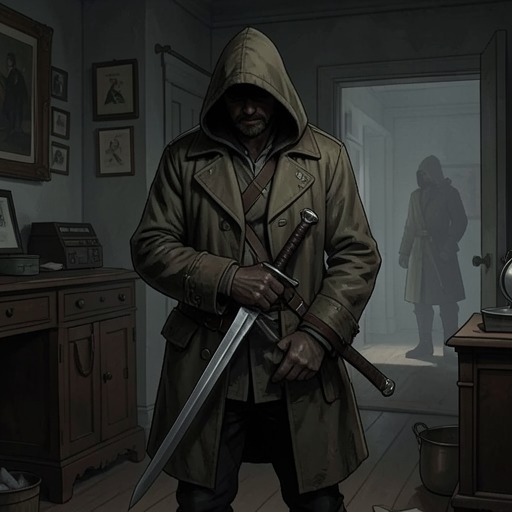
SVD sniper rifle
Heart of the HunterThe SVD sniper rifle is both the instrument of Thobela Mpayipheli’s first assassination and the object through which the novel exposes the distance between technical mastery and moral certainty. In Munich, its formidable reach and the trained eye behind its scope make a distant target appear attainable; the arrival of a woman and child in the sightline turns that apparent control into hesitation. Years later, the memory returns during Mpayipheli’s flight, making the rifle part of a reckoning with the violence he is trying to leave behind.
Design and trained use
Mpayipheli recalls the SVD as a latest-model weapon with a synthetic, non-folding stock and a deadly reach of 3,800 metres. In Munich, he holds it while watching for Klemperer, a double agent expected to emerge through a door about a kilometre away. The distance is not incidental: the rifle enables a killing across space, with its target reduced to a figure anticipated through the scope rather than encountered face to face.
The weapon belongs to a history of exceptional marksmanship. In East Germany, Mpayipheli attended the East German Ministry for State Security’s sharpshooters school, where he and the other students helped test an experimental SVDS. During that period, he met Evgeniy Fedorovich Dragunov, the Russian developer associated with the rifle. At 2,000 metres, in poor overcast winter light and a crosswind of seventeen kilometres per hour, Mpayipheli produced an R100 factor of less than 400 millimetres. Dragunov’s astonishment at the black student’s groupings, and his physical gesture of gripping Mpayipheli’s shoulder, mark the shooter as extraordinary even within this specialist setting.
That technical history makes the Munich scene more than a demonstration of skill. The rifle is familiar from practice, where competition supplied the test; in the assassination, the target is a living person. Mpayipheli wants to dedicate the shot to Dragunov, but his own bodily agitation distinguishes this assignment from a range exercise. The skill is real, and so is the human consequence it has been trained to deliver.
The Munich assassination
The mission gives the rifle a specific political use. Klemperer is a double agent feeding on both sides of the fence, and the KGB has earmarked him for elimination. Mpayipheli, an African National Congress exchange student, is expected to earn his keep. He waits on the door through the scope, aware of condensation on the telescope lens and unwilling to break his concentration. When the door opens, his finger curls around the trigger and the SVD seems to become an extension of his being.
The narrative renders the weapon’s mechanics with exactness: a 9.8-gram, 7.62-millimetre steel bullet, the grooved tunnel of a 24-inch barrel, a silencer, and a curved trajectory. As pressure on the trigger increases, however, a woman and child appear in the scope. The crosshairs rest on the woman’s forehead, below the band of her blue wool cap. Mpayipheli registers her healthy face and the laugh lines around her eyes. The sight picture that had organized the mission around a single target now contains people whose presence makes the impending shot intolerable to him.
He does not fire. The rifle’s capacity for distance and precision remains unchanged, but the decision at the trigger is no longer a technical problem. He recognizes a distaste for what he is doing and concludes that this is not the right way to wage war or the way of his people. The weapon’s immediate significance lies in this interruption: trained action reaches its limit when the scope frames lives that cannot be absorbed into the target’s identity.
Memory and moral reckoning
The Munich episode returns much later, prompted by the tension Mpayipheli feels as he enters a petrol station. The narrative carries the old scene into his present flight: the trembling hands and perspiration associated with his first assassination reappear in memory as he rides through the dark Karoo. On a good, hard-surfaced dirt road, he keeps the BMW GS to sixty or seventy because the earlier fall in the storm still troubles him. His attention is divided between the road ahead and the rifle’s remembered sightline.
As the memory unfolds, the rifle’s close details return with it. Mpayipheli wipes the sniperscope lens with a soft cloth, checks the focus and adjustments, and waits again for the dark wooden door to open. He notices the sweat running down his forehead and the heat building inside his clothes. These are not signs of improved control; they accompany a growing awareness that the act itself is wrong. The weapon’s procedures—cleaning the lens, setting the focus, waiting—continue with practiced order even as his moral confidence fails.
The recollection is described as part of a process of healing, changeover, and closure, a possible step in Mpayipheli’s metamorphosis. The rifle therefore connects two moments in his life without making them identical: Munich is the first blooding that establishes what his training can accomplish, while the later return to it gives him a chance to confront what that capability has meant. Its decisive role is not simply that it can carry a bullet to a distant target, but that the memory of aiming it preserves the instant when Mpayipheli’s obedience to the mission gave way to refusal.