South African Presidential Intelligence Unit
Heart of the HunterThe South African Presidential Intelligence Unit is a post-apartheid intelligence service built around The Director’s ambition to create an effective agency without the burdens of the old order. Under Janina Mentz, it establishes a disciplined operational center and pursues Thobela Mpayipheli, but the chase reveals an institution working amid fragmented authority, vulnerable records, and unresolved suspicions of internal betrayal. Its power to monitor and mobilize is real; its command of the information on which that power depends is not secure.
Formation and institutional purpose
The Unit emerges from a difficult transition in South African intelligence. After the elections, several branches had to be integrated, while the apartheid regime had left an even larger and more divided apparatus. Former rivals resisted cooperation, concealed information, and competed for influence; consolidation was costly and politically fraught. The Director’s answer was to divide work into projects and compartmentalize it, seeking order through controlled responsibilities. One large undertaking was the consolidation of computer records from sources that included Infoplan in Pretoria, Denel, the Security Police, the Secret Service, Military Intelligence, and ANC systems in Lusaka and London. The records amounted to hundreds of gigabytes and ranged from public information to weapons systems, informants, and double agents. This history supplies the Unit’s setting: the new institution inherits not a clean slate, but a mass of records shaped by secrecy, deletion, and competing custodians.
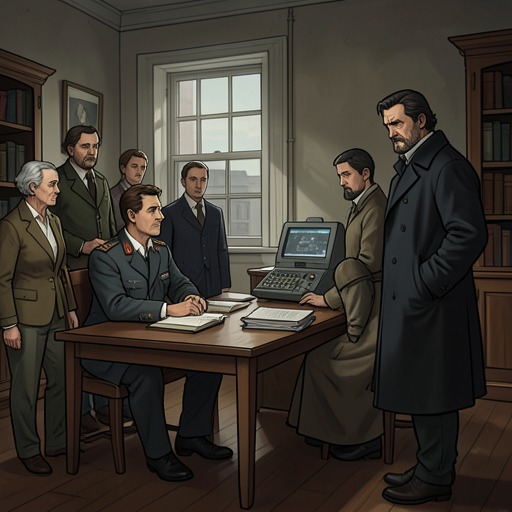
The Director presents the proposed service to Mentz as an agency intended to be outstanding and unburdened by a past. He sees her as the architect for that project and gives her a substantial budget and broad authority. When the operational room is formally activated, Mentz addresses sixteen staff members gathered around its table and makes clear that the operation is real, not an exercise. The occasion marks the change from assembling a team to testing its abilities in live work. The room’s members had already tested Mentz’s authority: predominantly male and drawn from backgrounds in which men held social power, they found that aggression and disguised anti-feminism did not unsettle her. They came to respect both her accomplishments and the composure with which she commanded them.
Command, surveillance, and the pursuit
Mentz directs the Unit’s operational response as an information problem. After Johnny Kleintjes visits the American Embassy, the agency does not know what he was doing there; it begins monitoring the Kleintjes household by telephone. Mentz introduces Monica Kleintjes to the team as Johnny’s daughter and notes her computer-science education and senior technology role at Sanlam. Her profile is part of the operational picture, but the surveillance soon intersects with a larger effort to locate Mpayipheli and the data he is believed to carry.
As the pursuit develops, the Unit distributes personnel across transport and travel routes. Teams are assigned to the airport and Cape Town station, including the trains and bus terminal; other staff contact car-rental firms and private-aircraft charter services, while additional teams wait in vehicles near Wale Street. The agency also monitors the Nzululwazi telephone. Its intelligence gathering combines direct surveillance with database searches: a search in Pretoria finds no record of Mpayipheli in the Umkhonto we Sizwe files. Rahjev Rajkumar reports that Mpayipheli’s registered address in Mitchell’s Plain belongs to Orlando Arendse, whose criminal record and suspected links to organized crime make the address look potentially like a drugs house. The inference helps investigators construct a lead, but the missing file entry also demonstrates how little a database search can establish about a person’s history.
Mentz weighs whether the Unit should seize the data from Mpayipheli and send its own team to Lusaka. Keeping the operation within the agency’s control seems safer, and she considers using the Reaction Unit as backup; sending Tiger Mazibuko and his colleagues into Zambia, however, would require diplomatic favors and risk exposing the operation. The deliberation shows that the pursuit is not simply a matter of issuing orders. It involves jurisdiction, political relationships, and the danger that expanding the operation could make it less controllable. Later, Mentz briefs The Director and the Minister of Intelligence on the background, a counterintelligence operation, and what has gone wrong, carrying the operational crisis into the political chain of command.
Records, security, and institutional practice
The Unit’s methods reflect a deep distrust of electronic information. Rajkumar advises Mentz that digital material is easy to copy and distribute, whether through disks, networks, email, or hacking; any linked system may itself be penetrated. The response is unusually restrictive: one paper copy, treated as controllable and limited. Four typists transcribe digital and magnetic tapes on electric IBM typewriters in a video-monitored room. Each tape is signed out and back in; the paper transcript is retained in an access- and temperature-controlled document library with the magnetic tapes, while digital tapes are deleted. This practice attempts to turn information security into a chain of custody, replacing easy duplication with logged handling and a single physical record.
The procedure sits uneasily beside the history of missing and altered files. During the integration process, some personnel could not abandon the old habit of secrecy and an us-against-them mentality; operational records disappeared. Johnny Kleintjes began making backups when he realized that material was being deleted, and eventually took work home after a backup tape went missing. His actions preserve information that official systems may lose, but they also create a separate, unofficial archive. The Unit’s insistence on restricting copies and Kleintjes’s decision to make them are opposing answers to the same institutional danger: records can be compromised both by uncontrolled circulation and by those who control what remains on file.
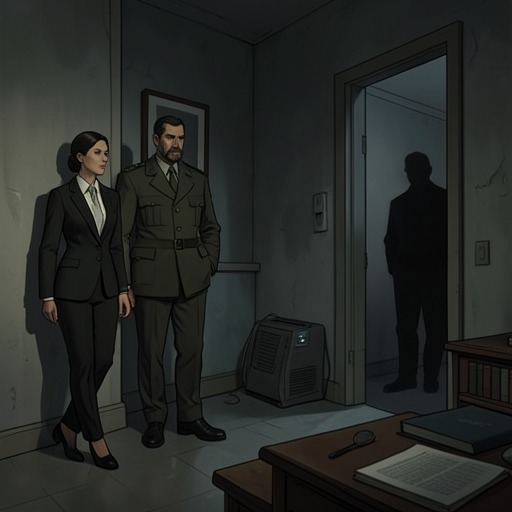
The Unit’s interrogation room embodies another aspect of Mentz’s approach. She rejects the customary table, bare walls, and hard chairs because nobody can explain why an uncomfortable room would produce better results. Instead, she specifies three practical, upholstered chairs, bolted in an intimate triangle on a beige carpet. The room still contains a concealed microphone, a one-way mirror, and a camera in the observation room; the chairs cannot be shifted to block the door. Mentz removes some conventional signs of punitive interrogation without surrendering observation or control. The design makes the tension visible: a setting intended to feel less hostile remains carefully engineered for surveillance.
Exposure, accountability, and unresolved risk
The public learns of the pursuit through a report in the Cape Times describing a province-wide search for Mpayipheli as an armed and dangerous fugitive. The newspaper attributes the alert to an undisclosed government intelligence agency, rumoured to be the Presidential Intelligence Unit, and reports that he is believed to have two firearms and a BMW R 1150 GS. The report also notes that possessing the weapons and motorcycle is apparently not the real reason the authorities want to apprehend him. The distinction between the official warning and the unknown underlying purpose leaves the public-facing account incomplete, even as the Unit’s alert expands the search beyond its own rooms.
The suspected leak becomes still more consequential in the account of Johnny Kleintjes’s execution in Lusaka. An internal report assumes that Muslim extremists were involved but cannot explain how local or foreign groups learned of the operation; it raises the possibility of a leak within the Unit. The report argues that the unknown operatives were seeking the information Kleintjes had hidden during the 1994 integration process, rather than the fabricated data associated with him. It also notes that an arrested Unit member was waiting in ambush near the Zambian border for Mpayipheli and the hard disk, and suggests that the operation may have been tipped off. These remain suspicions rather than a demonstrated explanation. The hard disk is still missing, and the report leaves open whether its original records could identify a mole in South African intelligence.
The inquiry into Miriam Nzululwazi’s death exposes the limits of the agency’s own claims when they are tested formally. At the commission, Mentz says there is tangible evidence that key information reached an international network of Muslim extremists, but acknowledges that the Unit cannot directly link Vincent Radebe to the process. The chairman points out that Radebe is charged with negligence, not high treason, and that the allegations rely on circumstantial evidence. The proceedings do not resolve the suspected leak; instead, they show the distance between an intelligence assessment, an accusation against an individual, and proof that can be admitted in an inquiry. The Unit’s central predicament is therefore not just that its records may be stolen or withheld. It must also act on uncertain information while demonstrating that its conclusions and methods can withstand scrutiny.