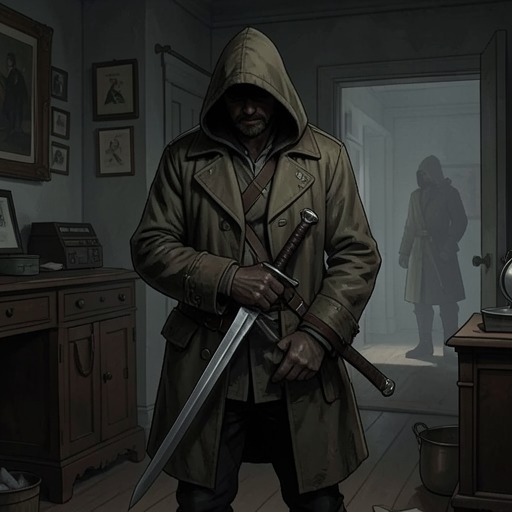
Thobela Mpayipheli assassinates Dorffling
Heart of the HunterThobela Mpayipheli’s assassination of Marion Dorffling in Paris in 1981 is both a completed mission and a defining memory of the violence he later tries to leave behind. Mpayipheli recognizes his target on the Métro, follows him through the Latin Quarter, and kills him after a brief face-to-face encounter. The scene gives the act the shape of an assignment carried out with deliberation, while its later return in Mpayipheli’s thoughts exposes the distance between his trained readiness to kill and the life he hopes to make for himself.
Assignment and Recognition
The encounter begins on a crowded train. Mpayipheli stands close behind the American, but his thoughts are far from Paris, at the Transkei coast. The memory of the waves and the silence between them places the approaching violence beside an image of stillness and ancestral belonging. He imagines that, when his own life ends, he will return to those quiet intervals. The contrast does not make the Paris scene peaceful; it shows how far inward he has withdrawn while remaining physically close to his target.
Mpayipheli identifies the man as Dorffling and addresses him with contempt, making clear that he knows whom he has been assigned to kill. The assignment has been accepted, and the dossier studied and memorized. Dorffling, in turn, does not react visibly to the recognition. At St Michel, Mpayipheli says that they have reached their station, and the two leave the train together. The apparently ordinary movement through a station and up into the Latin Quarter carries an unmistakable double purpose: Mpayipheli is guiding the encounter toward its conclusion.
Dorffling then runs toward familiar territory near the Sorbonne, where he has an arsenal of weapons. Mpayipheli had expected the American’s ego to prevent flight; Dorffling’s escape changes his assessment of him. He recognizes the ex-Marine’s capacity to act rather than assume that the man will submit to the confrontation. That recognition does not stop the pursuit. It makes the pursuit a contest between two trained adversaries, each reading the other’s choices.
The Confrontation in Paris
The chase carries the men through the streets and into the quieter University alleys. Mpayipheli catches up and forces Dorffling to turn and face him. Their exchange is not extended: Dorffling’s confidence and practiced movements are set against Mpayipheli’s readiness, while the surrounding city briefly registers the sight of a white man pursued by a Black man. The racialized attention of Parisian onlookers makes the pursuit visible as more than a private contest, even though the decisive encounter takes place away from the crowds.
Mpayipheli reaches for the short-handled assegai carried in a scabbard against his back and says Mayibuye. When Dorffling asks what language he is speaking, Mpayipheli identifies it as Xhosa. The exchange makes language part of the confrontation: Mpayipheli names his own identity at the instant he closes on his target, rather than allowing the encounter to be described solely in the terms of an intelligence assignment. The two men circle and assess one another before Mpayipheli acts quickly, bringing the struggle to an end with the assegai.
The killing is followed not by triumph but by a deliberate acknowledgment of the dying man. Mpayipheli corrects Dorffling’s pronunciation of Umzingeli, then watches him die and lowers his body gently to the ground. That composure and courtesy complicate the scene without softening its outcome. The act is lethal, yet Mpayipheli treats the encounter as a process governed by attention and respect, including respect for an opponent who does not plead. His manner suggests a personal code operating inside the assignment, not an absence of violence or consequence.
Memory and Moral Consequence
The Paris killing does not remain sealed in 1981. Years later, in the Karoo, Mpayipheli lies awake as a different confrontation with soldiers replays in his mind. He searches for the point at which his wish to become a new person gave way to the reflexes of his former life. He recalls how quickly battle-readiness returned and how readily his hands and knowledge could serve violence. The memory of Dorffling belongs to this larger reckoning: it is part of a history Mpayipheli cannot simply dismiss by declaring himself changed.
In that later reflection, Mpayipheli recognizes that his accusation that another person made him act was displaced blame. The guilty party he was looking for, he understands, was within himself. The recognition changes how his past actions can be narrated: responsibility cannot be transferred to an opponent, an order, or the immediate circumstances of a fight. His response to Captain Tiger Mazibuko’s hatred reinforces the connection. Mpayipheli recognizes that kind of hatred because it had accompanied him for nearly forty years, making the pursuit of Dorffling one point in a much longer life shaped by violence.
A separate recollection of an earlier assassination shows the limits of that readiness. When Mpayipheli has a shot lined up, the sight of a woman and child stops him from pulling the trigger. This is not the Paris encounter, but it provides a telling contrast: a trained killing response can be interrupted, and recognition of the lives beyond a target can alter what happens next. The novel places such moments beside Mpayipheli’s memories of violence, not as proof that the past is undone but as evidence that action is not wholly beyond choice.
Place in Mpayipheli’s Change
The assassination’s lasting significance lies in the way it returns during Mpayipheli’s effort to imagine a future not governed by his past. In another memory, he sees his younger self expressing a wish to become a healer. The recollection confronts him with the possibilities of choices he did not make and with grief for the hatred, violence, and death that followed. He cannot undo what happened or erase who he has been; he can, however, determine how to proceed. His aspiration to become a farmer and nurturer gives that decision a practical direction rather than making it a claim that change will be easy.
The 1981 encounter therefore holds two meanings at once. At the time, Mpayipheli completes the assignment through pursuit, tactical judgment, and a final act of violence. In retrospect, the same event becomes part of the history he must face honestly if he is to reject the habits that once defined him. Its quiet gestures—the recalled coast, the brief naming of Xhosa identity, the respectful lowering of Dorffling’s body—stand beside the irreversible fact of the killing. The memory neither absolves Mpayipheli nor fixes him permanently as an assassin; it clarifies the burden from which his later attempt at a different life must begin.