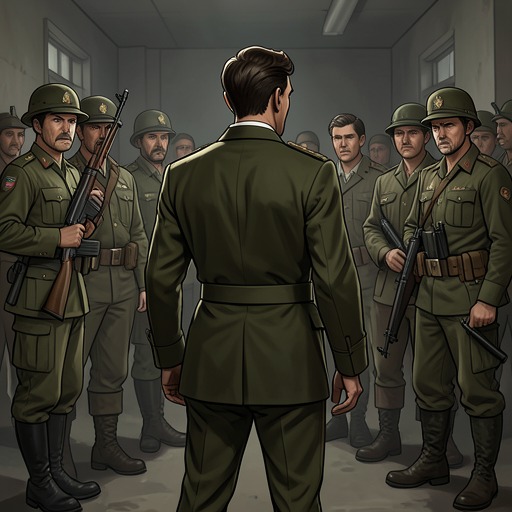
Thobela Mpayipheli reveals Mazibuko is being used and urges him to disarm
Heart of the HunterThobela Mpayipheli reveals Mazibuko is being used and urges him to disarm in a confrontation that turns their pursuit into a test of whether Captain Tiger Mazibuko can act independently of his anger. Thobela is still a wanted adversary, and Mazibuko arrives threatening to kill him; yet Thobela does not answer the threat with violence. Instead, he asks Mazibuko to consider who benefits from his rage and what might remain of him if that rage disappears. The encounter does not reconcile the men, but it interrupts the expected movement from hatred to armed action, while leaving the hard disk and Pakamile Nzululwazi at the center of their immediate dispute.
A Pursuit Reaches a Face-to-Face Test
The meeting takes place in a parking garage, where Thobela stands beside his motorcycle and Zatopek van Heerden waits in a car with a silenced machine pistol. Allison Healy has chosen not to come. At one minute to eleven, Captain Tiger Mazibuko walks toward Thobela from the shopping-centre entrance. Thobela recognizes him instinctively, matching the man’s physical presence to the voice and anger he already knows. The approach makes the conflict concrete: the pursuer who has been heard at a distance is now directly before the fugitive, and each must decide what to do in the other’s presence.
Mazibuko begins by promising that he will find and kill Thobela once the data no longer matters. His threat establishes the depth of their hostility, but it also ties his intended violence to the changing importance of the hard disk. Thobela’s first question is not about the threat. He asks where Pakamile is. The child’s whereabouts remain a pressing concern, distinct from the intelligence material that has brought the men into the same place. Their exchange therefore turns on two unresolved stakes: whether the information is safe and whether Pakamile is safe.
Thobela Redirects the Conflict
The encounter gives Thobela a chance to answer hatred with force. He feels the pull of his own fighting instincts, and the novel acknowledges that response rather than presenting him as untouched by violence. He nevertheless speaks instead of striking. He asks whether Mazibuko contains anything beyond his anger and whether others are using the fury that consumes him. The questions shift the frame: Mazibuko is not only Thobela’s opponent but potentially a person whose anger serves someone else’s purposes.
Mazibuko rejects the suggestion and insults Thobela. His posture leans forward as though he may attack, but he does not cross the distance between them. Thobela presses the question of usefulness, asking him to consider how long he will remain valuable before a new administration, system, or era changes the terms. The warning is specific to Mazibuko’s place in a political order that can change while leaving its agents exposed. Thobela describes him as being treated like a piece of equipment, making the possibility of being used—not merely the danger of losing a fight—the issue Mazibuko must confront.
A Weapon Lowered, Not a Feud Ended
Mazibuko’s hand moves to the concealed bulge beneath his jacket. The movement brings the confrontation to its sharpest point: his hostility is no longer only spoken, and the possibility of drawing a weapon is immediate. Janina Mentz calls out his nickname in an authoritative voice. He hesitates, visibly caught between alternatives, while his hand remains on the gun. Thobela tells him he is not alone and warns that Mazibuko would be dead before he could point the weapon. The warning signals that Thobela has support nearby, but the scene does not turn into a display of force. He returns instead to the appeal not to let others use him.
Mazibuko finally drops his hand and stands speechless. This is a limited but consequential change in the encounter: he does not attack, and Thobela’s appeal has helped interrupt the movement toward violence. The scene does not establish that Mazibuko has accepted Thobela’s analysis or abandoned his hostility. Before lowering his hand, he has made a grave threat, and the evidence of anger remains plain. What changes is the immediate choice in front of him. He does not draw the weapon.
The Hard Disk, Pakamile, and an Unsettled Relation
After Mazibuko lowers his hand, Janina asks where the hard disk is. Thobela answers that it is safe, but the exchange gives no location for it and does not independently verify his statement. Mazibuko then asks where Pakamile is. The order of these questions keeps the practical objectives of their confrontation distinct: the authorities want the data, while Thobela’s concern for the child continues to shape what he asks of his adversary. Neither question, in the available exchange, receives a full answer.
The relationship remains adversarial rather than repaired. Thobela has not secured forgiveness, friendship, or a promise of future cooperation; Mazibuko has not withdrawn his earlier threat. Yet Thobela treats him as someone capable of reflection and choice, not simply as an enemy to be defeated. That appeal echoes Thobela’s own insistence elsewhere that doing the right thing is a choice, even when the difficult choice is to refuse a familiar way of life. The parallel does not make the men equivalent: it shows Thobela applying to Mazibuko the possibility of change he has had to claim for himself.
The encounter’s significance lies in this pause within a continuing conflict. Thobela’s restraint does not erase his fighting instincts, and Mazibuko’s lowered hand does not resolve the danger between them. But the expected exchange of threat and counterforce gives way, briefly, to a question about agency: whether a man can recognize when his anger is being made useful to others and choose not to act through it. The hard disk is reported safe, Pakamile’s location remains the final concern voiced, and the men part from the exchange without a demonstrated reconciliation.