Zatopek van Heerden
Heart of the HunterZatopek van Heerden is a former policeman, psychologist, and Thobela Mpayipheli’s long-time friend. Their bond is rooted in a violent experience they survived together, but Van Heerden is more than a witness to Thobela’s past: he understands the force of Thobela’s loyalties while questioning whether anyone can truly change. His insistence on complexity gives the story a counterweight to the labels imposed on its characters, and his choices eventually make him an active protector as well as a confidant.
Identity and Background
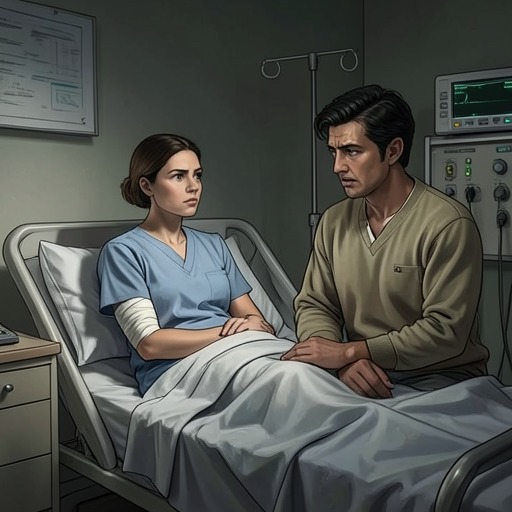
Van Heerden is introduced as Thobela’s white friend and former policeman. At one point, while Thobela is working for Orlando Arendse, the two men lie bandaged in a hospital in Milnerton, sharing medication, pain, and the trauma of a strange, violent experience they encountered by chance. Van Heerden’s eyes show a trace of empathy, but his expression otherwise remains unreadable. The scene establishes a friendship formed under pressure: the men have faced death together, and their connection does not depend on easy disclosure or sentimentality.
A later account identifies Van Heerden as a staff member of the UCT Department of Psychology. He is also presented as a practising psychologist whose work brings him motorbike clients, including middle-aged men seeking help with male menopause. The small occupational detail gives his professional life an everyday dimension distinct from his history in policing and intelligence. In another later explanation, he tells Allison Healy that two years earlier he had been moonlighting as a private investigator, investigating a murder case the police had been unable to solve. His inquiry led to a clandestine army operation involving weapons transactions for Unita in Angola, diamonds, and money. The available account places him in the same complicated world as Orlando Arendse and Thobela, without reducing his role in it to a single label.
Van Heerden also has a family home beyond Table View. He lives in a small white house on a smallholding, while his mother occupies the larger white house. When Thobela visits with Miriam Nzululwazi and Pakamile Nzululwazi, the setting offers a glimpse of Van Heerden’s life outside professional and political entanglements: an afternoon visit, his mother’s affectionate attention to the boy, and a shared braai.
Friendship with Thobela Mpayipheli
Van Heerden’s friendship with Thobela persists across sharply different phases of Thobela’s life. After the two men’s shared hospital ordeal, Thobela experiences a sudden vision of a new life. Van Heerden does not echo that optimism. His restrained response, and the empathy visible in his eyes, establish a durable difference between them: Thobela is reaching toward transformation, while Van Heerden is reluctant to believe that a person can leave an essential nature behind.
The friendship is also at ease in ordinary company. During the visit to Van Heerden’s smallholding, he and Thobela talk readily while Miriam remains uncomfortable and Pakamile watches with interest. Van Heerden’s mother takes the child to see a pony; when Pakamile returns, excited by the experience, he asks Thobela whether they can have horses on their farm. Later, Van Heerden and Thobela prepare the braai together. Van Heerden tells stories about his new work, while Thobela’s gift for mimicry makes them laugh. Against the violence that has shaped their history, this domestic visit shows the friendship operating through conversation, shared tasks, and hospitality.
Thobela later describes himself to Van Heerden as a new man. The declaration matters precisely because Van Heerden has already heard Thobela speak of a different life and has not treated that hope as proof of change. Their exchanges preserve both sides of the friendship: Thobela’s desire to begin again and Van Heerden’s conviction that self-reinvention cannot simply erase what a person is. He neither abandons Thobela for his past nor accepts every claim about his transformation without question.
Violence, Nature, and Change
Van Heerden’s view of human nature is stated plainly. He argues that people are shaped, or programmed, by what they are; a person cannot simply alter an inherent nature. The best available response, in his account, is to acknowledge the potential for both good and evil within oneself and accept that it exists. He objects to treating goodness as the whole truth and badness as something that can be dismissed or misunderstood. His position is not that people are beyond judgment, but that moral judgment becomes false when it divides them into uncomplicated categories.
That view informs his account of Thobela. Speaking to Allison Healy, Van Heerden warns that Thobela is not complex, but that this should not be mistaken for simplicity or a lack of intelligence. Thobela examines the facts, accepts or rejects them, and acts without prolonged agonizing. If he decides that loyalty to a friend requires carrying something to Lusaka, Van Heerden explains, the consequences will not necessarily dislodge that decision. He predicts that efforts to stop Thobela will meet formidable resistance. The analysis makes Thobela’s loyalty both a strength and a source of danger: a clear personal code can guide him, but it can also carry him into situations from which others cannot easily turn him back.
Van Heerden also supplies a distinction between political violence and private murder. He describes Thobela as an assassin for the KGB, but resists calling his wartime actions murder. Van Heerden had seen him in action and judged him highly capable; he believes many opponents may have died at Thobela’s hands, though Thobela never told him how many. This account does not conceal the scale of Thobela’s violence. Instead, it frames it through the war in which it occurred and insists that the question of what Thobela became cannot be answered by a single word.
When Allison asks what changed, Van Heerden directs attention to Thobela’s departure from Orlando Arendse. For him, that decision is the necessary question behind Thobela’s attempted reinvention: what happened that made him leave? Van Heerden’s answer remains skeptical but not dismissive. Thobela believes he can change, and believes that he has changed. The difference between belief and proof remains unresolved in Van Heerden’s view, giving their friendship an ongoing tension rather than a simple verdict.
Loyalty and the Public Account
Van Heerden’s account of Thobela is shaped by loyalty, a fact he makes explicit to Allison. He agrees to speak only on the condition that he will not be quoted on the record. His caution is not indifference: Thobela is his friend, and he is unwilling to turn that friendship into an unrestricted public statement. At the same time, he gives Allison information that helps her understand the man being pursued, including Thobela’s wartime history, his decision-making, and the importance of his loyalty to others.
That position places Van Heerden between friendship and the demands of public knowledge. He does not present Thobela as innocent of violence, but he rejects a flattened account in which wartime action is treated as ordinary murder and the person who committed it is defined forever by that description. His explanation asks Allison to consider both the record of violence and the circumstances in which it took place. The balance is characteristic of his broader outlook: recognizing good and evil together is not the same as denying either.
His loyalty also has practical consequences. When a badly injured man falls from his motorbike in northern Botswana, Doctor Pillay of Kasane finds Van Heerden’s phone number in the man’s pocket and calls him. Van Heerden relays this account to Allison, connecting the injured rider to the network of people who can help. Later, during the final leg back to Cape Town, he sits beside Thobela and holds his hand. The gesture is quiet, but it gives physical form to a friendship that has endured beyond argument, danger, and uncertainty about whether change is possible.
Allison Healy and the Closing Crisis
Van Heerden’s connection with Allison develops alongside his efforts to help her understand Thobela. When Allison visits him at the small white house with its green roof, she observes his lean build, intense eyes, and contained energy. He speaks openly about his dilemma: loyalty to Thobela. He sets a clear condition on any interview, and his account turns the conversation away from easy judgments toward the questions of history, allegiance, and change.
Their relationship becomes more intimate. In a later scene, Van Heerden takes Allison’s bag, helps her into a seat, checks that her seat belt is fastened, and kisses her before she can pull away, then grins at her. During the journey back to Cape Town, she wakes to find him seated beside Thobela, still holding his hand. These moments place personal tenderness beside the duties of assistance and friendship; Van Heerden’s care is not confined to one relationship or one role.
At home, Thobela asks Van Heerden to prepare coq au vin in the traditional Provençal manner. Van Heerden cooks it, and the meal is shared with Allison in a scene of domestic ease. The table, the food, and Thobela’s visible eagerness to eat briefly establish an ordinary household rhythm for people whose lives have been marked by pursuit and violence. That calm is interrupted when a tall man enters armed. Van Heerden takes up a double-barrelled shotgun, orders Allison to go into the kitchen and close the door, and holds the intruder at gunpoint until the man puts his weapon on the floor. Allison is unable to move at once, a moment she later revisits with Van Heerden. The scene shows his friendship and professional history converging in immediate action: the man who questions whether people can change nevertheless acts decisively to protect those beside him.
Van Heerden’s narrative importance lies in his refusal to make loyalty depend on certainty. He does not claim that Thobela’s past has vanished, or that a declaration of renewal settles the question of who Thobela is. Instead, he knows the violence, names its consequences, and remains present through the attempt to build another life. His steadiness gives the novel a human measure for change: not a clean break with the past, but a contested possibility witnessed by someone who has reason both to doubt and to stay.