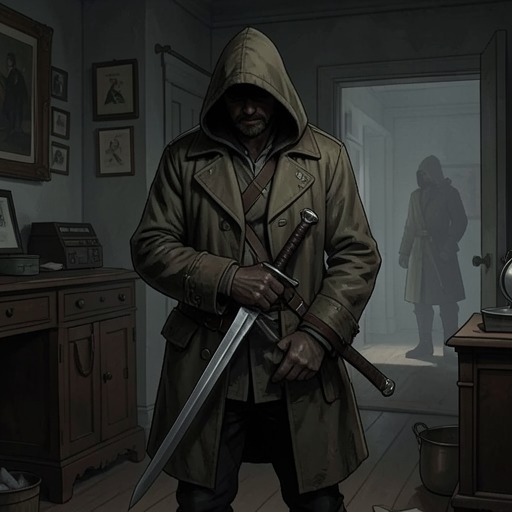
short-handled assegai
Heart of the HunterThe short-handled assegai is a weapon whose meaning changes with the hand that holds it. For Thobela Mpayipheli, it connects a remembered lesson from Senzeni to a deliberate code of face-to-face combat; later, it becomes an emblem of how badly that code fits the people he has killed. Its physical form promises directness, but the weapon cannot make violence honorable merely by changing its instrument.
Appearance and Acquisition
In Amsterdam, about a week after the assassination in Munich, Thobela enters a shop displaying objects presented as curios from Africa. Amid ostrich eggs, carvings, and other souvenirs, he notices an assegai and an oxhide shield, dusty and almost forgotten. He examines the weapon: its wooden shaft is smooth, its metal point unusually long, and flecks of rust mark the blade. Though expensive, it appeals to him enough that he buys it and carries it away as a parcel wrapped in brightly colored paper.
The purchase takes place amid a display of African culture reduced to portable decoration for European interiors. The shop’s other objects prompt Thobela to see that culture as packaged and made harmless for outsiders. Against this setting, the assegai and shield appear neglected rather than polished for display. His choice of the weapon therefore brings a charged object out of the shop’s curated image of Africa, though the passage does not suggest that buying it can undo the reduction surrounding it.
Senzeni’s Lesson and the Weapon’s History
After sawing off the shaft in his hotel room, Thobela remembers standing with his uncle Senzeni on a hill in the Eastern Cape. Senzeni had pointed out the history of his forefathers and described the battle of Grahamstown, where soldiers broke the long assegai shafts. In Senzeni’s account, the shortened stabbing spear originated there, not in Shaka’s territory as a European story claimed. He treated that mistaken attribution as another way of dispossessing the Xhosa of their history.
Senzeni’s lesson gives the weapon a genealogy that is both familial and political. He tells Thobela that he has the blood of Nqoma and the soul of Nxele, urging him to give that inheritance life. The memory does not make the assegai a neutral heirloom: its shortened form recalls a particular history of conflict, while Senzeni’s interpretation challenges who has the authority to tell that history. Thobela’s act of sawing the shaft thus accompanies a return to a teaching about identity and inheritance, rather than simply preparing a convenient weapon.
A Code of Combat
In another remembered scene, Thobela lays the shortened assegai at the feet of his East German Ministry for State Security masters and presents it as the weapon with which he intends to fight. Its central principle is confrontation at close range: he will look opponents in the eye and meet them where they can see him and fight back. The officials accept the declaration with apparent amusement, but their reaction does not dissuade him. He makes a scabbard himself, positioning it against his body along his back so that the weapon remains ready to hand.
The spear and its carrying place give practical shape to the code. The shortened shaft distinguishes it from a weapon used at greater distance, while the self-made scabbard keeps it close to Thobela’s body. He imagines that this directness will change the moral character of his actions: a visible opponent, able to resist, seems different from a distant target. Yet the account places the certainty of that belief beside its later failure, without treating the weapon itself as proof that his conduct has become just.
The Code’s Failure
Thobela later recognizes that he had believed the assegai’s blade and the principle of direct confrontation would make a difference. But he had used it against civil servants who were not fighters. The intimacy that was supposed to distinguish honorable combat instead makes the contradiction harder to evade: pressing the blade into such opponents’ hearts and hearing their final breaths betrays the warrior identity he meant the weapon to express.
That recognition turns the assegai from a chosen instrument into evidence against Thobela’s self-understanding. He regards the killings as a self-made prophecy, an act whose consequences may return to him in the future. The weapon cannot cancel the difference between an armed opponent and a civilian, nor can a warrior’s code erase the people behind the label of enemies. By the time the earlier conflict has become memory, the shortened spear carries both Senzeni’s account of inherited history and the burden of Thobela’s own choices: its promise of directness has not prevented him from misusing the heritage he hoped to honor.