2009 World Junior Championships
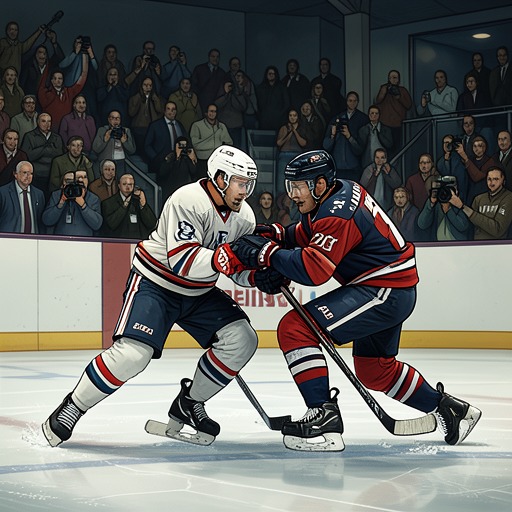
Heated RivalryThe 2009 World Junior Championships are the first major meeting between Ilya Rozanov and Shane Hollander, and the tournament’s decisive significance lies in the rivalry it sets in motion. Played in Regina in December 2008, it gives Ilya his first firsthand look at the Canadian phenom and leaves Shane to carry the weight of a loss in front of his own country.
Arrival in Regina
For Ilya, the tournament is his first visit to North America. Two days before Christmas, he trudges through the cold toward the team bus, finding Saskatchewan less overwhelming than he had expected: there is little to command his attention beyond the weather and hockey. He has come hoping to see Shane play, but the attention already surrounding the Canadian makes that prospect feel less like a discovery than a long-awaited confrontation.
Both players are eligible for the NHL draft the following June and are widely expected to be selected first and second overall. The order depends on whom one asks. Ilya already has his own answer, while the press has helped turn their anticipated professional competition into a public rivalry before either has played an NHL game.
The final and its aftermath
When the tournament’s final game ends, Canada must line up to shake hands with Russia while the Russian players are still celebrating. Shane takes part in the sportsmanship ritual, but it does not soften his anger: he considers the Russian team dirty and hates playing against them. He also recognizes that Ilya is exceptionally good, a fact that makes the loss more galling and gives the rivalry a personal focus.
At the handshake line, cameras flash around Shane and Ilya. Shane looks Ilya in the eye and offers a terse congratulations; Ilya answers with confidence about seeing him at the draft. The exchange is brief, but it places their competition in the future as well as the present. The silver medal around Shane’s neck feels to him like an unwanted burden. He endures the Russian anthem while blinking back tears, conscious that he has failed to deliver the gold expected of him as a seventeen-year-old Canadian playing at home.
Ilya’s repeated smirk during their face-offs has unsettled Shane throughout the tournament. The loss therefore has two scales: it is a national disappointment, and it is a personal defeat at the hands of a rival whose skill and composure Shane cannot dismiss. Media coverage has helped inflame Shane’s hostility, but the tournament also gives that rivalry something concrete to attach to: a final, a silver medal, and a meeting at the draft still to come.
A rivalry carried into their careers
The competition outlasts the tournament and becomes part of the structure of their professional lives. In July 2010, after Shane signs a lucrative endorsement deal with CCM, he learns that Ilya has also signed with the company and that they are to appear together in an advertising campaign. The pairing converts their rivalry into a commercial asset even before Shane has played an NHL game.
Their later public appearances expose a different imbalance. Shane can speak French fluently, while Ilya struggles to understand some English questions and, in one media exchange, falls back on Shane’s answer. Ilya privately watches Shane speak French on television, impressed by his ease and troubled by his own accent. Language thus becomes another point of contrast between them, as well as a measure of the distance between public performance and private feeling.
From opponents to a shared future
The rivalry’s long duration is also measured in the private arrangements it complicates. By the time they have been secretly meeting for six years, their Boston encounters have moved from hotel rooms to Ilya’s penthouse. A game schedule can leave Shane an evening free after travel and practice, but visiting Ilya’s actual home feels to him more personal than meeting in a hotel or at his own investment property. The private relationship has developed inside the same professional calendar that keeps them publicly opposed.
Their intimacy eventually includes forms of communication unavailable in public. When Ilya is distressed, Shane invites him to say everything in Russian, even though Shane cannot understand the words. Ilya speaks with an animation and fluency Shane has rarely heard from him in English; listening without translation becomes an unexpected kind of closeness. Later, when Ilya considers leaving Boston after his next season as a free agent, he raises the possibility of a Canadian team. Shane offers a future in which Ilya can visit his real Montreal apartment, keep a toothbrush there, and no longer depend on the secret building Shane bought out of fear of being seen.
After more than eight seasons of competition, the public story begins to change without disappearing. At a joint press conference, Shane describes Ilya as a respected player, leader, and friend, then announces their work together on the Irina Foundation. Ilya explains that it is named for his mother, who died when he was twelve after years of depression without support or treatment. The tournament’s rivalry began with a defeat and a promise to meet again; its later significance is that the two opponents can use their shared public platform to support a cause rooted in Ilya’s family history.