Hollander–Rozanov rivalry
Heated RivalryThe Hollander–Rozanov rivalry is both a highly visible contest between two elite hockey players and the public cover for a relationship they hide for nearly a decade. It grows out of an old feud between the Montreal Voyageurs and the Boston Bears, but becomes a story about Shane Hollander and Ilya Rozanov: first cast as opponents defined by competition, then privately drawn together, and eventually looking for a way to separate sporting rivalry from personal hostility.
Origins and Public Construction
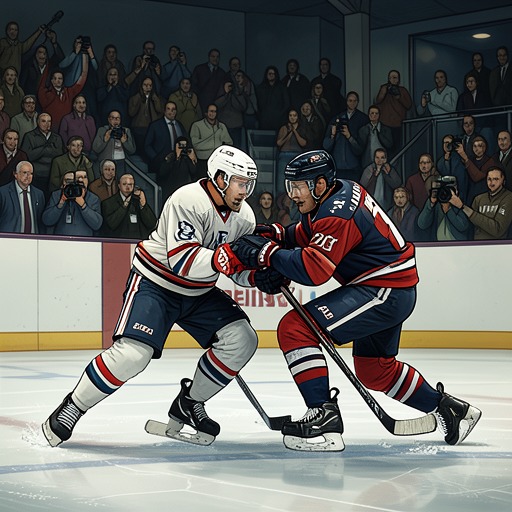
The teams’ rivalry is described as nearly a century old; over the six seasons preceding the opening Montreal–Boston game, Shane and Ilya had become its recognizable human embodiments. The animosity was legible even to fans in the cheapest, farthest seats. Its appeal was not merely an impression formed by spectators: the league repeatedly promoted the matchup, and its decisions helped keep the two players’ opposition in view.
Their personal contest began before they had met. At seventeen, Ilya arrived in North America for the World Junior Hockey Championships with a particular interest in seeing Shane, the Canadian phenom whose reputation had reached even Moscow. Both were expected to be the top two picks in the coming NHL entry draft, though observers disagreed about which would go first. Ilya already had his own answer: he was determined to destroy Shane. The rivalry therefore precedes any direct encounter, beginning as a projection of ambition onto a player Ilya knew through reputation alone.
The draft made that competition more tangible. Ilya was selected first, while Shane had spent months measuring himself against him: both had captained their teams to championships, earned league and playoff MVP honors, and led their respective leagues in scoring. Shane’s silver medal stood against Ilya’s gold. After a career in which he had usually finished first, Shane found himself second again, and his fixation on Ilya intensified. Their competition was thus not simply a matter of team standings; it touched Shane’s established sense of himself as a player who came first.
The Rivalry as a League Spectacle
When the nineteen-year-olds first faced each other in the NHL, their careers were only weeks old, yet the anticipation surrounding the game already seemed outsized to Shane. His father tried to frame it as an ordinary game and reminded him that the league was looking for a marketing angle. The matchup’s prominence was therefore visible even to the players themselves: the rivalry had become a product before either had accumulated a long professional record.
The league continued to organize attention around their opposition. At the January 2011 All-Star event in Nashville, Ilya had expected to share a team with Shane because they played in the same conference. Instead, North American players were assigned to one team and European players to another. Ilya understood the choice as another way of keeping the rivalry marketable. Their individual scoring race supplied a further measure of comparison: Ilya had 38 goals while pursuing a promise of 50 by the end of February; Shane had 41. Even outside a Montreal–Boston game, their achievements could be set beside one another.
On the ice, the public image was sustained through direct confrontation and competitive accusation. In the epilogue, sixteen months after the main events, Shane protested a tripping call while Ilya, wearing an Ottawa jersey, insisted that Shane had fallen. Their teams and circumstances had changed, but the familiar argument still played out in a game. The scene preserves the rivalry as a form of banter and competition, even after their relationship has changed.
Private Desire and the Cost of Secrecy
For Ilya, the attraction makes the rivalry more dangerous rather than less real. He thinks of Shane as a profoundly bad idea: they are men, NHL players poised to become major stars, and opponents from teams with a long history of hostility. Ilya’s private catalogue of reasons to hate Shane—his polished manners, languages, family, and public suitability as a league star—sits beside the intimacy he seeks with him. The friction between those judgments gives their public opposition a private counterpart: desire does not erase the rivalry but makes its performance harder to disentangle from genuine feeling.
Shane recognizes that he is willing to have sex with a man, but sees no easy way to explore that recognition safely. He fears rumors about his sexuality in Montreal and in a league where he has never seen an openly queer player; he has heard homophobic slurs on the ice and in the dressing room. In his assessment, whoever came out first would have to be exceptionally brave, and he does not believe that person will be him. He also trusts that Ilya will keep their encounters secret, because Ilya has as much to lose. The rivalry supplies both a reason for their secrecy and a plausible public explanation for their intense attention to each other.
That pressure is echoed in the hockey environment itself. During an exchange on the ice, an opponent calls Ilya a homophobic slur after Ilya trades sexualized banter with Shane; Ilya responds by treating the accusation as partly true. The episode makes the contrast between public speech and private identity explicit. Later, Shane admits how frightening it was to feel attracted to his archrival at eighteen, especially because that rival was also a man. When his father recognizes that Shane has carried the secret for so long, the rivalry’s public history acquires a hidden duration: the antagonism has accompanied a relationship kept private for almost ten years.
From Enmity to a Different Public Story
A change becomes imaginable when Shane and Ilya discuss what their future could look like if Ilya left Boston. Ilya considers a western team, where they would meet only twice a year, but neither likes the prospect of seeing each other so rarely. Shane proposes Ottawa instead. He points out that the city needs a star center and argues that, although they would remain rivals on the ice, they need not pretend to be enemies away from it. Ottawa and Montreal are close enough to keep them near one another while changing the public conditions around their rivalry.
Shane’s proposal is not to abandon the story altogether. He suggests that they start a charity benefiting both cities and present a public account of how the idea arose, giving people a visible reason to see them working together. New players and new rivalries will emerge, he argues; they need not keep performing the same antagonistic dance until retirement. Their plan treats the rivalry as something that can be revised: its competitive element may remain, while its claim that they personally cannot stand each other is no longer necessary.
The contrast between their former public image and this proposed cooperation becomes clearer after Shane hears about Scott Hunter’s public kiss with his boyfriend and his speech at the awards. Shane calls Hunter brave and says the moment made him hopeful that things might change. Ilya admits that it made him jealous. The response connects their private life to the possibility of a different public culture for gay players, without suggesting that hope alone removes the risks Shane has described.
The rivalry’s lasting significance lies in that unresolved double meaning. It is real competition, intensified by records, draft position, games, and the old Montreal–Boston feud; it is also a story amplified by the league and used by two men whose private bond contradicts its image of mutual hatred. The Ottawa plan does not erase their on-ice opposition. Instead, it imagines a future in which they can keep competing without letting the public performance dictate the terms of their relationship.