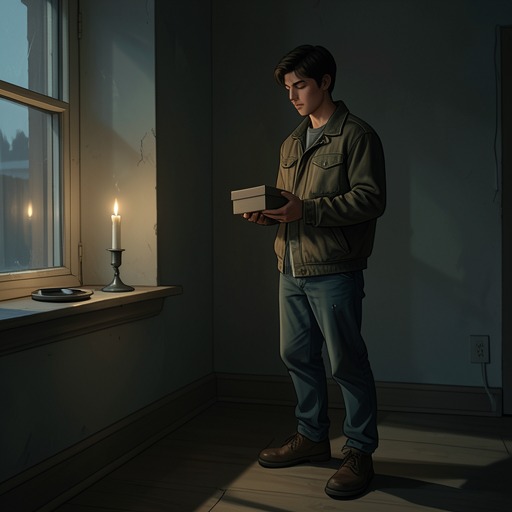
Ilya’s mother
Heated RivalryIlya’s mother, Irina, is a largely absent but consequential figure in the novel: remembered by Ilya as a loving, remarkable woman, she died by suicide when he was twelve after years of depression without support or medical treatment. The false account of her death imposed silence on that loss; later, Ilya’s decision to name a foundation for her turns private grief into public remembrance and practical support for others.
Identity and remembered character
Ilya’s mother is identified by name only after Ilya and Shane Hollander have become intimate. As they lie together afterward, Shane traces the chain around Ilya’s neck and asks his mother’s name. Ilya answers, Irina, observing that he has not said it in so long that it feels strange in his mouth. The smallness of the exchange matters: her name has been withheld from speech, and saying it again makes her presence newly tangible.
Ilya describes her as great, amazing, and not weak. He also remembers that she was deeply sad, and that Ilya’s father was hard on her. His account refuses to reduce her either to her illness or to the manner of her death. She remains a person he loved and admired, whose suffering was real without exhausting who she was.
Death and concealment
When Shane asks how she died, Ilya first gives the explanation that his father had presented to the world: an accident. He says it sardonically, explaining that his father told everyone this and insisted that Ilya accept it, even though Ilya knew at twelve that it was not true. The account makes the concealment part of the injury: the child was not only bereaved but instructed to repeat a lie about what had happened.
Ilya eventually tells Shane that he was twelve when his mother died and that he found her. The words come with difficulty, and his voice breaks. Shane stands and holds him while Ilya buries his face against Shane’s shoulder. In that moment, the history long kept from other people becomes speakable, but disclosure does not make it painless; Ilya’s account remains bound to the child’s direct encounter with the death and to the grief he has carried since.
The novel later makes explicit what the family’s cover story obscured. At the Irina Foundation’s public launch, Ilya says that his mother battled depression for years without help, support, or medical treatment, and that she died when he was twelve after losing that battle. His public account replaces the word accident with an acknowledgment of her illness and the absence of care around her.
Influence on Ilya and Shane
Irina’s death remains consequential beyond Ilya’s private memory. After asking her name, Shane proposes that the charity he and Ilya have discussed should include a hockey school, with summer camps in Ottawa and Montreal, and that its funds should go to mental health organizations, possibly including suicide prevention. The proposal connects their plans to the loss Ilya has just described, though Shane presents it tentatively rather than as a demand that Ilya turn grief into a cause.
At the foundation’s launch, Shane announces that the Irina Foundation will raise money and awareness for organizations offering support, counseling, and assistance to people suffering from depression and other mental illnesses that can lead to suicide. He identifies the cause as important to both of them. Ilya then adds, beyond the prepared remarks, that the foundation is named for his mother. As he speaks, Shane places a hand on his forearm; he cannot publicly offer the more intimate comfort he wishes to give, but his touch marks his presence beside Ilya as the disclosure unfolds.
Legacy and narrative significance
The foundation gives Irina’s name a public life after years in which Ilya could scarcely say it. Its purpose is directly shaped by the conditions described in his account: depression without support, counseling, or medical treatment, and a death that the family explained away as an accident. The work the foundation supports is framed as a way to help people like Irina so that they do not have to struggle alone.
Irina’s place in the story is therefore carried through both memory and consequence. Ilya’s disclosure does not resolve the grief or restore what was hidden from him as a child. Instead, it changes what can be said about his mother and what can be done in her name. The foundation preserves her identity not merely as the subject of a tragedy, but as someone loved and remembered, whose suffering prompts a commitment to offer others the help she did not receive.