Loon
Heated RivalryThe Loon is a bird heard, rather than seen, during a night by the lake with Shane Hollander and Ilya Rozanov. Its call initially sounds so much like a wolf that it frightens Ilya, but Shane identifies the noise and then imitates it himself. The bird’s two interruptions transform a dark, uneasy quiet into a private joke and, later, a burst of shared laughter that eases an emotionally charged moment.
Identification and First Call
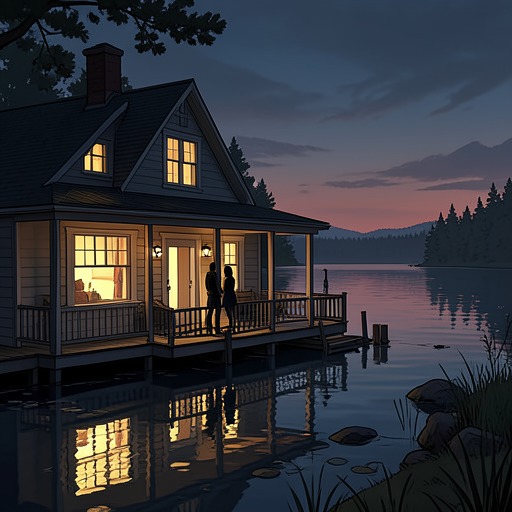
The Loon enters the scene through sound. Shane and Ilya sit in a small pool of firelight, surrounded by darkness. The quiet is made up of the fire’s crackling and the occasional lap of lake water; against that subdued background comes what Ilya takes to be a wolf howl. His immediate question, “What the fuck was that?”, carries unmistakable fear. In his mind, the danger is not merely a sound: he imagines that hungry wolves surround them.
Shane corrects him with a simple identification: “It’s a loon.” When Ilya asks what that is, Shane calls it a bird, “Like a duck, kind of.” The explanation is brief and conversational, not a natural-history account. What matters in the moment is the gap between the familiar category Shane offers and the alarming noise Ilya has just heard. Ilya cannot reconcile the two, protesting, “What the fuck bird makes a noise like that?” The Loon is therefore introduced through a mismatch between sound and expectation: a bird’s call registers, to a frightened listener in the dark, as a predator’s howl.
The “Canadian Wolf Bird”
The revelation does not end with Shane naming the bird. His laughter grows as Ilya realizes that he mistook it for a wolf. Ilya answers with mock indignation, calling it “Stupid Canadian wolf bird.” The phrase keeps both interpretations in play: the animal is a bird, as Shane insists, but Ilya’s improvised nickname preserves the frightening wolf-like impression that started the exchange. Fear becomes teasing without the original sound being dismissed as ordinary or quiet.
Shane then turns identification into a small performance. He makes a tunnel with his hands, brings it to his mouth, and produces the same “wolf bird noise.” Ilya responds, “You speak bird now too?” The imitation confirms that the call can be reproduced by a person, while also extending the joke: Shane’s hands and mouth become part of the scene’s playful demonstration. The narrative does not describe the bird’s appearance or establish further facts about its behavior. Its presence is defined by the sound, the mistaken interpretation, and the human response to both.
Ilya initially tries to hold back from laughing, even as Shane’s face crinkles with amusement. The restraint does not last; Shane shoves him, and Ilya begins laughing too. The call has brought their contrasting reactions into the same exchange: Ilya’s alarm supplies the setup, Shane’s delight makes the correction comic, and the shared laughter completes the reversal. The Loon is not a threat in the scene, but its sound briefly makes danger feel possible before the two men can laugh at the mistake together.
Return of the Call
The Loon’s second appearance comes after the scene has moved from joking into tenderness. Shane murmurs to Ilya, kisses his temple, and tells him he is strong and incredible. Ilya holds his breath as Shane begins, “I—”. Before the unfinished declaration can continue, another Loon screams over their heads. The call interrupts not only the quiet but the moment’s emotional suspense: Ilya’s held breath and Shane’s unfinished words give way to the same startling sound heard earlier.
This time, neither man has to mistake the bird for a wolf. They both lose control of their composure and hold each other as they shake with laughter. The narration explicitly frames the laughter as relief after what came before; the Loon’s return provides the interruption that releases the tension. Its first call created a comic exchange out of fear, while the second repeats that pattern at a more intimate point in the encounter. The bird’s sound becomes a recurring cue that changes the scene’s emotional register without changing its source.
Narrative Significance
The Loon’s importance lies in this carefully repeated contrast. In darkness, its call is frightening enough for Ilya to imagine wolves nearby; in Shane’s explanation and imitation, that same sound becomes a joke. When it returns over their heads, it cuts across a tender pause and prompts laughter rather than alarm. The bird remains audible but unseen, while its effect is registered in the men’s voices, expressions, breath, and embrace.
After the laughter, they sit back down. Shane tucks himself against Ilya on the bench, and Ilya wraps an arm around him and kisses the top of his head. He then asks whether there is more wood for the fire. The scene thus returns to its simple lakeside circumstances—the bench and the fire—after the call has twice unsettled them. The Loon does not resolve Shane’s unfinished words; instead, its interruption redirects the moment into shared ease and physical closeness. As a recurring sound, it binds the night’s initial fear to its ending in relief, making the same uncanny call first a source of misrecognition and then a private joke between the two men.