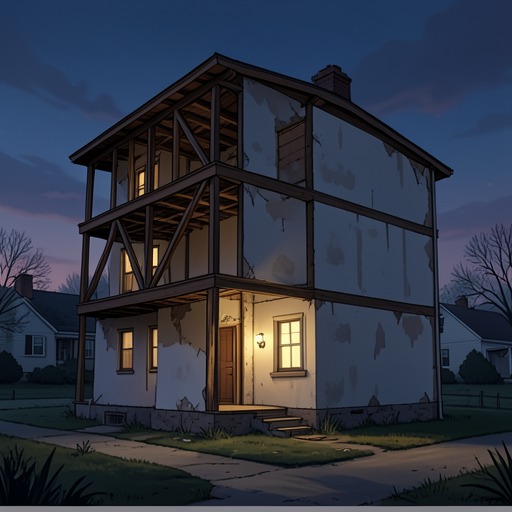
Plateau
Heated RivalryPlateau is where Shane Hollander keeps a second, deliberately private home: a condominium in a three-story building that he owns and uses as a discreet meeting place with Ilya Rozanov. Removed from Shane’s public domestic life, the property gives their relationship a space of its own, while its staged or unfinished interiors preserve the fiction that it is merely an investment.
Setting and Ownership
After a game in Boston, Shane drives not to his Westmount penthouse but to the Plateau condominium that almost nobody knows about. He spends only a few nights a year there, choosing it when he wants complete privacy. The contrast between the two homes is practical as well as revealing: the penthouse is his usual residence, while the Plateau property is kept apart for occasions when he does not want to be seen or interrupted.
The building’s layout helps create that separation. Shane parks in the small lot behind it, enters through the back door, and climbs to the top floor. He owns the other two floors as well; at the time described, they are unoccupied. The ground floor is rented to a high-end kitchenware boutique, but the shop has already closed for the night when Shane arrives. These details give the property an ordinary commercial face and a less visible domestic interior. Its rear entrance, empty upper floors, and after-hours arrival make privacy something the building’s physical arrangement can provide, not merely something Shane requests.
The top-floor condominium initially looks like a professionally staged demonstration unit. Its furnishings and finish suggest a place arranged to be shown to prospective buyers rather than a settled home. Technically, it is intended to help sell itself and the unit below. Shane tells himself he will sell it soon, but he has been repeating that intention for more than three years. The gap between the property’s advertised purpose and its continued retention quietly establishes that the investment explanation is not the whole story.
A Private Meeting Place
When Ilya arrives by cab, the building looks abandoned to him. He checks the address Shane sent, then follows the instruction to go around back, text, and wait at the door. In the dark lot, the unfamiliar setting makes him imagine being murdered; he also wonders whether Shane might be preparing a prank, though he does not think Shane has a sufficiently diabolical streak for that. The scene makes the same approach that offers Shane concealment feel unsettling from Ilya’s side: the place is private precisely because it is obscure and unfamiliar.
Shane opens the back door about a minute after Ilya texts. Before letting him in, he looks around nervously, as though expecting a tactical team to appear. The caution suggests that secrecy shapes even the small mechanics of their meeting. Ilya has previously encountered Shane only in hotel rooms, and the prospect of entering a place Shane owns excites him. The Plateau building therefore marks a change in their arrangements: this is not another temporary room selected for a trip, but a private setting Shane has secured and can return to.
The Loft and Its Changing Appearance
On the later visit, Shane leads Ilya up a long flight of stairs and unlocks another door on the top floor. The loft is only partly finished: the walls appear freshly plastered but unpainted, a ladder leans against one wall, and an open box of tools sits nearby. The kitchen has new countertops and cupboards but no appliances. Rather than presenting a completed home, the room displays work in progress.
This unfinished loft contrasts with the earlier description of a professionally staged condominium. The available scenes show the property in distinct conditions, but do not explain the difference or establish the precise progress of any renovation. What remains consistent is the gap between the unit’s apparent status and its importance to Shane. Whether arranged to resemble a sale-ready demonstration or exposed as a work site, it is not presented as the home where he ordinarily lives. Its incompleteness leaves room for its actual function to outweigh its outward domestic appearance.
Investment, Secrecy, and Intimacy
When Ilya asks whether Shane will move in, Shane says he will not; he describes the property as an investment and explains that he thought it could be a safe place for them to meet. The investment label echoes his longstanding promise to sell, but the stated purpose is more direct: the building supplies somewhere for the two men to be together away from hotels and public scrutiny. The property’s value in the relationship lies less in settled domestic comfort than in the privacy its ownership and layout permit.
Plateau thus connects concealment with an unusual form of preparation. Shane has bought and retained a whole building, yet the top-floor space is not furnished as an established shared home; it is a controlled refuge for secret encounters. The rear-door arrival, the empty floors, and Shane’s nervous check outside all make secrecy tangible. At the same time, his repeated claim that the condominium will soon be sold sits against the fact that he has kept it for years. The building’s double identity—as purported investment and actual meeting place—gives physical form to the distinction between Shane’s public life and the intimacy he can allow Ilya to enter.