Scott Hunter
Heated RivalryScott Hunter’s public kiss with a man during New York’s Stanley Cup celebration becomes a turning point for Shane Hollander and Ilya Rozanov. A player whose success had long made him a rival and a target of resentment, Scott appears on television not only as a champion but as someone willing to make his relationship visible. The act does not instantly resolve the dangers Shane and Ilya face, but it gives their imagined future a new shape: public happiness has become something they can witness, discuss, and begin to want for themselves.
Career and Rivalry
Scott is an NHL player whose pursuit of the Stanley Cup has taken nine seasons, according to Yuna Hollander. While Shane is recovering at his parents’ home, Yuna predicts that New York will win because Scott is determined to claim the Cup. Her confidence is striking partly because she is rarely wrong, and partly because the family has reason to dislike Scott: Yuna speaks of him as the man who took Olympic gold from her beloved son. The rivalry gives Scott a place in Shane’s life before he becomes personally important to either Shane or Ilya.
That competitive framing persists even when the story’s emotional focus shifts. Shane’s father is glad that the likely victory means the family will not have to watch Ilya lift the Cup, while Shane privately admits that he would like to see Ilya win. The contrast makes Scott’s eventual triumph more than a sports result. He is the rival whose achievement both disappoints the Hollanders’ public loyalties and opens an unexpected possibility for the couple’s private lives.
The televised kiss
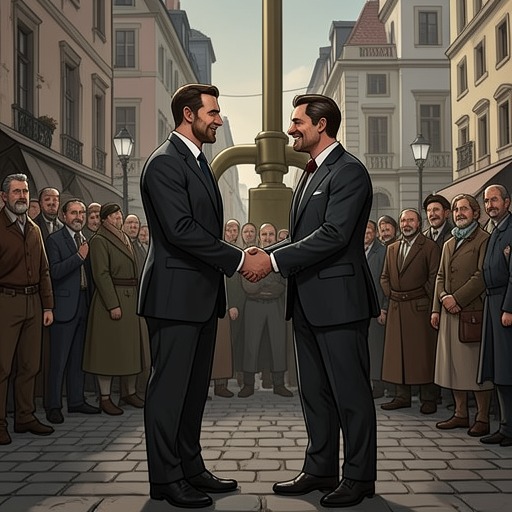
In June 2017, after Ilya’s season ends, he watches the Stanley Cup celebration from Boston. Scott is about to become a champion when the cameras show him kissing a man in street clothes on the mouth. The scene is unmistakably intimate to Ilya: it is not a teammate’s affectionate gesture but a sustained kiss, followed by Scott holding the man’s face and kissing him again. Scott smiles at him as if the surrounding celebration has receded. For Ilya, the television image is difficult to reconcile with the assumptions that have governed his own life.
The reaction is immediate and bodily before it becomes an argument about what the kiss means. Ilya stares at the screen, unable to process what he is seeing, while messages arrive from Jane asking whether he is watching and whether the man is Scott’s boyfriend. The broadcast cuts away, but the image has already altered the choices available in Ilya’s mind. He calls Shane and says he is coming to the cottage. Scott’s public act does not remove the risks of being known; it makes the prospect of choosing a shared life feel newly imaginable.
A model for Shane and Ilya
Scott’s influence becomes explicit during Shane and Ilya’s time together at the cottage. Ilya tells Shane that, after the NHL Awards, he went out with Scott. The two attended a gay bar alongside other NHL players, an experience Ilya remembers as exciting. The episode shows Scott in a different setting from the televised celebration: not only the subject of a public kiss, but someone with whom Ilya can share a night in a queer space among fellow players.
When they discuss Scott’s televised kiss and his speech at the awards, Ilya acknowledges that the gesture was brave. Shane agrees that it made him hopeful about the possibility of change. Ilya admits that it also made him jealous. The responses do not cancel each other out: Scott’s visibility offers hope, while also exposing the distance between a public declaration and the secrecy that still structures Shane and Ilya’s relationship. His example affects them precisely because it makes both the possibility and the cost of openness harder to ignore.
Shane later explains to his parents that seeing Scott kiss his boyfriend changed something inside him. It made Shane want to try to be braver and allow himself to pursue happiness. Ilya answers that the moment affected him too. This connection reaches back to Shane’s earlier conviction that he would never be the first openly queer player in the NHL. In a hockey culture where players hear homophobic slurs, the public image of Scott’s relationship gives Shane evidence that the future he once ruled out may not be impossible.
Public example and private limits
Scott’s example also changes how other characters interpret Shane and Ilya. At a public appearance where the two rivals are presented together for a shared cause, Hayden Pike notices the way Shane looks at Ilya and compares their near-revelation to Scott’s televised kiss. Shane insists that they have more control than Scott Hunter. The comparison captures the tension between their public performance as rivals and the private intimacy they are trying to protect: Scott has made visible what they are still containing.
That difference matters because Shane and Ilya’s relationship is already nearly a decade old when Shane finally voices how frightened and alone he has felt. Scott’s act does not create their love or make their choices safe. Instead, it serves as a public precedent that helps them recognize how much secrecy has cost and gives Shane a reason to attempt a different future. His narrative role is therefore larger than that of a champion or rival: by appearing openly affectionate on television, Scott makes a private life briefly visible to the people who most need to imagine one.