Shane Hollander’s sexual self-discovery
Heated RivalryShane Hollander’s sexual self-discovery is not a single revelation but a difficult process of recognizing what his experiences have been telling him, finding language for his attraction to men, and confronting the risks of being known. His private uncertainty takes shape against the homophobic culture of professional hockey; it becomes clearer in an honest conversation with Rose Landry and in his blunt admission to Ilya Rozanov, before he can describe the years of fear and secrecy he has carried.
Identity and Early Understanding
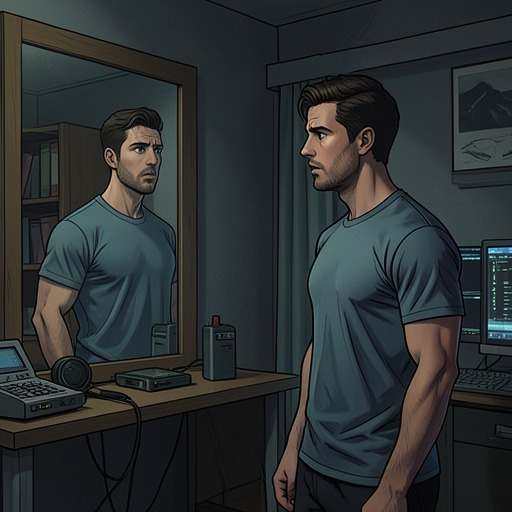
Shane has already begun to accept that he is comfortable having sex with men, but acceptance of an experience is not yet the same as a settled identity. He considers whether Ilya Rozanov might simply have been the first man to recognize an openness in him and give him the chance to explore it. That possibility leads him to wonder whether he should seek another man, but the question quickly becomes practical as well as personal: he does not know whom he could trust, and he does not want rumors about his sexuality to spread.
His uncertainty is sharpened by the contrast between his sexual history with women and what he experiences with a man. He has had substantial experience with women, yet cannot recall those encounters as genuinely satisfying. He describes himself as having gone through the expected motions while feeling little enthusiasm for them. He prefers a receptive role and finds some forms of intimacy with women easier to engage in than others; he is also attentive to whether his partners are enjoying themselves, and would stop if he believed they were not. His concern for their pleasure coexists with a growing recognition that his own desire is not being met in those relationships.
For a time, he preserves the possibility that he simply has not met the right woman. That explanation lets him avoid drawing a conclusion from disappointing experiences, even as he recognizes that what he wants with a man feels different. The tension is not between an already certain identity and a simple refusal to admit it: Shane is still working out what his experiences mean, and the explanation he gives himself changes as he becomes more candid with others.
Secrecy and the Hockey Environment
Shane’s hesitation is grounded in his surroundings, not only in private confusion. In Montreal, he sees himself as a rising player whose career ambitions would make public speculation increasingly dangerous. The NHL may present itself as more inclusive, but his experience on the ice and in the dressing room tells him that homophobic language remains common. He cannot imagine an openly queer player being accepted without a struggle, and believes whoever came out first would need exceptional courage. At this stage, he is certain he will not be that person.
The public insult directed at Ilya Rozanov makes the risk visible in a brief, ugly exchange. Ilya responds with a shrug rather than a denial, then privately treats the suggestion as only partly true. His reaction gives Shane reason to think Ilya will keep their encounters confidential: Ilya, too, has something to lose. Secrecy therefore offers a form of protection, but it also narrows Shane’s choices. He weighs abandoning sex with men, seeking someone discreet and patient, or allowing his connection with Ilya to continue while trying not to think too hard about what it means.
That narrowing helps explain why Shane’s self-discovery is inseparable from the culture of the sport. He is not simply deciding what label fits; he is calculating what can be said, to whom, and at what cost. The same competitive world in which he is expected to project confidence leaves him with no obvious safe way to speak openly about attraction to a man.
Honesty with Rose Landry
The difference between affection and sexual compatibility becomes harder to avoid when Rose Landry tells Shane that she likes him but suspects she is not satisfying him. Her directness forces him to stop reassuring her automatically. He admits that he likes her company and conversation, while acknowledging that sex between them is not working. Rose reframes the mismatch as incompatibility rather than a defect that either of them must solve, and says they cannot keep trying to make the relationship fit.
Shane remains cautious about defining himself. He tells Rose he is not sure he is like a gay man she knows, and she does not demand that he settle the question immediately. When she asks whether he has been with a man, he answers honestly. Asked whether it was better, he says it was, and explains his preference through a playful comparison of sexual roles. Rose laughs, and Shane laughs with her; the conversation leaves him feeling lighter rather than examined or judged.
The exchange matters because it gives Shane a way to state what he wants without pretending to possess a complete account of himself. Rose accepts both the answer and its uncertainty. Their decision not to continue trying to make the sexual relationship work does not erase their affection; instead, candor replaces the performance of compatibility. Her joking suggestion that she could give him another man’s number also treats his attraction as something that can be discussed without turning it into a crisis.
Naming His Attraction to Ilya Rozanov
With Ilya Rozanov, Shane moves from describing experiences to attempting a name for them. In a conversation that leaves Ilya confused about why Shane is raising the subject then, Shane blurts out that he thinks he is gay. Ilya first responds with laughter and asks what has led him to that conclusion. When Shane insists on the seriousness of the question, Ilya distinguishes his own identity from Shane’s: Ilya does not consider himself completely gay, while Shane thinks he may be.
Ilya’s eventual acceptance is simple. He tells Shane, in effect, that if Shane is gay, that is what he is, and asks what follows from it. Shane objects that it is a major matter to him, even if Ilya finds the declaration unremarkable. Their different reactions expose a meaningful gap: Ilya can make the label sound straightforward, but Shane is still confronting everything he believes the label could change. The conversation does not resolve every uncertainty, but it allows him to say aloud what he has so far only been testing in private.
Fear, Disclosure, and Narrative Significance
Later, Shane describes the larger history behind that fear. He recalls being eighteen and realizing he was attracted to his archrival, who was also a man. By the time he confronts Hayden Pike over the way others have responded to the relationship, Shane insists that the relationship with Ilya is not new simply because people have only recently learned of it. He says they have kept it secret for almost ten years and describes how frightened and alone he has felt throughout that period.
The reaction of Shane’s parents makes the duration of the secret newly tangible. His father recognizes that Shane has held it inside for all that time, while his mother worries that the rivalry might have been compromised by the relationship. Shane rejects that implication. His response underscores the distinction between hiding a relationship and failing at his professional responsibilities: secrecy has shaped his life, but it has not meant he deliberately gave up competing.
Across these moments, Shane’s self-understanding develops through speech that becomes progressively less evasive. First he considers his experiences without a firm label; then he tells Rose what has felt better and admits the mismatch in their relationship; with Ilya, he tries out the word gay; finally, he connects his fear to the years he has spent hiding a lasting relationship. The arc does not suggest that naming himself instantly removes the danger. Its decisive change is that Shane can articulate what he wants and how much the concealment has cost him, rather than treating either as something he must bear entirely alone.