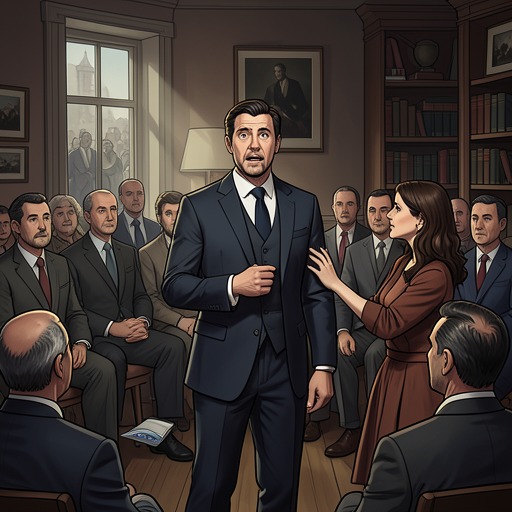
Shane and Rose End Their Dating Relationship
Heated RivalryShane and Rose end their dating relationship when Rose gives voice to what Shane has struggled to say: he cares for her, but their sexual relationship does not fit. The conversation brings his concealed experience with men into the open between them, without forcing him to settle on a label or decide what comes next. Its decisive result is not simply a breakup. Rose and Shane agree to remain close friends, giving him a confidante at a moment when he recognizes how little room he has had to discuss his desires honestly.
The mismatch becomes speakable
The conversation takes place over wine. Rose begins by acknowledging that she may be approaching a difficult subject the wrong way, and Shane immediately braces himself, experiencing the moment like a slap shot coming toward him. She tells him she likes him but has the impression that she is not what he wants. He rushes to reassure her that he likes her too, yet the reassurance cannot resolve the question beneath it.
Rose carefully offers a more specific possibility: perhaps Shane would rather kiss Miles. Shane has never faced such a direct suggestion before, and his delay in answering makes the truth harder to avoid. The scene distinguishes Rose’s question from an accusation. She is trying to understand him, not condemn him; her touch and gentle reassurance allow him time to answer rather than demanding a defense.
Shane admits that he likes being with Rose and talking to her, while acknowledging that the sexual part is a problem for him. Rose resists treating their incompatibility as a defect to be fixed. She describes them instead as two people who do not fit together in that way, and says they cannot keep trying to make the relationship work as it is. The change is consequential: the question shifts from whether Shane can perform the expected role of a boyfriend to whether the two of them can accept what their relationship actually is.
An admission without a settled label
When Rose asks whether Shane has ever been with a man, he chooses not to lie. He confirms that he has. Asked whether it was better, he says yes, and explains his preference in terms of the role he prefers sexually. The admission is specific about experience and desire, but it does not resolve his identity: he tells Rose he is not sure he is exactly like Miles. Rose accepts that uncertainty, telling him he does not need to figure everything out that day.
That distinction matters to the scene. Shane is able to acknowledge what has happened and what he prefers without turning either fact into a final definition of himself. His hesitation is not presented as a refusal of Rose’s care; it reflects how much remains unsettled for him. When Rose jokes about giving Miles his number, Shane declines and says that he needs time to work things out. The conversation therefore opens a door without pushing him through it.
A breakup that preserves affection
After they leave the bar, Rose proposes that they be friends—not as a polite consolation, but as people who genuinely care about one another. She specifically offers to be someone Shane can talk to about matters he may not have anyone else to discuss. He tells her that she is right: he does not have someone else for that, and he wants her in his life as a friend. They agree to keep in touch and to spend time together whenever they are in the same city.
Their exchange changes the meaning of the separation. Rose does not treat Shane’s attraction to men as proof that his affection for her was false, and Shane does not pretend that affection makes their sexual incompatibility disappear. Their decision to stop trying to make the dating relationship work follows from that distinction. When Rose’s response makes room for honesty rather than punishment, Shane laughs with her and feels lighter. The relief comes not from having answered every question, but from no longer having to conceal this part of the answer from her.
Secrecy and the wider stakes
The conversation occurs against a professional hockey culture that Shane regards as dangerous for an openly queer player. He knows that slurs are common in the sport and cannot imagine being the first NHL player to come out; he is determined not to let rumors about his sexuality reach the public. In that context, even a candid conversation with Rose is a rare opening, not a public declaration. He also believes Ilya will keep their encounters secret, since Ilya has as much to lose. Shane’s uncertainty is therefore shaped not only by private discovery but by the risks he associates with being known.
The book later makes the duration of that fear explicit. Shane describes having been frightened and alone since he was eighteen, when he felt attracted to a male archrival, and says that the secret relationship lasted almost ten years. His parents’ later realization that he had carried the secret inside for so long echoes what Rose recognizes here: he needs someone with whom he can speak. This breakup does not itself end his secrecy or settle his identity. It does, however, establish a form of support based on care without pressure, and marks an early moment when telling the truth makes him feel less alone.