The Montreal Voyageurs–Boston Bears rivalry
Heated RivalryThe Montreal Voyageurs–Boston Bears rivalry is an old franchise feud transformed into a personal contest between Shane Hollander and Ilya Rozanov. As the two young stars became its public faces, their games drew the heat of the teams’ history into every matchup; privately, their attraction made the hostility more complicated, turning the rivalry into both a genuine sporting conflict and a framework for concealing their relationship.
Historical Rivalry and Its Protagonists
The feud between the Montreal Voyageurs and Boston Bears is described as nearing a century in age. Over six seasons, it became personified by Shane and Ilya, whose animosity was legible even to fans in the farthest, cheapest seats. The scale of the old team conflict gave their personal antagonism a ready-made public stage: each player could be understood as representing his club, and every encounter carried more weight than an isolated matchup.
Their careers were linked at the 2009 NHL draft. Shane went to Montreal, a team he respected and a two-hour drive from his hometown of Ottawa, though being selected second stung. Ilya was drafted by Montreal’s archrival, the Boston Bears. Shane recognized that the placement would make their careers difficult to separate; had either been sent to a Western Conference team, the rivalry between them might never have taken hold in the same way.
The Rivalry on the Ice
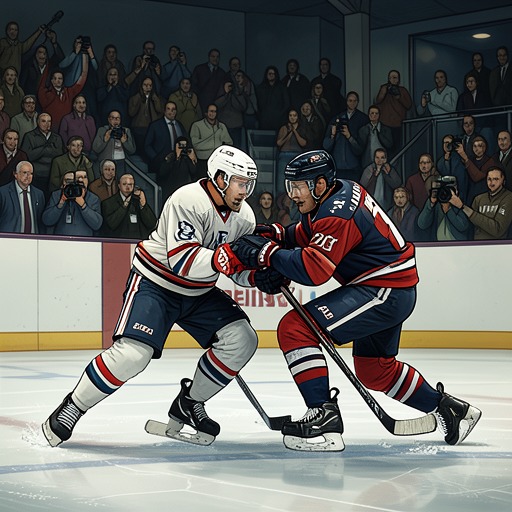
The team feud gives the rivalry its public stakes, but the games sharpen it into an immediate personal contest. In one Montreal home game, the Voyageurs were losing 4–1 to Boston with less than eight minutes remaining. Shane had produced five promising scoring chances without converting, while the Bears capitalized on Montreal’s mistakes. Ilya had scored twice, and the two faced each other at a face-off after his second goal, with Ilya cheerfully needling Shane. The score and the exchange make the rivalry concrete: it is not merely inherited team history, but a contest played out in goals, missed chances, and provocation.
Boston’s visits could tighten the mood across Montreal. On home game days the city buzzed around its hockey team, and when Boston arrived Shane felt that the city’s tension matched his own urgency to face Ilya. Ryan Price was another source of added intensity in those games. The crowd’s investment could turn overtly theatrical: fans outside the arena were shown burning what appeared to be an effigy of Ilya. The rivalry therefore extends beyond the players and the rink into a public performance in which Ilya is treated as a symbol of Boston as well as an individual opponent.
Private Attraction Behind Public Hostility
The rivalry is also the condition that makes Shane and Ilya’s relationship frightening to Shane. At eighteen, he was attracted to a man who was also his archrival; he later described how terrifying and lonely that combination had felt. Their secret relationship had lasted almost ten years by the time Shane confronted friends who assumed it was new. The private history thus ran alongside the public one for nearly a decade, while the rivalry supplied a plausible explanation for the intensity with which they watched, challenged, and provoked one another.
For Ilya, Shane seemed to embody everything the league wanted from a star: bilingual fluency, good manners, earnestness, and a polished public image. Ilya’s attraction did not dissolve his antagonism; he could desire Shane while resenting the qualities that made him such a fitting rival. That coexistence gives the feud its intimate tension. The hostility is not simply a performance invented to hide a romance, nor does their attraction erase the competitive conflict. Both remain active at once.
Secrecy, Hockey Culture, and the Rivalry’s Meaning
Shane feared that rumors about his sexuality could threaten the career he was building. Although the NHL presented itself as more inclusive, he had experienced the atmosphere on the ice and in the dressing room, where homophobic slurs were common and no player had come out publicly. He believed that whoever came out first would need extraordinary courage and was certain it would not be him. Ilya’s status as another elite player with as much to lose made him seem unlikely to expose their secret, reinforcing the concealment that kept their relationship private.
The language of hockey shows how that pressure operates alongside the rivalry. When another player called Ilya a slur, Ilya shrugged it off as partly true, then qualified that admission as only about thirty percent true. The response is wry, but it also exposes the distance between private identity and what can be acknowledged in a hostile sporting environment. The feud makes their connection visible as competition while the culture around them makes its actual nature dangerous to disclose.
When Shane’s parents learned about the relationship, his father recognized that Shane had kept the secret inside for all that time. His mother’s first alarmed thought was whether Shane had ever let Ilya win; Shane emphatically denied it. The exchange captures the rivalry’s double life in miniature: even after the secret becomes known, the competitive record matters, and the romance does not invalidate the games. The feud remains real, but it can no longer contain the whole truth about the two men at its center.