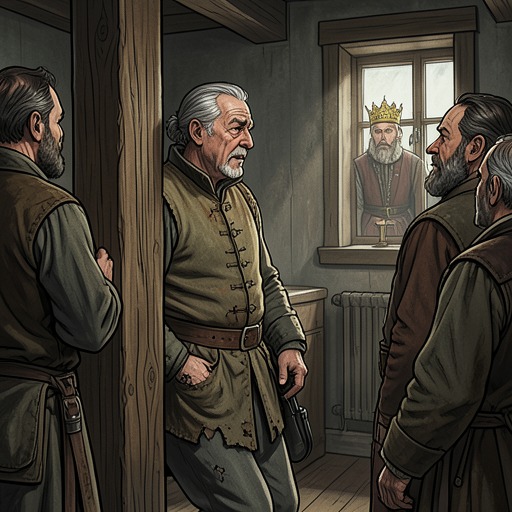
Banishment of Falstaff and the former companions of Henry V
Henry IV, Part 2The banishment of Falstaff and the former companions of Henry V makes the king’s break with his past both personal and administrative. Henry V bars his former associates from his presence on pain of death, but does not abandon them to poverty: he promises support and possible advancement if they reform. The policy draws a hard boundary around the new king while leaving a limited route back into public life.
From Personal Renunciation to Public Rule
Henry V presents the order as part of a wider change in identity. He declares that he has turned away his former self and will likewise turn away those who kept him company. Falstaff is addressed as the tutor and feeder of the king’s former riots, a description that makes their association part of the past Henry now rejects. The ban is conditional in time but severe in effect: Falstaff must not approach the king’s person within ten miles until he hears that Henry has become as he once was. The prohibition is backed by the threat of death, so the language of personal estrangement carries the force of royal command.
The order also reaches beyond Falstaff. Henry says he has acted similarly toward the rest of his misleaders, making the rupture a policy for the former circle rather than a private quarrel with one man. Their exclusion is tied to their conduct: the king will hear of their reform before restoring access or offering advancement. In this way, the proclamation separates past intimacy from present standing. Familiarity with the king no longer guarantees protection at court; changed behavior must precede renewed favor.
Support, Reform, and the Limits of Exclusion
Banishment is not presented as simple abandonment. Henry allows the former companions a competence for life, explicitly so that lack of means will not force them into wrongdoing. He also promises that, as reports of their reform arrive, they will receive advancement according to their strengths and qualities. The policy therefore combines exclusion with material provision and a conditional prospect of return to useful status. Its boundary is strict, but not described as irrevocable.
That distinction matters to the character of the order. The companions are kept away from the king and from the influence associated with their former access, yet they are not denied every form of support. Henry’s measure attempts to make reform possible while withholding the privileges of proximity. The condition is public and behavioral: their conduct must appear wiser and more modest to the world. John of Lancaster later summarizes the arrangement in those terms, saying that the king intends his accustomed followers to be well provided for, while all remain banished until their behavior earns a better appearance.
Enforcement and the Fleet
The policy becomes concrete when John of Lancaster re-enters with the Lord Chief-Justice and officers. The Lord Chief-Justice orders that Falstaff be carried to the Fleet and that his company go with him. The scene gives the king’s broad declaration an institutional consequence: an order about access and conduct is enforced through officers and detention, rather than left as a private promise between Henry and Falstaff.
John of Lancaster approves the proceeding as fair. His account stresses both sides of the measure: the king intends his former followers to be provided for, but they are all banished until their conduct appears more wise and modest. The closing exchange confirms that the exclusion is collective and still in force. Falstaff’s individual fate and the companions’ shared condition are joined in a single public settlement, administered under the authority of the Lord Chief-Justice.
The Past the Order Leaves Behind
Earlier scenes give the old association a markedly different social texture. Falstaff enters with a page carrying his sword and buckler, then asks what the doctor said about his urine; the page reports that the water itself was healthy. In another exchange, Mistress Quickly answers Falstaff’s question about his debt by recalling his oath over a parcel-gilt goblet in her Dolphin-chamber. These moments place him in a world of bodily comedy, borrowing, and remembered promises, in contrast with the measured language of royal provision and reform.
The play also shows how loyalty and self-interest mingle in the wider comic world. Bardolph claims that a soldier is better accommodated than with a wife, while Davy argues that even a knave should receive some countenance at a friend’s request. These remarks are not themselves part of Henry’s decree, but they illuminate the informal bonds and excuses against which the king’s new standard of conduct is set. The banishment turns such familiar habits into a liability at court: affection and companionship no longer suffice when the king requires wiser and more modest behavior.
Kingship and the Separation from the Former Self
The order follows scenes that frame kingship as a burden as well as an inheritance. King Henry IV asks how many of his poorest subjects are asleep while he lies awake, and concludes that the head wearing a crown lies uneasily. Later, as he sleeps, Prince Henry sees the crown beside his father’s pillow and calls it a troublesome bedfellow. After King Henry IV’s death, the new king announces that Henry V is crowned and dismisses the former courtly arrangement. The dying king’s confession about how he came by the crown adds a note of unease to the transfer of power.
Against that sequence, the banishment is more than a rejection of old companions: it is one of Henry V’s first means of defining the conduct and company of his reign. The order replaces private familiarity with public conditions, and it makes the king’s altered identity visible through a practical separation. Its final qualification prevents that separation from being merely absolute: support remains available, and advancement is possible, but only after reform. The former companions may be provided for, yet they cannot resume their old place beside the king simply because it once belonged to them.