Crushing of Northumberland's rebellion
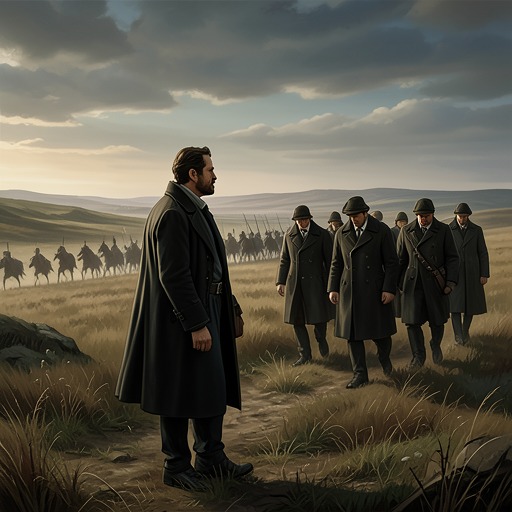
Henry IV, Part 2The Crushing of Northumberland's rebellion is presented as a decisive military defeat reported at court rather than enacted onstage: the Earl of Northumberland and Lord Bardolph, leading a large force of English and Scottish troops, have been overthrown by the sheriff of Yorkshire. The brief announcement makes the collapse plain while directing attention to a written packet for the fuller course of the fight.
Withdrawal and delayed return
Before the defeat is reported, Northumberland resolves to go to Scotland and remain there until time and advantage require his presence. His words establish a posture of postponement, not a return to immediate action: he places his future participation at the mercy of circumstances. The later news that his force has been defeated closes off that anticipated opportunity. The evidence does not describe what prompted the sheriff’s victory or say whether Northumberland himself was present in the fight, so the reported outcome should not be mistaken for a staged account of his capture or death.
The decision to wait also gives the rebellion’s outcome a particular shape. Northumberland’s plans depend on a future moment when his company will be needed; the report instead announces that the forces associated with him have already been beaten. The reversal is therefore conveyed through the contrast between a deferred intention and a completed military loss, without supplying the intervening movements that connect them.
The reported defeat
The announcement identifies two principal rebel leaders, the Earl of Northumberland and Lord Bardolph, and says that they had a great power of English and Scottish troops. It attributes their overthrow to the sheriff of Yorkshire. That is the report’s clearest account of the balance of power: a substantial mixed force has been defeated by a named local officer. The speech does not give the size of either side, the date or location of the engagement, or the tactics used, and it does not explain the sheriff’s command or the circumstances of the victory.
The speaker says that a packet contains the manner and true order of the fight at length. The distinction between the short spoken announcement and the fuller written account matters: the defeat is established as fact, but its detailed sequence is referred elsewhere. The packet promises an ordered account rather than a scene witnessed directly by the audience. In the material available here, that promised account is not reproduced, so the event’s military particulars remain undisclosed even as its result is certain.
A recurring pattern of defeat and report
The play has already introduced the victory at Shrewsbury as news of King Henry’s triumph over Harry Percy and his troops. Morton, fleeing from that battle, describes death as having frightened his party. That earlier defeat is not the crushing of Northumberland’s rebellion: it concerns a different force and an earlier conflict. Its presence nevertheless establishes a pattern in which rebellion and military reversal reach the audience through reports, with the violence summarized by those who have survived or arrived afterward. Here, too, the decisive fact is delivered verbally, while the fight itself remains at a distance.
The rebellion also belongs to a history of political loyalties that have changed rapidly. Warwick recalls that Richard II and the Earl of Northumberland were great friends less than ten years earlier, before the subsequent division of their amity. This retrospective frame does not explain the sheriff’s victory, but it places Northumberland’s defeat against a past in which friendship and political alignment were not stable. The rebellion’s destruction is thus both a military result and a further turn in a political history marked by shifting relations and successive losses.
Outcome and limits of the account
The report confirms the overthrow of Northumberland and Lord Bardolph’s force; it does not, in the evidence presented, establish either leader’s individual fate after the defeat. Nor does it describe a settlement, arrests, or the surrender of surviving troops. The event’s consequence that can be stated securely is the destruction of the military power with which they had acted. By making the outcome definite but withholding the battle’s full particulars, the play gives the rebellion a clear ending as a campaign while leaving its mechanics to the packet’s unseen narrative.