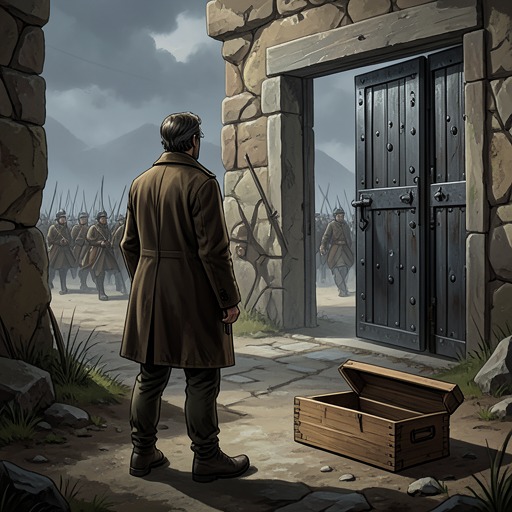
Defeat of the Earl of Northumberland and Lord Bardolph
Henry IV, Part 2The Defeat of the Earl of Northumberland and Lord Bardolph is a decisive military reversal in the rebellion against King Henry IV, but the play presents it through a report rather than a staged battle. A messenger announces that the sheriff of Yorkshire has overthrown the two rebel leaders and their substantial English and Scottish force. The packet accompanying the news promises the fight’s full account; the king, however, receives victory while his own failing body prevents him from rejoicing in it.
Causes and Political Background
The defeat belongs to a conflict whose loyalties have already proved changeable. In the king’s recollection, less than ten years earlier Richard II and Northumberland were close enough to feast together; only two years after that, their amity had divided. The recollection places the rebellion within a longer history of political friendship turning into estrangement. Northumberland’s defeat is therefore not simply the collapse of a force in the field: it is another reversal in the fortunes of a powerful figure whose relations with the crown have changed over time.
The play has earlier established Shrewsbury as a site of rebel defeat. Rumour announces that King Henry’s forces have beaten young Hotspur and his troops there, while Morton later describes having fled that battle amid the threat of death. Those earlier accounts concern a different clash and should not be confused with the later overthrow of Northumberland and Lord Bardolph by the sheriff of Yorkshire. Their contrast nevertheless gives the later news its place in a widening sequence of reversals: rebellion is met by defeat, and reports of military outcomes become the means by which the court learns how the conflict is moving.
The Report of Defeat
The messenger’s announcement identifies the defeated leaders, the scale and composition of their force, and the source of their defeat. Northumberland and Lord Bardolph had with them a great power of English and Scottish troops, but the sheriff of Yorkshire has overthrown them. The concise declaration establishes the outcome firmly while withholding the combat itself. No tactics, individual acts of courage, or precise losses are described in the announcement.
Instead, the messenger presents a packet containing the manner and true order of the fight at length. This physical document matters to the scene’s presentation of military knowledge: the court first receives a compact public conclusion, then a written account said to supply the fuller sequence. The audience is likewise placed at a remove from the battlefield. It learns who has won and who has lost through a speaker’s report, with the packet standing as evidence of details not dramatized in the scene. The distinction between headline result and fuller record gives the news both immediacy and an acknowledged documentary depth.
Reception at Court
The victory arrives as news the king believes he ought to welcome. He says that he should rejoice at it, but in the same moment his sight fails and his brain turns giddy; he calls those near him and declares himself seriously ill. The political result and the bodily crisis thus meet in a sharply divided response. The crown’s cause has gained an advantage, yet the king cannot experience that advantage as uncomplicated relief or triumph.
This response also places the report within the play’s sustained attention to the burdens of kingship. Shortly before the news, the king has reflected on how many of his poorest subjects sleep while he remains troubled by the responsibilities attached to the crown. His illness makes that burden physical: public rule and private vulnerability occupy the same scene. The defeat may strengthen the royal position, but it cannot restore the king’s health or free him from the pressures of governing.
Consequences and Significance
As reported, the defeat removes Northumberland and Lord Bardolph’s large force from the immediate contest and marks a major setback for the rebel cause. The messenger names the sheriff of Yorkshire as the victor, emphasizing that the royal side’s success is conveyed through a specific local authority rather than an account of the king personally directing the fight. The packet, meanwhile, promises a fuller record without making that record part of the scene’s spoken report.
The event also carries a temporal irony. The king recalls a former friendship between Richard II and Northumberland just as the news confirms Northumberland’s defeat in the present conflict. Political bonds that once seemed secure have become part of the history leading to rebellion and its suppression. Yet the report does not close the scene with uncomplicated restoration: its military certainty is set against the king’s failing sight and sudden illness. The rebels have been overthrown, but the ruler who should welcome that outcome is himself in urgent need of care.