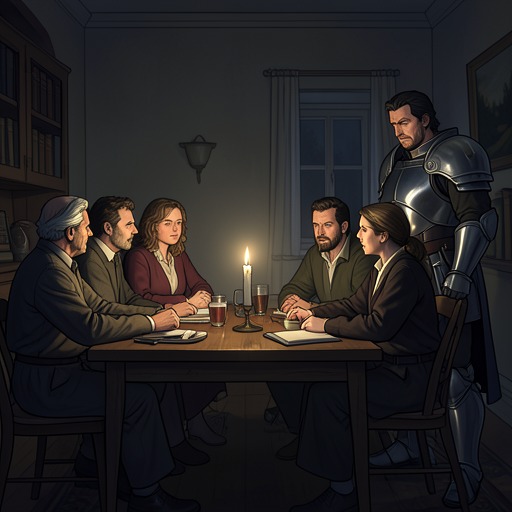
Falstaff and Mistress Quickly
Henry IV, Part 2Falstaff and Mistress Quickly are bound by an unsettled debt in which private familiarity becomes a claim that must be heard and answered. Their exchanges connect money to intimacy: Quickly remembers what Falstaff promised her, while Falstaff’s repeated need to borrow makes repayment a continuing source of conflict.
Debt, intimacy, and claim
Quickly presents the debt not as a bare sum but as part of a history of trust. She says Falstaff swore upon a parcel-gilt goblet in her Dolphin-chamber, and recalls him kissing her, promising that she would soon be called madam, and asking her to fetch thirty shillings. These remembered details give her claim both a financial and a personal force: she insists that his conduct toward her created an obligation, and challenges him to deny it under oath. Her description of having borne a hundred marks, while repeatedly being put off, shows how delay has shifted the burden onto her. When the Lord Chief-Justice tells Falstaff to pay what he owes and make amends for the wrong he has done her, the dispute is recognized as more than a private quarrel over money. The judgment separates the debt, which can be paid in sterling, from the injury, which money alone cannot undo.
A wider economy of borrowing
The dispute sits within Falstaff’s wider dependence on credit. He describes the depletion of his purse as an incurable consumption: borrowing, he admits, only keeps the loss going. He then sends letters to John of Lancaster, Prince Henry, and Westmoreland, seeking support from people with access to power. Elsewhere he asks the Lord Chief-Justice for a thousand pounds to furnish an expedition and is refused. These episodes sharpen the imbalance in his dealings with Mistress Quickly: where powerful men can deny him outright, her claim rests on personal trust and a debt she says she has long been made to carry.
The debt also reaches toward the things Mistress Quickly owns. When she is reluctant to pawn her plate, Falstaff tells her to leave it alone and says he will find another way. His response does not settle what he owes; it shows that their financial entanglement persists even as he tries to prevent her from sacrificing her own property. The relation is therefore neither a simple exchange of money nor a settled act of generosity: her resources remain exposed to his need, while the promise of another solution keeps repayment deferred.
Promised advancement and unequal credit
The promise that Mistress Quickly would soon be called “madam” gives their bond a future-facing dimension. Falstaff’s words, as she recalls them, cast her credit not simply as money lent but as trust in a promised change of standing. Yet the anticipated honor does not arrive in the evidence: instead, Quickly says she has borne the hundred-mark burden while being repeatedly put off. The contrast makes the promise part of the debt’s cost, because what remains unpaid is not only money but also the future Falstaff had invited her to expect.
The relationship’s imbalance is sharpened by the different resources each can invoke. Quickly brings her account of their private familiarity into a public hearing, while Falstaff’s wider pattern is to seek money from people able to refuse him or to send letters to powerful patrons. Her claim therefore rests on an obligation he incurred through personal access and a promise of advancement, rather than on the institutional leverage available to those patrons. The evidence records the demand for payment and amends, but does not show Falstaff fulfilling either; their connection remains marked by an unresolved claim.
The debt remains part of a larger ledger
Near the play’s end, Falstaff tells Shallow that he owes him a thousand pounds. This separate obligation does not settle or explain the debt claimed by Mistress Quickly, but it extends the pattern in which Falstaff’s promises and borrowing bind personal relationships to money. His account with Quickly remains without a recorded resolution, while the late exchange with Shallow makes clear that indebtedness continues to follow him beyond their dispute.