Falstaff's recruitment of soldiers
Henry IV, Part 2Falstaff's recruitment of soldiers is presented not as a pageant of martial courage but as a muster shaped by lists, bodily judgments, appeals, and money. Falstaff examines Shallow’s candidates, rejects some men from service, and assigns a weapon to Wart; the scene makes recruitment a negotiation over who will bear military risk and who can escape it.
The Muster and Its Participants
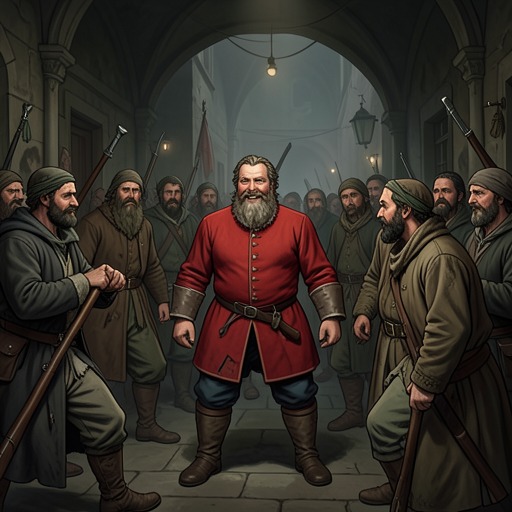
Falstaff asks to see the men Shallow has assembled, and Shallow calls them forward from a roll, beginning with Ralph Mouldy. The roll gives the process an administrative shape: candidates are summoned and assessed individually, while Falstaff holds the authority to decide whom he will take. Shallow is not merely an observer. He supplies the candidates and, when Falstaff leaves the selection to him, names Mouldy, Bullcalf, Feeble, and Shadow.
That delegated choice does not settle the matter. Falstaff retains the power to reject Shallow’s selections, and the difference between naming a man and accepting him becomes important. The muster is therefore a small chain of command: Shallow proposes, candidates plead or bargain, Bardolph intervenes, and Falstaff makes the consequential decisions. The roll records people as potential soldiers, but the exchanges around it show that their service remains contested.
Selection by Usefulness
Falstaff challenges the idea that a recruit should be chosen for an impressive frame. He asks whether limb, strength, stature, bulk, and appearance are what matter, then argues for spare men rather than large ones. His reasoning is practical rather than heroic: a conspicuous body can present an easy target, while a smaller man may be more useful in the field. The standard of fitness is not physical grandeur but the particular use a man can be put to.
Feeble becomes the clearest example. Falstaff identifies him as a woman’s tailor and treats his likely speed in retreat as an advantage. The joke depends on a reversal: a quality that might make Feeble seem an unlikely soldier becomes, in Falstaff’s calculation, a reason to recruit him. The scene does not show that Feeble is brave or capable in battle; it shows Falstaff valuing a predicted ability to run away. Military selection is measured against the risks and movements of actual fighting, not an abstract ideal of courage.
Falstaff also orders a caliver placed in Wart’s hand. That instruction turns the muster from verbal appraisal toward equipment and assignment: a recruit is not only named but paired with a weapon. The surviving evidence does not establish what Wart does with it or whether the selected men later fight. It does establish that Falstaff’s choices are directed toward preparing a force, even as his criteria undercut the dignified language usually associated with military service.
Appeals, Payments, and Exemption
Mouldy and Bullcalf do not simply accept the prospect of being taken. Bullcalf appeals to Bardolph to stand as his friend and offers money, specifying French crowns in his appeal. After Falstaff and the justices leave, Bullcalf makes the request again, bringing the financial offer into sharper view. His attempt shows that recruitment can be resisted through personal influence and payment, although the scene does not confirm that Bardolph accepts the money or secures Bullcalf’s release.
Mouldy likewise asks Bardolph to stand his friend, invoking his old dame. His appeal gives the decision a household consequence: service would affect not only the recruit but someone at home whom he names as a reason for sparing him. The request remains a plea rather than a demonstrated exemption. Together, the two appeals make clear that the muster is not an impersonal sorting of bodies; it is a point at which family claims, friendship, and money meet the authority of the recruiter.
Bardolph says he has three pounds to free Mouldy and Bullcalf. That offer makes the financial mechanism explicit, but it does not mean that the sum is paid or that the two men are freed by Bardolph. The outcome shown is Falstaff’s own decision: he tells Mouldy to stay at home until he is past service and tells Bullcalf to grow until he comes to it, refusing both. Their exemption is thus represented as Falstaff’s choice, even though Bardolph’s proposed payment forms part of the surrounding negotiation. The scene distinguishes an attempted purchase of release from the recruiter’s final exercise of discretion.
Risk, Authority, and the Limits of the Record
The contrast between Bullcalf’s offered money, Mouldy’s appeal for his household, and Falstaff’s preference for spare men reveals how unevenly military obligation is distributed. Those summoned have reasons to avoid service; the recruiter, meanwhile, judges their bodies according to his own estimate of usefulness and danger. The episode does not describe a formal rule governing exemptions, nor does it give a complete account of the men’s circumstances. Its evidence lies in the particular bargains and judgments made in front of the roll.
The wider play also frames Falstaff’s dealings through debt and requests for funds. He asks the Lord Chief-Justice for a thousand pounds to furnish himself, and the request is refused. Later, Shallow insists that Falstaff not be excused from payment, and Falstaff acknowledges owing him a thousand pounds. These moments do not prove that Shallow’s debt financed the recruitment or that money changed the muster’s outcome. They do place the recruiting scene within a world where military provision and personal obligations coexist, and where sums of money repeatedly measure the relationships between men.
The recruitment’s significance lies in this double view of military power. A roll and a weapon make the muster look orderly; the appeals, proposed payments, exemptions, and tactical jokes expose the human decisions beneath that order. Falstaff’s command over who is marked for service is real, but it is exercised through comic, contingent judgments rather than a stable ideal of soldierly worth. The scene makes war’s manpower visible as a matter of selection and negotiation, while leaving the recruits’ eventual service beyond what it records.