Henry V rejects Falstaff
Henry IV, Part 2Henry V rejects Falstaff in a public encounter that turns their former intimacy into a test of the new king’s authority. Falstaff greets him as the beloved Prince Hal, but Henry answers by disavowing his old identity and banishing the companions associated with it; the rejection is severe, yet accompanied by provision for their needs and a limited condition under which they might return to favor.
The public encounter
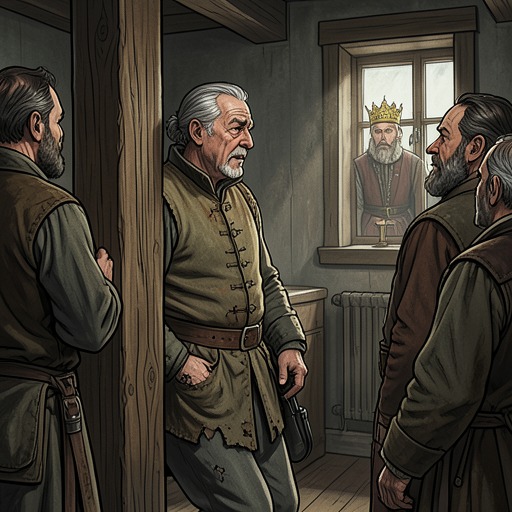
The scene begins with Henry V entering with his train, including the Lord Chief-Justice. Falstaff addresses the king as “King Hal” and “my royal Hal,” then greets him again as “my sweet boy.” His language insists on the old relationship: the king is still the familiar companion whom Falstaff can address through private affection. The titles and setting, however, make that familiarity newly consequential. Falstaff speaks to a sovereign in the presence of his attendants, and his intimate manner is immediately exposed to public judgment.
Henry first directs the Lord Chief-Justice to deal with “that vain man.” The Chief-Justice asks Falstaff whether he has his wits and understands what it means to speak. The exchange places an official intermediary between the king and his former companion before Henry delivers his own answer. Falstaff persists, calling the king “my Jove” and “my heart”; the extravagant address treats affection as if it could still bridge the change in rank. Henry’s response makes clear that the old terms of access no longer apply.
Disavowing the former self
Henry’s declaration, “I know thee not, old man,” refuses Falstaff’s claim to recognition. He tells him to turn to his prayers and contrasts Falstaff’s white hair with the role of fool and jester. The rebuke makes age visible in the very relationship Falstaff tries to revive: the “sweet boy” he addresses is now a king, while Falstaff appears as an old man whose familiar conduct has become incompatible with the new public order.
Henry explains the refusal as a larger change in identity. He says he has “turn'd away my former self” and will likewise turn away those who kept him company. Falstaff is therefore not rejected only for this greeting or for a single act in the scene; he is included among the companions Henry identifies with his former life. The king’s announcement converts personal separation into policy: those who were once close to him are to be kept at a distance from his person.
The terms are explicit. Falstaff is banished “on pain of death,” and the distance imposed is ten miles from the king. Henry makes the banishment conditional only in a limited sense: if Falstaff hears that he has returned to his former way of being, he may approach, and their former relationship may resume. Until then, the old intimacy cannot be treated as an entitlement. The condition places the burden on future conduct while preserving a distinction between the king’s present decision and what might happen if that conduct changes.
Punishment and provision
The sentence is not simple abandonment. Henry says he will allow Falstaff the means to live so that lack of money does not compel him to evil. He also speaks of hearing whether Falstaff and his companions reform themselves. The language pairs a hard boundary with material support: they are excluded from the king’s immediate presence, but their livelihood is not left wholly to chance. The allowance does not cancel the banishment; it establishes that mercy and access to royal authority are separate matters.
The later order makes the boundary concrete. The Lord Chief-Justice directs officers to carry Sir John Falstaff to the Fleet and to take all his company with him. Falstaff’s companions, not only Falstaff himself, are included in the enforcement. The movement from the king’s verbal sentence to the Chief-Justice’s command shows the rejection passing from declaration into action. Falstaff’s appeal to personal affection has not displaced the institutional response: officers carry out the order under the authority of the court.
The limits of reconciliation
The account also preserves a distinction between banishment and permanent deprivation. Henry intends that Falstaff’s former followers be well provided for, but they remain banished until their conduct appears wiser and more modest to the world. The standard is public as well as personal: reform must become visible in behavior, rather than rest on Falstaff’s claim to an old bond with the king. Support is promised, but return is not immediate, and the Chief-Justice confirms that the banishment remains in force.
This combination gives the rejection its defining tension. Henry does not restore the companionship Falstaff assumes still exists, and the threat of death, the ten-mile limit, and the transfer to the Fleet make the separation unmistakable. Yet he does not simply cast the former companions into destitution. Falstaff’s familiar salutations meet a king who claims a changed self; the king’s care for their material needs, in turn, does not undo his refusal to admit them to his presence. The episode closes their former intimacy as a political relationship while leaving their future conduct, rather than past familiarity, as the stated basis for any change.