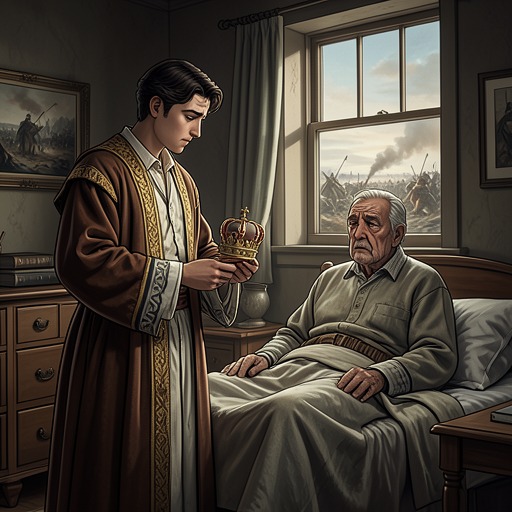
Prince Harry takes the crown
Henry IV, Part 2Prince Henry takes the crown from King Henry IV’s pillow in a scene where a possible act of seizure becomes an examination of inheritance, filial duty, and the cost of rule. The crown moves briefly onto the prince’s head, but his explanation makes its weight—not possession—central: he says he believed his father dead, tried the emblem of office as an enemy, and brings it back. The act places the vulnerable king’s body beside the political authority that must outlast it, while leaving the succession unsettled in feeling even as it appears immediate by blood.
Background and the crown at the bedside
Earlier, King Henry IV contrasts the sleep available to his subjects with his own inability to rest. He imagines thousands of his poorest subjects asleep and asks why sleep can visit a wet sailor amid danger but deny a king on a still night. His complaint culminates in the line, “Uneasy lies the head that wears a crown.” The later image of the crown lying on a pillow gives that reflection physical form: the object associated with kingship is placed where a head should rest, beside a ruler whose failing body cannot escape the demands of office.
The taking occurs during a bedside vigil. Prince Henry has stayed with the king after the others withdraw, and he sees the crown lying on the pillow. He wonders why it should be such a troublesome bedfellow. The crown is at once an object within reach and a sign of the authority that may soon pass to him; its proximity makes succession intimate, but not easy. The scene does not begin with a public ceremony or a formal transfer. It begins with a son alone beside his father and with the emblem of rule lying between them.
Taking the crown and asserting inheritance
King Henry IV discovers that the crown is gone and asks who took it from his pillow. When told it had been left there, he concludes that Prince Henry has taken it and fears that the prince has mistaken his sleep for death. That fear turns the act into more than a private movement of an object: for the king, it raises the possibility that his son has treated a living ruler as already dead and claimed the office before its time.
Prince Henry does not deny taking the crown. He also states the basis on which he understands it to be his: it is due to him and derives to him immediately through his place and blood. His claim makes hereditary succession explicit, but the scene does not let that claim settle the moral meaning of his action. The prince’s language of immediate inheritance stands beside his admission that he placed the crown on his own head. The physical act can therefore look like anticipation of power even as he presents the right itself as something conferred by descent, not seized by force.
The prince’s explanation and return
Prince Henry explains that he came to look upon his father believing him dead, and that he was nearly dead himself from the thought that the king had died. He says he spoke to the crown as if it could hear. In that address, he accuses it of consuming the person who bears it; he then says he put it on his head to try it as an enemy that had murdered his father. The explanation recasts the brief wearing of the crown as a test of its burden and an accusation against the office, rather than an uncomplicated celebration of possession.
He returns the crown to the king, declaring that he had wished to forestall the rebuke by speaking before his father could deliver it. The return matters as an action in its own right: the prince does not keep the emblem after asserting that it descends to him. His account holds together filial grief, acknowledgment of inheritance, and suspicion of what kingship does to its bearer. The crown has been on his head, but the scene makes his willingness to give it back part of what his conduct means.
Succession, mortality, and the burden of rule
King Henry IV initially names the apparent transfer in stark terms, declaring that Harry the Fifth is crowned and calling for royal state and its forms to be put down. The language makes the change feel both accomplished and destabilizing: the son’s future title rises as the father’s authority falters. Yet the crown’s return prevents the moment from becoming a simple image of displacement. The scene instead brings inheritance into contact with an endangered body, a son’s grief, and a father’s apprehension about being prematurely counted dead.
The king’s later prayer over how he came by the crown, and that it may live with his son in true peace, extends the scene beyond a question of who possesses the object. The crown carries the history and consequences of rule into the next reign; the son receives an inheritance whose legitimacy is joined to an ethical hope for peace. The episode’s decisive tension is therefore not whether Prince Henry has a hereditary claim—he says plainly that he does—but what it means to take up kingship when its bearer is mortal and its authority has been won through a troubled past.