Prince Henry
Henry IV, Part 2Prince Henry, also known as Harry and later King Henry V, stands at the turning point between the disorder of his youth and the public responsibility of rule. The play associates him with the victory over Harry Percy at the Battle of Shrewsbury, but also shows him reckoning with time wasted in the company of Poins and Falstaff. His decisive change comes beside his dying father: left alone with the crown on the king’s pillow, he watches over the old king and then succeeds him.
Identity and Introduction
The play first places Prince Henry within the political report of the Battle of Shrewsbury. Rumour announces that King Harry has won there, defeating Harry Percy and his troops. The news makes Prince Henry’s military importance public before the play turns to the private and political consequences of the victory. The report is triumphant, but another account from Shrewsbury recalls the terror of the battle: the speaker says that death appeared in its ugliest form and frightened the rebel party. Together, these accounts distinguish the victorious outcome from the fear experienced by those caught in the fighting.
Prince Henry’s later scenes locate him in London with Poins, where he admits that he is weary and feels blame for profaning precious time through idleness. The admission does not erase his association with the tavern company; instead, it shows him becoming conscious of the distance between that life and the demands approaching him. The preceding account of someone bare-headed and sweating while searching taverns for Sir John Falstaff sharpens the contrast between restless comic activity and the prince’s growing awareness that time has a cost.
Conduct and the Use of Time
The prince’s sense of wasted time becomes more striking beside the king’s sleeplessness. King Henry IV thinks of the thousands of his poorest subjects who are asleep while he, burdened by office, cannot rest. His lament ends with the line, “Uneasy lies the head that wears a crown.” The play gives the prince a different relation to time: he recognizes that his own hours have been spent idly, while his father experiences the crown as a weight that denies even sleep.
That contrast prepares the prince’s transition without making it a simple conversion from frivolity to effortless authority. His admission of blame is a moment of self-recognition, while the king’s sleeplessness supplies the political reality into which he must move. The play places the prince’s private judgment about wasted time beside the bodily and mental strain of reigning, so succession carries an obligation rather than merely a prize.
The Crown and Succession
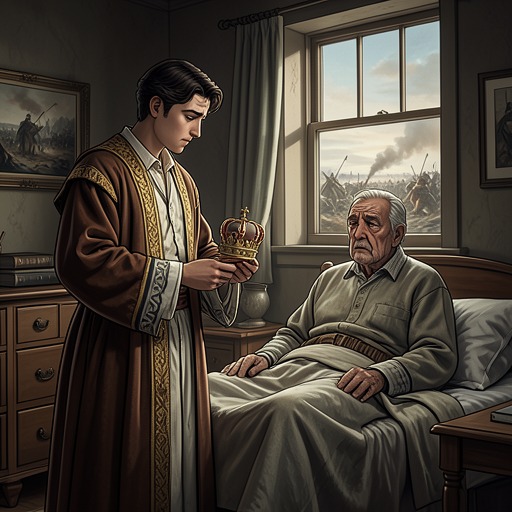
After the reports of renewed rebellion, Prince Henry chooses to remain beside his father. When the others leave, he is alone with the king and the crown lying on the pillow. He asks why it should lie there as such a troublesome bedfellow, making the emblem of royal authority appear physically close to the dying king and inseparable from the disturbance of his rest. The crown is not simply displayed: its place beside the king’s head turns succession into an immediate, intimate problem.
The king’s deathbed language gives that transfer a further complication. He speaks of how he came by the crown and asks God’s forgiveness, praying that it may live in true peace. Those words concern the king’s own acquisition of power, not a confession by Prince Henry; nevertheless, they place the inheritance within a history of disputed legitimacy. The prince receives an office whose past is morally and politically unsettled, and whose future must be secured through his own conduct.
Change and Narrative Significance
The succession is marked by a change in public identity: the prince who has been called Harry is now announced as King Henry V. The play’s staging makes the change legible through presence and ceremony: after remaining with his father, the new king appears attended and is greeted by the Lord Chief-Justice. The brief entrance establishes that private succession has become public rule, even as the evidence here does not yet detail the new king’s policies or his response to his former companions.
Prince Henry’s arc is therefore built through contrasts rather than a single declaration. The victory at Shrewsbury places him in the history of rebellion; Poins and the tavern world recall the use of time he judges wasteful; and the crown on his father’s pillow makes the consequences of inheritance visible. His accession converts those contrasts into a new political identity, while the king’s final concern about the crown’s origins leaves the new reign shadowed by the question of how authority can be made peaceful and legitimate.