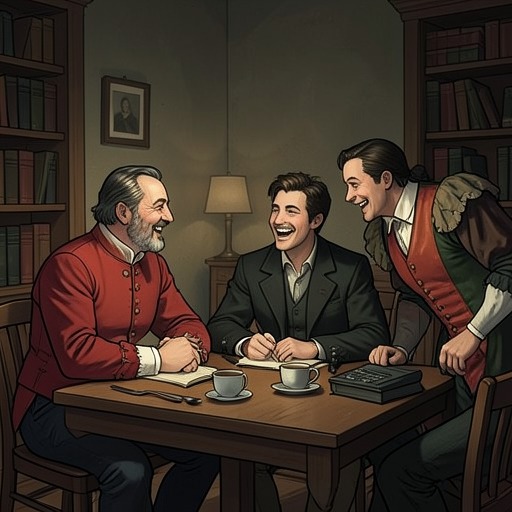
Prince Henry and Falstaff
Henry IV, Part 2The relationship between Prince Henry and Falstaff is a conspicuous bond of fellowship that the play ultimately makes subject to a test of character and public duty. The prince recognizes a likeness between himself and Falstaff in their stubbornness, but insists that their future conduct will show what that likeness means. Once the prince becomes king, Falstaff’s affectionate greeting meets not a return to their old intimacy but a formal rejection: the former companion is named among the prince’s misleaders and kept at a distance from the royal person.
Fellowship and the test of character
Prince Henry’s account of the bond is not simply that Falstaff has led him astray. He tells Falstaff that Falstaff thinks him as deep in the devil’s book as the two of them are, alike in “obduracy and persistency.” The comparison makes their connection reciprocal: the prince does not claim innocence or present Falstaff as the sole source of his conduct. Yet he immediately sets a limit on what that likeness proves. “Let the end try the man,” he says, making the final measure of character depend on what each does in the end rather than on their shared reputation or past habits.
That formulation gives the relationship a future tense. The prince can speak from within the same unruly fellowship as Falstaff while reserving the right to become different from him. Their closeness is therefore also a test: Falstaff’s persistence in the old relation cannot guarantee that the prince will remain the companion Falstaff expects. The play’s later reversal answers the challenge the prince has stated, not by erasing the past, but by showing that past intimacy does not decide the king’s conduct.
The prince’s change and Falstaff’s expectation
The transition from prince to king is marked by a changed account of the self. After taking the crown, Prince Henry declares, “Harry the Fifth is crown'd: up, vanity!” The declaration frames kingship as a break with vanity and with the earlier life the new ruler must leave behind. In addressing the princes, he says that his father is gone into the grave and that his affections lie there with him. That statement concerns his father, not Falstaff, but it helps establish the scale of the change: the new king presents his former attachments as belonging to a life that has ended.
Falstaff’s greeting at the king’s public appearance exposes the distance between his expectation and the new order. He hails him as “King Hal” and “my royal Hal,” combining the familiar name with the language of royal allegiance. The greeting carries their old closeness into a setting where the prince’s identity is now inseparable from the crown. Its warmth does not alter the king’s response. Instead, the scene makes the gap between Falstaff’s familiar address and the king’s public role unmistakable.
Rejection, distance, and provision
The king’s answer names the intimacy Falstaff once occupied even as it ends his access to it. He identifies Falstaff as “the tutor and the feeder of my riots,” acknowledging a formative role in his former behavior rather than pretending that their association never existed. He then makes continued proximity conditional on reform and declares, “Till then, I banish thee, on pain of death,” adding that he has done the same with the rest of his misleaders. The decision is both personal and political: Falstaff is rejected as a companion, and his exclusion is expressed as an order governing access to the king.
The banishment is severe, but it is not a simple wish to destroy Falstaff. The king allows him “competence of life,” explaining that lack of means should not force him into evil, and says that reform may change the terms of their future relation. Material provision thus survives where intimacy does not. The king separates care from companionship: Falstaff is not restored to the royal circle, but neither is he left without support. The condition is explicit, however; any return to favor depends on a changed life, not on the old claim of familiarity.
The relationship’s final meaning
The king’s choice gives the prince’s earlier words about letting the end try the man their dramatic answer. The shared obduracy and persistence do not lead to an identical future. Falstaff approaches the new king as though personal history can sustain their former bond, while the king defines himself through restraint, distance, and an order that reaches beyond this one friend to the other misleaders. Their relationship consequently stages the cost of the prince’s transformation: the past is acknowledged, but it cannot command the present ruler.
Nor does the rejection reduce the relationship to a simple opposition between a virtuous king and a merely corrupt companion. The king’s own phrase, “the tutor and the feeder of my riots,” binds Falstaff to a real part of his past, and the offer of subsistence preserves a measure of responsibility toward the man he banishes. What ends is not the fact of their history but Falstaff’s claim to enter the king’s future on its old terms. Fellowship yields to sovereignty, while the king’s conditional mercy leaves reform—not intimacy—as the only stated route toward a different outcome.