Shallow
Henry IV, Part 2Shallow is a Gloucestershire esquire and justice of the peace whose household provides the setting for Falstaff’s recruitment of soldiers. The play gives him a small but revealing part: through the roll of men and the negotiations surrounding it, local legal status meets the practical, compromised business of raising an army.
Identity and Setting
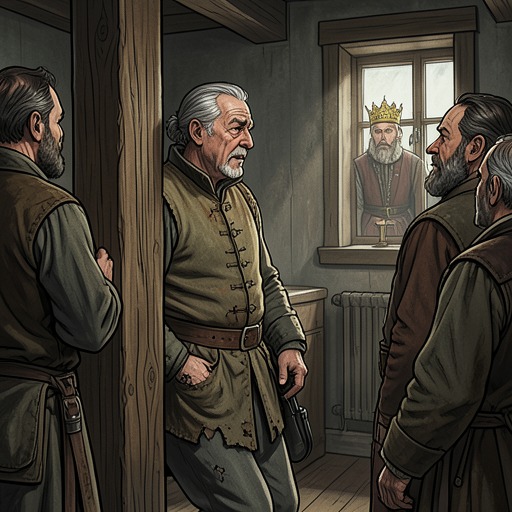
Shallow appears at his house in Gloucestershire, where he is introduced alongside Silence and a group of prospective recruits. Asked to identify himself, he names himself Robert Shallow, describes himself as a poor esquire of the county, and states that he is one of the king’s justices of the peace. The introduction establishes both his local standing and the modest means with which he associates himself. His authority is grounded in county office rather than in the high politics of the court. Yet his house is not merely a domestic backdrop: it is where the recruitment roll is produced and where Falstaff’s party assesses the men available for service.
The Recruitment at His House
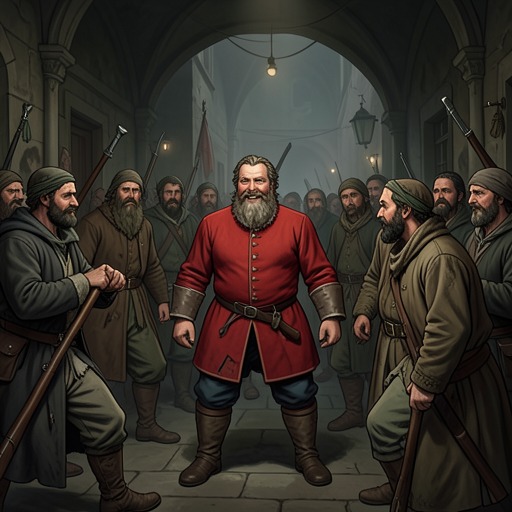
Shallow participates in the muster by asking for the roll and inviting Falstaff to inspect it. The exchange makes his household part of the machinery through which men are selected for military service. The roll gives the scene an administrative surface, but the decisions made around it quickly show that recruitment is also a matter of bargaining and personal advantage. The recruits’ attempts to secure exemption expose that bargaining directly. Bullcalf appeals to Bardolph for help and offers French crowns; Bardolph, in turn, says that he has three pounds to free Mouldy and Bullcalf. The evidence does not establish that Shallow accepts money or arranges these payments. Instead, it places him in a process where the nominal selection of soldiers is accompanied by attempts to buy release. Falstaff, rather than Shallow, makes the decisive choices. He rejects Mouldy and Bullcalf, telling Mouldy to remain at home until he is past service and Bullcalf to grow until he is fit for it. He then disparages Feeble’s likely conduct in a retreat, asks for the spare men, and directs that Wart be given a caliver. These judgments make the muster less a straightforward measure of military fitness than a comic, uneven sorting of bodies for service.
Authority and Comic Scrutiny
Shallow supplies the roll and the setting, but Falstaff dominates the scene’s judgments. As the party leaves, Falstaff says that he sees the bottom of Justice Shallow and reflects on old men’s susceptibility to lying. This is Falstaff’s assessment, not an independent statement of fact about Shallow; its force lies in turning the justice himself into a subject of scrutiny after he has helped facilitate the inspection of others. The contrast gives Shallow’s office a double aspect. He is a county justice with a recognized role in the recruitment encounter, yet he does not control the scene’s final decisions or its comic interpretation. Falstaff’s dismissive remark punctures the dignity attached to the title without showing that Shallow has lost his position or that any formal consequence follows.
Return and Narrative Role
Shallow appears again in Act V at his Gloucestershire house, with Falstaff, Bardolph, and a Page present. The supplied action establishes the return to his home and his continued place in the play’s local, comic world, but it does not specify a new decision or outcome for him in that scene. Across these appearances, Shallow connects county office and household hospitality to the larger demands of war. His role is not that of a battlefield participant: he is the local justice whose roll helps set recruitment in motion, while Falstaff’s choices and judgments expose the disorder and self-interest surrounding that process.