The burden of kingship
Henry IV, Part 2The burden of kingship in the play is both bodily and political: the ruler bears an office that denies him ordinary rest, while the crown passes from a failing king to an heir who must give authority new public form. Sleep, illness, inheritance, and government make the distinction between a person and the office he holds visible. The crown can outlast the body beneath it, but it cannot make that body invulnerable or free its bearer from responsibility for the past and the state.
Sleep, vulnerability, and the crown
King Henry IV measures his isolation against the people he rules. He thinks of the thousands of his poorest subjects asleep at that very hour, then addresses sleep as a gentle nurse whose comfort he has frightened away. The contrast is pointed: a king possesses the resources and rank associated with power, yet cannot command a rest available to ordinary subjects. His sleeplessness turns sovereignty into deprivation. The crown sets him apart, but that separation offers no protection from anxiety or the needs of the body.
The thought culminates in the paradox that the king cannot obtain sleep even when the night is calm and every aid is available. The crown is thus more than a badge of authority: it marks a condition in which the ruler’s privileges fail to secure the most basic human comfort. King Henry IV’s reflection that the crowned head lies uneasily condenses the play’s image of rule as an exposed, burdensome position. His authority does not remove fear; it gives fear a political scale, since the king must remain answerable to the safety and continuity of the realm.
The crown at the bedside
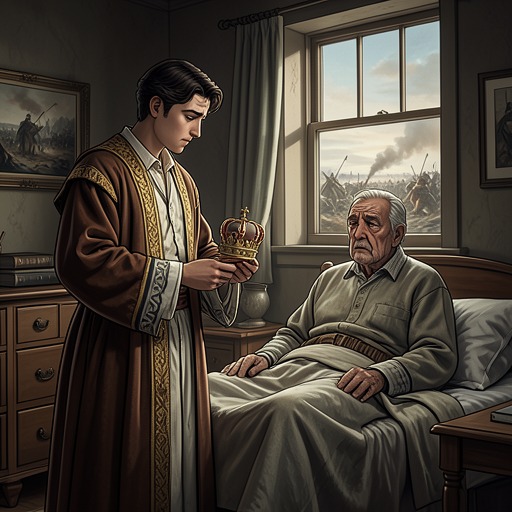
The burden becomes an object in the scene after King Henry IV’s death. Left alone beside his father, Prince Henry finds the crown lying on the pillow and regards it as a troublesome bedfellow. The image brings the earlier problem of sleeplessness into the next reign: the crown occupies the place of rest, as though political responsibility has taken the dead king’s place beside the living heir. Prince Henry calls it a polished disturbance and golden care, joining its beauty and value to the agitation it brings.
His comparison between the crown and heavy armor makes the cost more physical. The crown sits on its bearer like rich armor worn in the heat of day: a form of protection that also scalds. Royal security and royal discomfort are therefore not opposites. The object that signifies safety and status weighs upon the person required to wear it. Prince Henry’s encounter gives succession an intimate, material face: the crown is not simply inherited as an honor but encountered as a demanding presence at the moment of grief and transition.
A failing body and a continuing office
King Henry IV’s own body makes the limits of personal rule explicit. Near death, he says that his lungs are so wasted that he can no longer speak with strength. His last concern reaches beyond his physical decline: he asks God to forgive how he came by the crown and to grant that it may live in true peace. The prayer joins the legitimacy of the office to the history of its acquisition. The crown can be passed on, but its troubled origin remains part of what the next ruler inherits.
Prince Henry’s declaration that he is crowned marks a sharp change of public posture. He calls for royal display to be put aside and summons the English court, signalling that the accession is not merely a private transfer beside a deathbed. He then calls the high court of parliament and proposes choosing the members of noble counsel through whom the state may act. The sequence makes government an active responsibility: inheritance supplies the office, while counsel and parliamentary action give it public shape. The ruler’s body may weaken or die; political authority must continue through institutions and decisions.
History, obligation, and the work of rule
The play also places kingship within a history of unstable relationships and political change. King Henry IV recalls that Richard II and Northumberland had been great friends less than ten years earlier, before their amity divided. Warwick responds that every life contains a history that can figure the character of past times. Their exchange resists the idea that political order is permanent or self-explanatory. A king’s burden includes living amid relationships that can alter, and ruling in a present shaped by the remembered changes that came before it.
The contrast between royal responsibility and ordinary claims on money and justice gives the theme a further, grounded dimension. Falstaff asks the Lord Chief-Justice for a thousand pounds to equip himself, but the request is refused. A woman describes the hundred marks she has had to bear and the repeated delays she has endured. Later, Shallow insists that a sum be assessed and paid, and Falstaff acknowledges that he owes Shallow a thousand pounds. These are not equivalent to the king’s responsibility for the state, but they show obligation operating at different levels: as a denied loan, a complainant’s prolonged burden, and a debt that remains due. Against these specific claims, the crown concentrates the largest duty of all: an office borne by one vulnerable person, yet required to survive that person and maintain the state.