The legitimacy of the crown
Henry IV, Part 2The legitimacy of the crown in King Henry IV, Part 2 is neither a settled matter of inheritance nor a simple question of who wears it: it is shadowed by the history of King Henry IV’s accession and tested by rebellion, illness, and succession. The play lets the king acknowledge the compromised paths by which he took power, then makes the crown a literal presence beside his failing body. When Prince Henry succeeds him, the office passes on, but the unsettled history of its acquisition passes with it.
A Crown Shaped by Contested History
The play places royal legitimacy within a history of friendships broken and political necessities that have become sins. King Henry IV recalls that fewer than ten years earlier Richard II and the Earl of Northumberland had been great friends. He remembers Richard with tears in his eyes, checked and rated by the Earl of Northumberland, and recalls Richard’s warning that sin would gather strength and break into corruption. In retrospect, that warning seems to have anticipated the division of their former amity. The crown’s present holder is therefore surrounded by a past in which allegiance changed and political relationships fractured; the present order cannot be separated from the circumstances that produced it.
King Henry IV later states the problem in more personal terms. As he gives his son what he believes may be his last counsel, he acknowledges that he met the crown by indirect and crooked paths and knows how troublesome it has sat upon his head. His request that God forgive how he came by it, and grant that it may live in true peace, joins political rule to moral reckoning. He does not present possession of the crown as proof that its acquisition was innocent. Instead, the king’s own account makes the origin of his authority an unresolved burden carried into the next reign.
Rebellion, Reports, and Political Knowledge
The crown’s authority is also shown under pressure through news of military conflict. Rumour announces that King Henry has won at Shrewsbury, where Harry Percy and his troops have been beaten. A later report from Morton recalls Shrewsbury as a field where death appeared in its ugliest form and frightened his party. These accounts make the battle known through speakers who arrive from it, rather than through an impersonal chronicle. The audience encounters victory and its human cost through reports, a form that suits a play in which political control depends partly on whose account of events reaches the powerful.
The threat to the regime recurs when the Earl of Northumberland and Lord Bardolph are reported overthrown by the sheriff of Yorkshire. In response to grievances raised against abuses by people around him, King Henry IV promises that those grievances will be speedily redressed and calls for forces to be discharged to their respective counties. The episode places two means of maintaining authority beside one another: answering complaints and confronting armed opposition. The king’s promise does not erase the conflict, but it represents the crown as having obligations as well as coercive power. Its claim to rule is tested by whether its agents’ conduct and its response to grievance can be brought under control.
The Crown as Burden and Physical Object
The play makes the strain of kingship visible in King Henry IV’s sleeplessness. He contrasts the thousands of his poorest subjects asleep at that hour with his own inability to sleep, and names the crown as the reason the ruler cannot enjoy the rest available to ordinary people. The familiar image of the uneasy crowned head is not merely an abstract reflection: it grows out of the king’s bodily exhaustion and his awareness of dangers already past and still to come. Sovereignty brings authority, but it also binds the ruler to anxieties that private life cannot put aside.
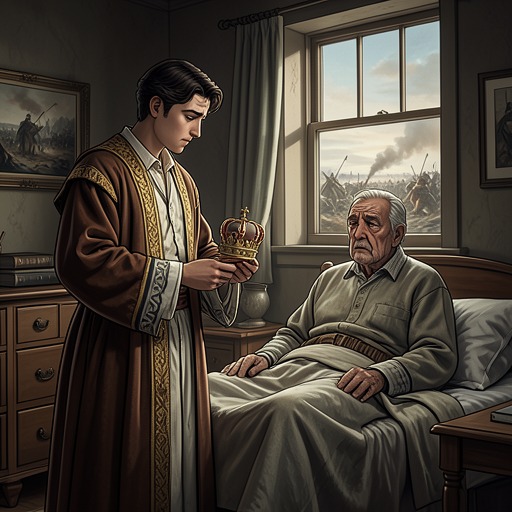
As his condition worsens, King Henry IV asks for the crown to be set upon his pillow. The object is now physically close to the king’s vulnerable body, yet Prince Henry, left beside him, wonders why it lies there as such a troublesome bedfellow. The son’s response turns the emblem of office into an intimate source of disturbance. The scene brings the distinction between a mortal ruler and the continuing political office into view: the king’s body is failing, while the crown remains present, ready to pass to another wearer. The succession is not yet a public ceremony in this moment; it is first staged as a charged encounter between father, son, and object.
Succession and the Use of Authority
After King Henry IV’s death, Prince Henry declares that Harry the Fifth is crowned and rejects the trappings of royal display as vanity. The language marks a change of reign, but the crown’s history makes the change more than a simple substitution of one person for another. The former prince inherits an office whose burdens and compromised origins have been made explicit by his father. The transfer continues the institution of kingship while leaving the moral memory of its previous holder in place.
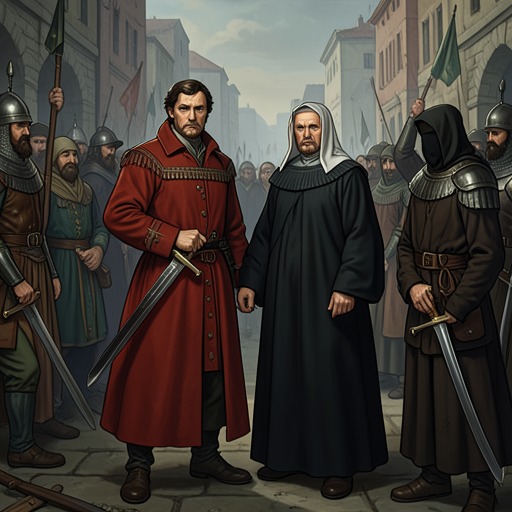
King Henry V’s later encounter with the Lord Chief-Justice gives the new reign a practical and legal dimension. He commits into the Lord Chief-Justice’s hand the unstained sword that the judge has used to bear. The gesture recognizes the authority of justice as something exercised through an office, not merely absorbed into the king’s personal will. It does not undo King Henry IV’s account of how the crown was obtained; rather, it shows the successor defining his rule through a public relation to law. The legitimacy of the new reign is thus represented not only by succession but also by what the new king does with authority.
Narrative Significance
Across these scenes, legitimacy emerges as both inheritance and argument. Reports of battles and defeated rebels show the crown’s power challenged in the field; remembered prophecy and broken friendship give those conflicts a longer political past; King Henry IV’s confession exposes the unease beneath possession. The crown’s movement from his pillow to the new reign concentrates these strands in a single object: it survives the weakness of one ruler, but it carries the burden of the history that placed it there.
The play does not reduce legitimacy to a formal declaration or offer an abstract legal ruling on King Henry IV’s title. Instead, it makes authority answerable to memory, public order, and conduct. The old king’s remorse complicates the meaning of succession, while the new king’s treatment of the Lord Chief-Justice indicates one way authority can be exercised differently. The crown passes on; whether its rule can inhabit peace, rather than merely possess power, remains the question attached to it.