Douglas
Henry IV, Part 2Douglas is a Scottish commander on the rebel side at the Battle of Shrewsbury. The play presents him through reports rather than an extended personal scene: first as a formidable fighter whose attacks reach the king, then as a defeated fugitive taken prisoner, and finally as a survivor whose fate is clarified after a false report of widespread deaths.
Identity and Place in the Conflict
Douglas is identified as a Scot and fights among the forces opposing King Henry IV. His role is established through accounts of the battle and its aftermath, not through a sustained account of his background or private aims. The reports give him a clear military profile: a dangerous combatant whose reputation rests on his swordsmanship, but who is ultimately caught in the rebel army’s collapse.
Fighting at Shrewsbury
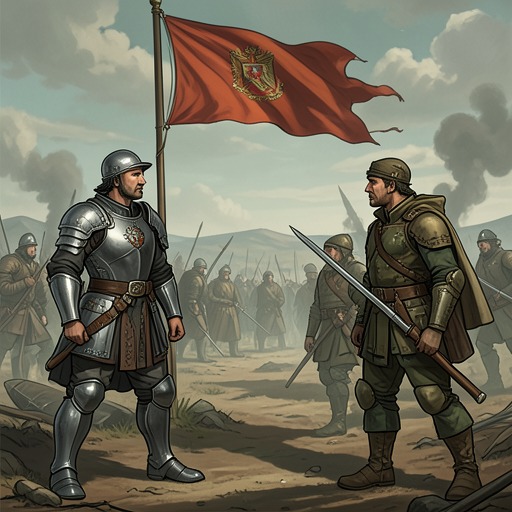
In the account of the battle’s reversal, the rebel soldiers flee, and Worcester is taken prisoner. Douglas is described as having struck at the king’s appearance three times, a detail that makes him one of the battle’s most forceful challengers to royal authority. Yet the account turns from his prowess to his retreat: he flees with the others and is captured. His defeat therefore does not erase the threat he posed; it marks the point at which a striking display of resistance gives way to the rebels’ rout.
Reports, Survival, and Narrative Significance
The play first frames the battle through Rumour, who announces King Henry IV’s victory over Harry Percy and his troops. Morton then speaks as someone who has come from Shrewsbury and describes the defeat. In a later exchange, Northumberland repeats an alarming report that ends with the claim that brother, son, and all are dead. Morton corrects it specifically: Douglas is still alive, as is Northumberland’s brother, though he does not finish his sentence about Northumberland’s son. Douglas’s survival thus emerges amid the uncertainty and distress produced by battlefield news.
Douglas’s brief reported trajectory hinges on a sharp reversal: the fighter who repeatedly reaches the king’s likeness cannot prevent his own capture, but capture does not mean death. The play leaves his subsequent fate unreported. His appearances instead help distinguish military defeat from the rumors that follow it, showing how a battle’s outcome can be known before the condition of every participant is.