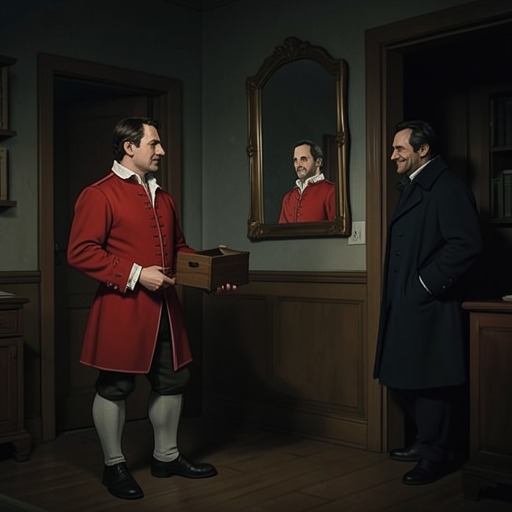
Falstaff and Robert Shallow
Henry IV, Part 2Falstaff and Shallow are old acquaintances whose reunion exposes a sharp imbalance between Shallow’s genial remembrance and Falstaff’s calculating use of him. Shallow offers hospitality and recalls shared adventures; Falstaff sees both a source of material for Prince Henry’s amusement and a person from whom money is owed. Their relation brings the play’s comic fellowship into contact with debt, age, and opportunism.
Old Acquaintance and Unequal Remembrance
Shallow greets Falstaff warmly and asks whether he remembers the night they lay together in a windmill in Saint George’s field. His recollection makes their connection older than the present visit: Falstaff is not merely a stranger seeking a meal or a favor, but someone linked to Shallow’s remembered youth. Shallow’s greeting conveys pleasure in seeing him again, though the available exchange does not establish how much Falstaff shares that feeling.
An earlier recollection supplies another measure of Falstaff’s long history. Shallow remembers that he and his companions knew the women of their youthful world, then recalls Jack Falstaff as a boy and page to Mowbray. The detail places Falstaff’s later identity as Sir John against an earlier, subordinate stage of his life. It also lets Shallow’s memories reach further back than the immediate reunion: the man who now arrives with followers and expects to be received was once a boy in another household.
Hospitality, Household Affairs, and Advantage
The reunion takes place at Shallow’s house in Gloucestershire. Its domestic setting matters to the relation: Shallow’s life appears through household business as well as reminiscence, including a direction that an item be assessed and paid and that Falstaff not be excused from the matter. The moment gives their visit a practical, accounting dimension alongside its friendly welcome. Shallow’s hospitality does not erase the presence of expenses and obligations.
Falstaff’s private assessment of the household is less affectionate than Shallow’s greeting. After sending Bardolph and the recruits away, he says he will return to deal with the justices and declares that he sees through Shallow. He reflects on how prone old men are to lying, making Shallow’s age and habits part of Falstaff’s appraisal rather than simply honoring the past they share. The contrast is pointed: Shallow invokes a remembered night of companionship, while Falstaff turns from the public business of recruitment to consider how he can profit from the people who have received him.
Falstaff makes that calculation more explicit when he says that, if he returns, he will make Shallow into a philosopher’s stone for his own use. The metaphor presents Shallow as something to be converted into advantage. It does not specify the exact gain Falstaff expects, but it confirms that he regards the acquaintance as useful, not merely sentimental. Their old connection therefore works in two directions: it gives Shallow grounds for welcome, and gives Falstaff access to a household he intends to exploit.
Shallow as Material for Prince Henry
Falstaff also plans to turn Shallow into entertainment. He says he will devise enough material from him to keep Prince Henry laughing through six fashions, which he reckons as four terms or two years. The promise joins personal exploitation to performance: Shallow’s character and behavior are to be observed, shaped into comic matter, and carried back to the prince. The stated span makes the scheme more than a passing joke; Falstaff imagines a sustained supply of amusement drawn from his host.
His mockery of Shallow’s body sharpens the same intention. Falstaff says that if he were cut into pieces, he would make four dozen of the bearded hermits’ staffs represented by Shallow. The extravagant comparison reduces the older man to a comic image and turns the gap between their bodies and ages into material. Shallow’s recollection treats shared history as a bond; Falstaff’s remarks show him converting the present encounter into a store of jokes for someone else.
Debt and the Final Measure of the Bond
At the end of the play, after the king and his company have departed, Falstaff tells Shallow that he owes him a thousand pounds. The sum gives the relationship a concrete financial conclusion, but the brief exchange does not establish when the debt arose or whether it will be repaid. What it does establish is that Falstaff’s dealings with Shallow have left a substantial obligation between them. The debt stands beside the earlier signs of hospitality and opportunism: Shallow has received Falstaff, and Falstaff acknowledges owing him a large amount.
The relation ends without resolving the tension between warmth and use. Shallow’s windmill story remembers companionship; his welcome places Falstaff among familiar faces; Falstaff’s asides disclose plans to profit from and ridicule his host; and his last statement names the debt. Together these moments make their acquaintance a comic but unequal bond, in which shared past and present generosity do not prevent Falstaff from treating Shallow as a source of money and material.